Monumental Contemporary Symbolism exploring humanity’s encounter with the eternal through light, sacred geometry, mythic architecture, fragmented forms and transcendent landscapes.

Monumental Contemporary Symbolism exploring humanity’s encounter with the eternal through light, sacred geometry, mythic architecture, fragmented forms and transcendent landscapes.

Surreal Paintings

Aurora’s Sacred Spring

Aurora’s Sacred Spring

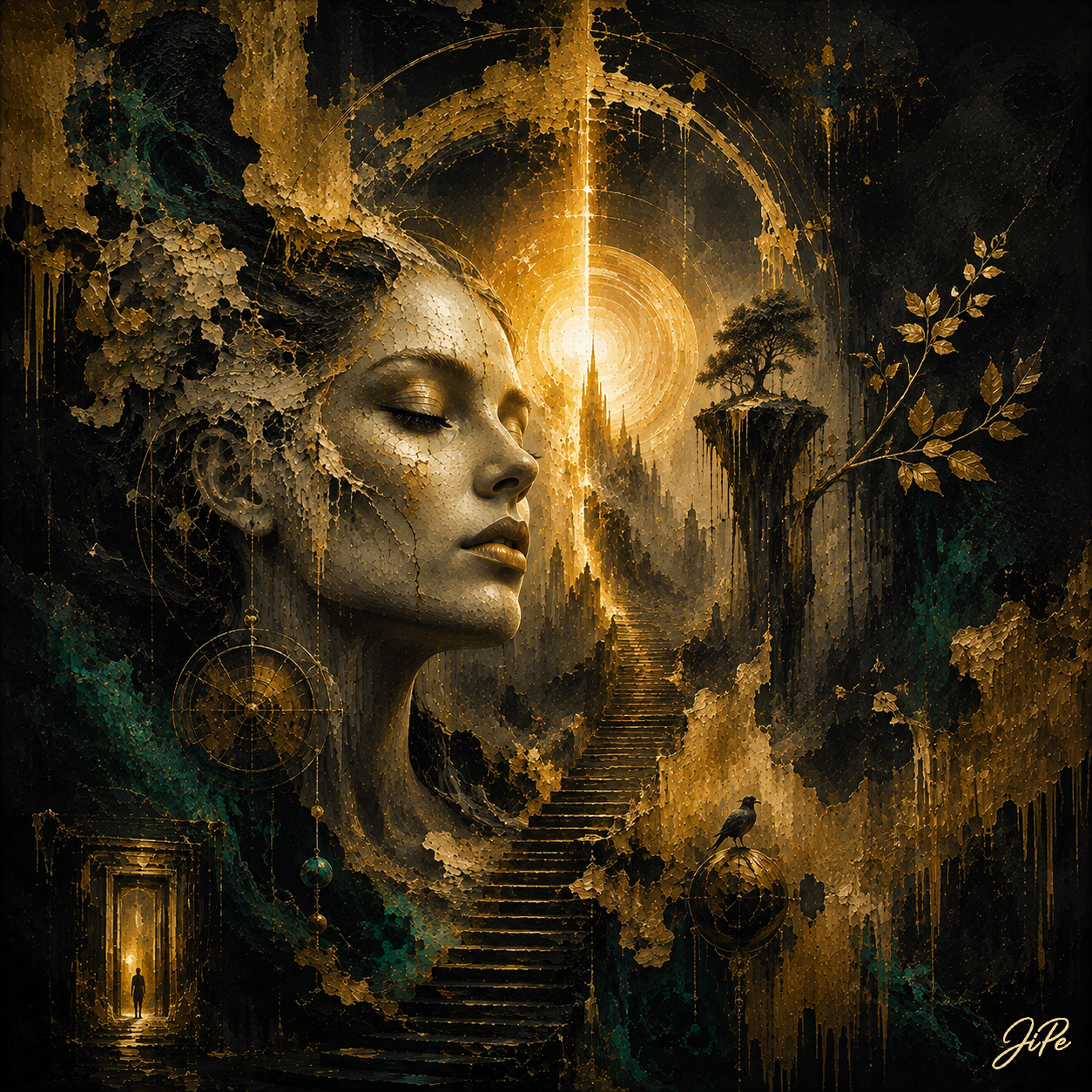
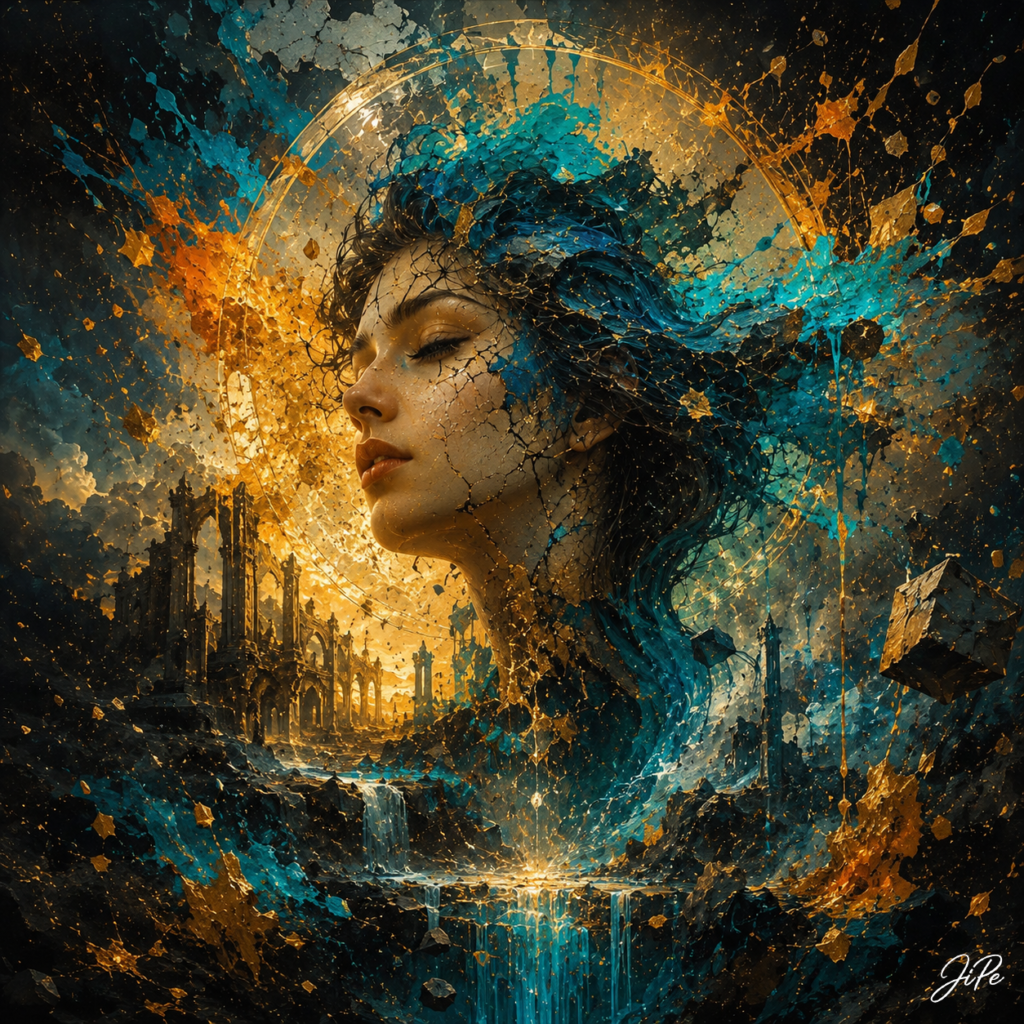
Aurora’s Sacred Spring presents a visionary world in which the human figure, sacred architecture, water, light, and fractured matter are fused into a single monumental image. At the center of the composition rises the serene profile of a woman whose presence seems simultaneously human and supernatural. She does not simply occupy the landscape; she appears to emerge from it, govern it, and perhaps even dream it into existence. Around her, ruined structures rise from darkness, waterfalls descend through an impossible terrain, fragments of stone seem suspended in space, and explosive fields of turquoise and gold transform the surrounding atmosphere into something between landscape, memory, and revelation.

The title introduces the figure as Aurora, a name inseparable from ideas of dawn, renewal, illumination, and awakening. In classical mythology, Aurora is the Roman personification of the dawn, eternally announcing the return of light after darkness. Yet the figure presented here is not intended as a literal reconstruction of a classical goddess. Instead, the work reimagines Aurora as a timeless symbolic presence—an embodiment of transition and the mysterious moment when darkness begins to surrender to light.

The second element of the title, “Sacred Spring,” expands this symbolism. A spring is a place of origin: water emerging from hidden depths and entering the visible world. Across cultures and mythological traditions, springs have been associated with purification, healing, rebirth, prophecy, and divine presence. Within this work, the spring becomes more than a physical source of water. It can be understood as a metaphor for the emergence of consciousness, creativity, memory, or spiritual renewal.

Together, Aurora and the sacred spring establish the central theme of the painting: the perpetual possibility of beginning again.

The monumental female profile immediately commands the viewer’s attention. Her closed eyes and composed expression introduce an extraordinary stillness into an otherwise turbulent environment. Paint appears to explode around her. Architectural structures collapse into abstraction. Stone fragments drift through space. Water falls through broken terrain. Yet Aurora herself remains calm.

This opposition between inner stillness and external transformation gives the painting much of its psychological intensity.

Her closed eyes are especially significant. She does not look outward toward the visible world, nor does she acknowledge the viewer. Instead, her attention appears directed inward. This transforms the image from a conventional portrait into something closer to an icon of consciousness. Aurora may be sleeping, dreaming, remembering, meditating, or listening to something beyond ordinary perception.

The world surrounding her can consequently be interpreted as an external manifestation of an internal state.

Perhaps the landscape exists within her.

Perhaps she exists within the landscape.

The painting deliberately refuses to resolve this ambiguity.

Behind Aurora’s head, an enormous circular form resembles a celestial disc, halo, astronomical instrument, or sacred architectural structure. Its presence immediately elevates the figure beyond conventional portraiture. The circle has long carried associations with eternity, unity, perfection, cosmic order, and the endless cycles of existence. Here it functions simultaneously as halo and portal, framing Aurora while connecting her to the larger cosmological dimension of the composition.

Yet this halo is not pristine. Like much of the surrounding world, it appears weathered and partially consumed by fragmentation. Sacred geometry encounters destruction. Order exists alongside chaos.

This tension runs throughout the work.

The surface of Aurora’s face is fractured by dark fissures resembling cracked stone, aged fresco, dry earth, or an ancient sculpture exposed to centuries of erosion. These cracks transform human skin into something archaeological. Aurora appears young and timeless simultaneously, as though her physical appearance belongs to the present while her material substance has survived countless ages.

The fragmentation should not necessarily be interpreted as destruction alone. It can equally represent transformation.

The cracks reveal vulnerability, but they also create structure. They suggest that identity is not a flawless surface but something formed through time, experience, rupture, and reconstruction. The figure remains serene despite her fractured appearance. Her integrity therefore lies not in remaining untouched, but in continuing to exist through change.

This idea is reinforced by the painting’s dramatic use of gold.

Gold erupts across the composition in splashes, fragments, luminous clouds, and fine lines. It surrounds Aurora and penetrates the fractured environment. At moments it resembles sunlight; elsewhere it evokes molten metal, gold leaf, sacred illumination, or energy escaping through cracks in matter.

Within the symbolic language of the painting, gold becomes a manifestation of transcendence. It represents not wealth but illumination—the presence of something incorruptible within a world continually breaking apart.

In opposition to the gold is the extraordinary intensity of the turquoise and deep blue that sweeps through Aurora’s hair and across the landscape. These cool tones are closely associated with the flowing water below, visually linking the female figure to the sacred spring. Her hair appears almost liquid, dissolving into currents of color until the boundary between body, atmosphere, and water becomes uncertain.

The palette therefore establishes a powerful elemental dialogue: gold as light and fire; turquoise as water and depth; black as darkness and matter.

Rather than remaining separate, these forces collide throughout the painting.

This collision is particularly visible in the energetic splashes surrounding Aurora. Pigment appears to burst outward from the figure and the celestial circle behind her. Thick painterly textures, dripping passages, fractured surfaces, scattered particles, and floating fragments interrupt the illusionistic space. The work moves continually between recognizable imagery and abstraction.

From a distance, the viewer encounters a coherent mythological vision.

At closer range, that vision begins to disintegrate into material gestures.

This duality is fundamental to the work’s contemporary character. Aurora’s Sacred Spring combines the emotional accessibility of figurative painting with the physical energy of abstraction. The image is simultaneously constructed and destroyed before the viewer’s eyes. Forms emerge from chaos and then dissolve back into it.

Beneath Aurora, the landscape opens toward an ancient architectural complex. Tall ruined columns and arches rise against a luminous horizon, suggesting the remains of a civilization whose history has been forgotten. Their precise identity is deliberately uncertain. They might belong to a temple, sanctuary, palace, or city that never existed.

This ambiguity gives the ruins an archetypal quality.

They represent not one historical culture but the broader human desire to construct places where the earthly and the sacred might meet.

The architecture also introduces the presence of time. Human civilizations rise, create monuments, and disappear. Stone collapses. Temples become ruins. Names are forgotten. Yet water continues to flow, dawn continues to return, and light continues to emerge from darkness.

Nature therefore outlives architecture.

Aurora appears to outlive both.

The waterfalls become especially important within this temporal structure. Water descends through several levels of the composition before gathering near the lower center in a radiant source. This luminous point acts as a secondary focal area beneath Aurora’s face. The viewer’s eye moves from the figure downward through the flowing water, creating a visual connection between consciousness above and renewal below.

The sacred spring appears almost to originate from light itself.

Water and illumination become inseparable.

Symbolically, this allows the spring to function on several levels. It can represent purification after destruction, knowledge emerging from hidden sources, emotional renewal, or the creative impulse itself. The water continuously moves while the ruins remain fixed, reinforcing the contrast between permanence and transformation.

The composition is structured around this dynamic relationship between stability and movement. Aurora’s face provides the great vertical and psychological anchor. The circular halo stabilizes the upper field, while sweeping diagonal explosions of turquoise and gold propel energy outward. Below, waterfalls pull the eye downward before the ruined architecture leads it back toward the luminous distance.

There is therefore no single static viewing point. The eye circulates through the work—face, halo, explosion, ruins, water, light, and back again.

Even the floating fragments contribute to this sensation. Some appear caught in an invisible gravitational disturbance, suggesting that ordinary physical laws no longer apply. The sacred space has entered a moment of transformation in which matter itself is becoming unstable.

For an art-historical viewer, Aurora’s Sacred Spring can be situated at the intersection of visionary symbolism, surrealism, contemporary figurative art, and the tradition of the sublime. Its impossible landscape and dreamlike spatial relationships recall Surrealism, while its monumental scale and dramatic confrontation between humanity and overwhelming natural forces connect it to Romantic concepts of the sublime.

At the same time, the frontal monumentality, circular halo, gold surfaces, and contemplative expression evoke the visual language of sacred and devotional imagery. Yet the work does not belong to a specific religious tradition. It borrows the psychological authority of sacred imagery while transforming it into a universal meditation on renewal, consciousness, and transcendence.

The painterly treatment further complicates these historical references. Areas of apparent realism coexist with textures resembling impasto, damaged fresco, cracked plaster, dripping pigment, and fractured stone. This gives the work the appearance of something simultaneously newly created and ancient—as though the viewer were witnessing both the birth and archaeological rediscovery of the image.

That temporal contradiction is one of the painting’s most compelling qualities.

Aurora appears eternal, yet fractured.

The city appears destroyed, yet illuminated.

The landscape appears ancient, yet in the process of being born.

The spring falls downward, yet symbolically represents emergence.

Everything exists between states.

And this condition of being between states may ultimately provide the deepest interpretation of the work.

Dawn itself is not a destination. It is a threshold between night and day. A spring is not the final form of water; it is the moment water emerges from darkness into visibility. Ruins occupy the threshold between civilization and disappearance. Cracks mark the boundary between wholeness and fragmentation.

Aurora therefore presides over a kingdom of thresholds.

She embodies the instant when one state of existence becomes another.

Her serenity suggests that transformation need not be understood purely as destruction. What breaks apart may reveal something previously hidden. What disappears may become memory. What falls may become water. What fractures may allow light to enter.

In this sense, the painting offers a powerful meditation on renewal through impermanence.

The sacred spring does not exist despite the ruins—it flows through them.

The light does not eliminate darkness—it emerges from within it.

Aurora does not remain untouched by time—she carries its fractures across her face.

And still, she remains luminous.

Ultimately, Aurora’s Sacred Spring invites the viewer into a mythological space where destruction and creation are not opposites but parts of the same eternal process. Its ruined temples, fractured surfaces, celestial geometry, flowing water, and explosive light construct a world caught at the precise moment of transformation.

At its center, Aurora remains silent.

She neither explains the ruins nor reveals the origin of the spring. Her closed eyes preserve the mystery. She seems to know something the viewer cannot yet see: that beneath every broken surface another beginning may already be forming.

The sacred spring is therefore not simply a place within the landscape. It is the invisible source from which the entire world of the painting appears to emerge—a symbol of the enduring possibility that after darkness, fracture, and silence, light can begin again.

Lämna ett svar