Before the Throne of Light

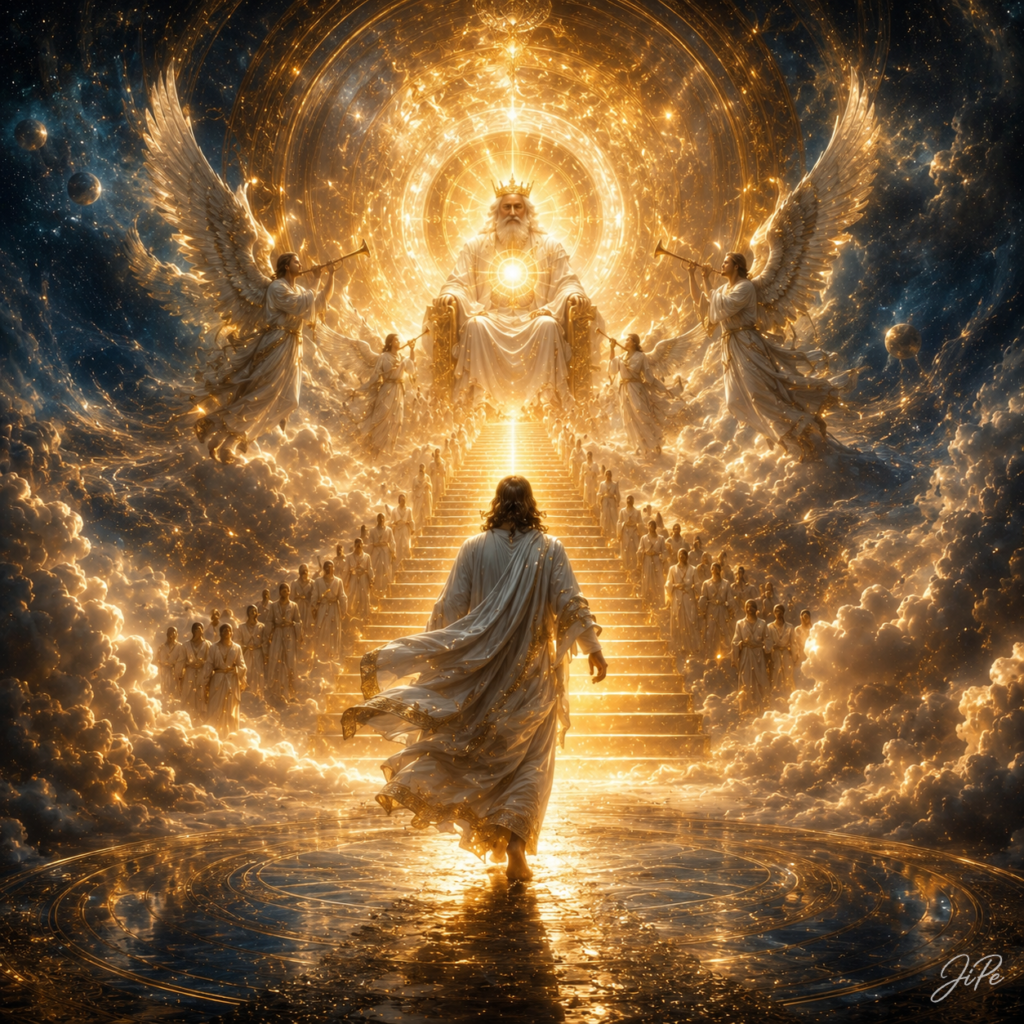
Before the Throne of Light presents a monumental vision of encounter, ascent, and transcendence. The composition unfolds as a threshold between the human and the infinite: a solitary figure advances through a vast celestial realm toward an enthroned presence surrounded by radiant geometry, angelic beings, and an overwhelming architecture of light. Rather than depicting a simple arrival, the work captures the charged moment immediately before revelation—the instant in which the traveler stands between what has been known and what can no longer be understood through ordinary human perception.
At the center of the painting lies one of its most important relationships: the figure who approaches and the figure who waits.
The traveler is seen from behind. His identity is withheld from the viewer, transforming him from a specific individual into a universal human presence. He may be interpreted as a pilgrim, seeker, prophet, returning soul, or symbolic representation of humanity itself. Because his face remains unseen, the viewer is invited to occupy his position. We do not simply observe his journey; compositionally, we stand behind him and are drawn toward the same destination.
Ahead rises an immense staircase of golden light.
The staircase forms the central axis of the work, beginning near the earthly position of the traveler and ascending through luminous clouds toward the throne. It is both architectural and immaterial. Its steps appear solid enough to climb, yet they seem constructed almost entirely from radiance. In this way, the staircase becomes a powerful symbol of passage: between earth and heaven, mortality and eternity, knowledge and mystery, separation and reunion.
Its extreme perspective amplifies the psychological experience of ascent. The viewer’s gaze is carried upward almost involuntarily, following the traveler toward the brilliant center of the composition. Every major element reinforces this movement. The clouds open around the staircase. The gathered figures turn toward it. The angels frame its destination. Circular celestial structures converge behind the throne.
The entire universe of the painting seems organized around this single act of approach.
At the summit sits the enthroned figure.
Rendered with monumental stillness, he occupies the visual and symbolic center of the celestial realm. His white garments and golden crown distinguish him from the surrounding beings, while the extraordinary radiance behind him transforms his presence into something greater than physical kingship. He can be interpreted through the visual tradition of divine sovereignty, yet the painting deliberately leaves room for broader metaphysical readings. He may represent God, divine consciousness, eternal wisdom, ultimate truth, or the unknowable source from which existence emerges.
What matters most is not precisely who he is, but what his presence represents.
He is the destination toward which everything converges.
At the center of his chest appears an intensely luminous sphere, almost like a concentrated sun. This light is not merely reflected upon him; it appears to originate from within. The distinction is significant. Authority in the painting is therefore expressed not primarily through the crown or throne, but through illumination.
Light itself becomes the true symbol of sovereignty.
The title Before the Throne of Light reinforces this interpretation. It does not describe a throne of gold, power, judgment, or conquest. It is specifically a throne of light. The central authority is consequently associated with revelation, consciousness, truth, creation, and transcendence rather than material domination.
Behind the throne expands an enormous system of concentric golden circles. These structures resemble celestial mechanisms, halos, sacred geometry, astronomical diagrams, and the imagined architecture of the cosmos. Their repetition creates the impression that the enthroned presence occupies the center not merely of a palace, but of a universal order.
The circles suggest infinity.
Unlike a linear form, the circle has neither beginning nor end. Across religious, philosophical, and artistic traditions, it has frequently symbolized eternity, unity, perfection, and cosmic completeness. Here, the repeated circles create an almost immeasurable depth, as though the visible throne were only the innermost point of a structure extending infinitely beyond the boundaries of the painting.
At the very center, these circles converge upon the enthroned figure.
The result is a composition that functions almost like a visual cosmology: the universe radiates outward from a central source of light.
Flanking the throne are monumental winged beings sounding long trumpets. Their scale and symmetry lend the scene ceremonial grandeur, while their wings create sweeping vertical arcs that echo the celestial circles behind them. They appear simultaneously protective and proclamatory—guardians of the threshold and heralds of an event whose significance exceeds the individual traveler.
The trumpet has a long symbolic history associated with revelation, awakening, proclamation, divine intervention, and the announcement of a decisive transformation. Within this work, however, the angels need not be interpreted exclusively through one theological narrative. They can also represent the moment when silence gives way to recognition: the instant when something hidden becomes impossible to ignore.
Smaller angelic figures and numerous robed beings populate the ascending realm. Their presence gives the composition a ceremonial and communal dimension. The traveler is alone in his approach, but he is not entering an empty universe. The staircase is surrounded by witnesses.
This creates an intriguing contrast between solitude and belonging.
The journey toward transcendence is intensely personal, yet the destination appears populated by countless presences. The traveler must walk alone, but he does not arrive alone.
The surrounding figures also provide a crucial sense of scale. As the staircase rises, individual bodies become increasingly small compared with the immense celestial architecture. Human scale gradually gives way to cosmic scale. The painting therefore visualizes one of the fundamental experiences associated with the sublime: the simultaneous recognition of human smallness and participation in something immeasurably greater.
The clouds intensify this sensation.
They form enormous sculptural masses around the central staircase, alternately concealing and revealing the celestial realm. Their edges ignite under golden illumination, while deeper areas descend into rich shadow. They function almost like curtains being opened upon another dimension.
Light pours through them rather than merely falling upon them.
This distinction contributes to the painting’s supernatural atmosphere. The illumination does not seem to obey a single conventional source. Instead, radiance appears embedded throughout the environment—in the staircase, the clouds, the throne, the celestial circles, the garments, and even the atmosphere itself.
The realm seems constructed from light.
Against this golden luminosity lies the deep blue-black expanse of space. Stars and distant planetary bodies remain visible around the edges of the composition, extending the scene beyond traditional representations of heaven into a cosmic dimension. The juxtaposition is significant: religious symbolism and astronomical imagery coexist without contradiction.
Heaven is presented not as a location above the clouds, but as something encompassing the universe itself.
This cosmic setting broadens the work beyond a literal theological illustration. It asks whether the human longing for transcendence might be understood not only religiously, but existentially. The traveler approaches the unknown source behind existence—the question that religion, philosophy, science, mythology, and art have attempted to confront in different ways throughout human history.
In the foreground, the traveler walks across a dark reflective surface marked by vast concentric patterns. His feet disturb the surface slightly, creating a subtle physical connection between the human body and the enormous celestial geometry surrounding him.
This lower circular structure mirrors the great golden circles behind the throne.
The visual correspondence creates a profound compositional idea: what exists below reflects what exists above.
The traveler stands within one circle while approaching another. The earthly and celestial realms are therefore not entirely separate. They appear to be different expressions of the same underlying order.
The reflective foreground also introduces the symbolism of water. Traditionally associated with purification, transition, birth, death, memory, and spiritual transformation, water functions here as the final surface the traveler must cross before reaching the staircase. His journey begins not on ordinary ground but within a reflective threshold.
Light from above is mirrored beneath him.
He therefore walks between two infinities.
Above him lies the celestial source.
Below him lies its reflection.
And between them stands the human figure.
This vertical relationship gives Before the Throne of Light much of its philosophical power. Humanity is positioned between material and transcendent realities, capable of looking upward while remaining physically grounded. The traveler is neither divine nor insignificant. His importance lies precisely in his position between worlds.
The painting’s color structure reinforces this symbolism. Gold dominates the central axis and celestial realm, while deep blue, charcoal, and black surround it. The contrast between warm luminosity and cosmic darkness creates both visual drama and conceptual tension.
Darkness is not presented simply as evil.
Instead, it functions as the unknown—the immeasurable space from which illumination becomes visible. Without darkness, the extraordinary intensity of the golden light could not exist.
The two depend upon one another.
From an art-historical perspective, Before the Throne of Light participates in a long tradition of visualizing the inaccessible. Sacred art has repeatedly confronted a fundamental artistic problem: how can something believed to exist beyond ordinary human perception be represented visually?
Historically, artists have answered this through halos, gold backgrounds, hierarchical scale, radiant clouds, sacred geometry, idealized architecture, and dramatic illumination. This work draws upon many of those strategies while translating them into a contemporary visionary language.
Its enormous spatial depth and overwhelming celestial environment recall the tradition of the sublime, particularly the Romantic fascination with experiences that exceed the limits of rational comprehension. Yet instead of confronting mountains, storms, or oceans, the viewer encounters a metaphysical sublime—an infinity constructed from light, celestial architecture, and cosmic scale.
There are also echoes of classical sacred compositions in the work’s strong central symmetry. The enthroned figure occupies the highest point of a hierarchical arrangement, surrounded by angels and witnesses. The staircase leads directly toward him, creating an almost processional structure.
Yet the painting also departs from traditional sacred imagery through its cinematic scale and cosmic environment. Stars, planets, vast luminous mechanisms, atmospheric particles, and seemingly infinite concentric structures transform the scene into a fusion of mythology, spirituality, visionary symbolism, and speculative cosmology.
The result is neither strictly historical nor futuristic.
It exists outside ordinary time.
This timelessness is important because the work ultimately concerns a question that transcends any particular period: What happens when the human being finally stands before that which has been sought throughout an entire existence?
The title carefully places the scene before the decisive encounter.
This word changes everything.
The painting does not show judgment.
It does not show acceptance.
It does not show rejection.
It does not show revelation completed.
Instead, it preserves the moment immediately preceding all of these possibilities.
The traveler is still walking.
That unfinished movement creates tension. The throne may appear close, but the staircase remains before him. The ultimate encounter has not yet occurred. The viewer is therefore held within a state of anticipation.
This makes the painting less about arrival than about approach.
The distance between the traveler and the throne becomes the true emotional space of the work.
Within that distance exist faith, uncertainty, longing, fear, wonder, hope, and the accumulated weight of a human life.
The traveler’s flowing white garment strengthens this sense of vulnerability. Despite the immense architecture surrounding him, he carries no weapon, crown, possession, or visible symbol of worldly status. Before the throne, conventional measures of power have disappeared.
He arrives only as himself.
This simplicity provides an important counterbalance to the overwhelming magnificence of the celestial realm. The painting may contain angels, cosmic structures, infinite stars, radiant architecture, and an enthroned presence, but its emotional center remains the solitary person walking forward.
The grand spectacle ultimately serves an intimate question.
What does a human being bring when standing before eternity?
Perhaps nothing material can be brought.
Perhaps only the life that has been lived remains.
For this reason, Before the Throne of Light can be interpreted as an image of death and the afterlife, but such a reading need not exhaust its meaning. The staircase can equally represent spiritual awakening, the pursuit of truth, artistic creation, self-knowledge, or the lifelong movement toward something greater than the individual self.
The throne may represent the divine.
It may represent truth.
It may represent the origin of consciousness.
It may represent the final answer.
Or perhaps it represents the mystery that remains when all answers have reached their limit.
The work deliberately leaves this question open.
That ambiguity allows viewers of different philosophical, cultural, and spiritual perspectives to enter the image through their own understanding.
Ultimately, Before the Throne of Light is a work about the boundary between the finite and the infinite. Its monumental scale creates awe, but its deeper power comes from the vulnerability of the single figure approaching the light.
Everything in the composition—the staircase, angels, clouds, celestial circles, gathered witnesses, planets, reflections, and radiant throne—converges upon that solitary journey.
And yet the final step remains untaken.
The viewer is left precisely where the title promises: before the throne.
In that suspended moment, the painting transforms spectacle into contemplation. It asks us to imagine not simply what eternity might look like, but what it might mean to stand before it.
The traveler continues toward the light, carrying nothing visible from the world behind him. Ahead lies an immeasurable radiance whose meaning has not yet been revealed.
Between the first step and the throne lies the central mystery of the work: the distance between what humanity can imagine and what, if anything, waits beyond the limits of human understanding.