
Echoes of the Self
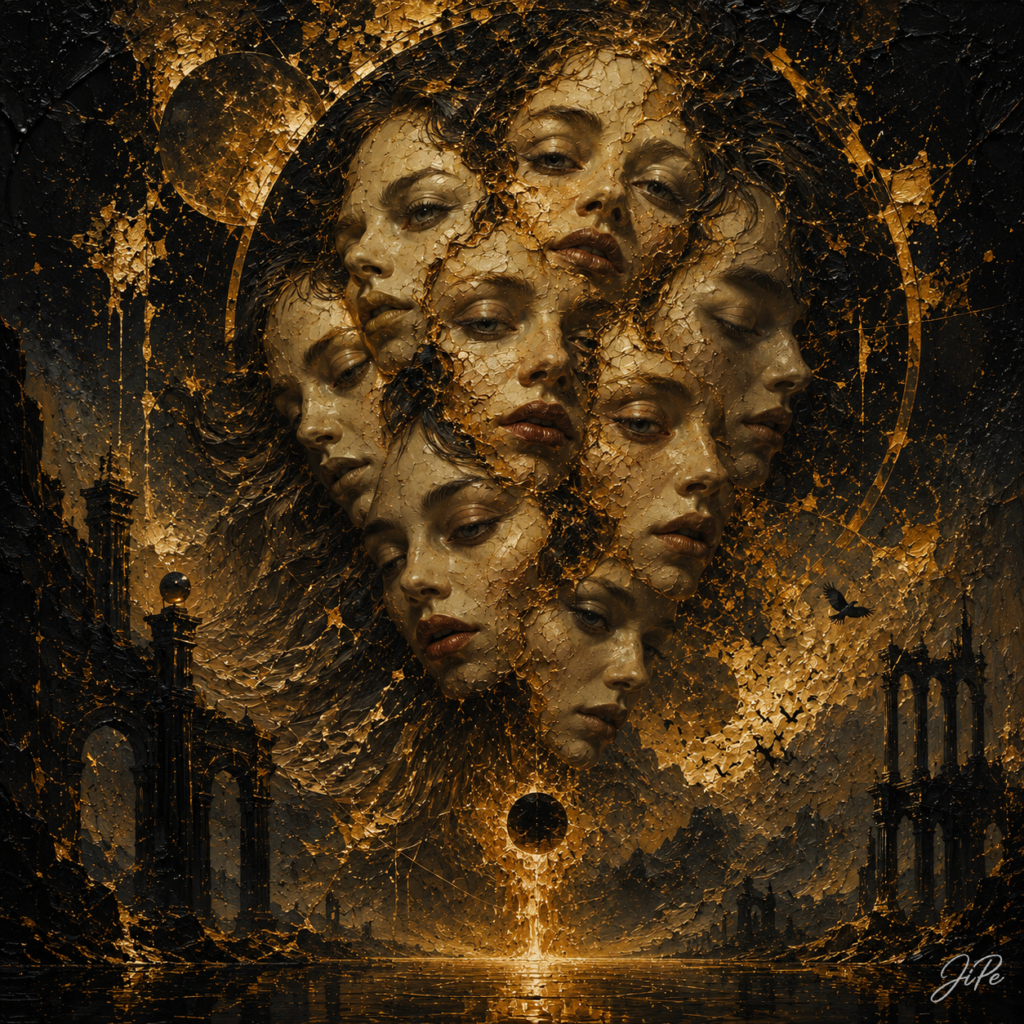
Echoes of the Self is a meditation on identity, memory, and the countless versions of ourselves that exist across time. Positioned between symbolic portraiture, contemporary visionary realism, and philosophical abstraction, the work explores one of humanity’s oldest questions: Who are we beneath the many faces we wear? Rather than presenting identity as something singular and fixed, the painting proposes that the self is layered, fragmented, remembered, imagined, and continuously transformed by experience.
The title, Echoes of the Self, speaks not of repetition but of resonance. An echo is never an exact duplicate of its source; it changes as it travels through space, gathering distance, atmosphere, and new meaning. Likewise, every version of ourselves carries traces of earlier lives, forgotten emotions, unrealized possibilities, and future identities waiting to emerge. The painting becomes a visual landscape of consciousness, where every face represents both an individual moment and an inseparable part of a greater whole.
At the center of the composition, multiple feminine faces merge into a single monumental form suspended above an ancient, dreamlike landscape. The arrangement appears almost celestial, resembling a constellation, a flowering organism, or a sacred icon assembled from fragments of memory. None of the faces dominates the composition. Each possesses its own emotional presence while simultaneously dissolving into the others, creating an image that feels both intimate and infinite.
This multiplicity is the conceptual heart of the work. The faces are not portraits of different people but manifestations of one evolving identity. Some gaze directly toward the viewer, others look inward, while several rest with closed eyes, suggesting contemplation, remembrance, or surrender. Together they form a visual map of emotional existence—moments of strength, vulnerability, uncertainty, wisdom, innocence, loss, and renewal existing simultaneously rather than sequentially.
The artist deliberately avoids creating a literal narrative. Instead, the composition invites viewers to recognize themselves within its symbolic language. Every observer brings their own memories and experiences into the work, allowing the painting to become a mirror rather than merely an image. In this way, Echoes of the Self functions as both portrait and reflection, revealing as much about the viewer as it does about the figure portrayed.
The extraordinary cracked surfaces covering every face introduce another essential layer of meaning. Gold appears to grow organically through fractures that spread across skin like ancient earth, weathered marble, or archaeological relics uncovered after centuries beneath the surface. These fractures do not signify destruction. Instead, they reveal transformation.
Inspired by the philosophy that brokenness may become a source of beauty rather than shame, the artist employs gold as a symbolic material of healing, resilience, and transcendence. The luminous fissures suggest that every emotional wound, every forgotten memory, and every personal loss contributes to the formation of identity. Rather than concealing these experiences, the painting elevates them into sacred architecture.
The extensive use of gold leaf aesthetics transforms the work into something that recalls Byzantine icons, illuminated manuscripts, and sacred altarpieces while remaining unmistakably contemporary. Gold ceases to function as decoration and instead becomes a language through which invisible emotional experiences acquire physical form. It represents consciousness itself—illuminating those aspects of identity that often remain hidden beneath the surface of daily existence.
Behind the cluster of faces, concentric celestial circles create a monumental halo-like geometry that anchors the composition. These circles simultaneously evoke planetary orbits, eclipses, sacred mandalas, and the eternal cycle of birth, death, and renewal. Throughout the artist’s symbolic vocabulary, the circle represents wholeness without beginning or end. Positioned behind the fragmented portrait, it quietly suggests that despite life’s countless transformations, an underlying unity always remains.
The composition masterfully balances complexity with clarity. Although numerous faces overlap within the central structure, the visual rhythm remains harmonious. Each portrait occupies its own emotional space while contributing to a larger architectural order. The viewer’s gaze moves fluidly between individual expressions before inevitably returning to the collective form. This movement reflects the psychological experience of self-awareness, where individual memories continuously merge into a unified sense of identity.
The surrounding landscape deepens the symbolic narrative without imposing a fixed interpretation. Ancient ruins emerge from darkness along the edges of the composition, their weathered columns suggesting civilizations long vanished. These architectural fragments become metaphors for memory itself—structures that endure even after their original purpose has faded. Just as ancient temples preserve traces of forgotten cultures, human consciousness preserves emotional impressions long after specific events have disappeared.
The distant mountains extending across the horizon reinforce themes of permanence and transcendence. Mountains traditionally symbolize endurance, spiritual ascent, and timeless perspective. Positioned beneath the floating portrait, they establish a dialogue between the ephemeral nature of personal identity and the enduring rhythms of existence. They remind the viewer that individual lives unfold within landscapes infinitely larger than themselves.
Near the base of the composition, a luminous sphere appears suspended above reflective water, creating one of the painting’s most quietly powerful symbols. The sphere recalls a celestial body, a seed of consciousness, or the origin from which all identities emerge. Its reflection dissolves into the water below, suggesting the constant exchange between conscious awareness and the subconscious mind. Water, throughout the artist’s work, functions as a symbol of memory, transformation, and emotional depth. Here it becomes the threshold where the visible self meets its hidden origins.
The presence of birds in flight introduces another subtle symbolic dimension. Traditionally associated with freedom, transcendence, and the soul, they move through the surrounding darkness as silent witnesses to the unfolding psychological landscape. Their movement contrasts with the stillness of the faces, suggesting that while identity may appear fixed, consciousness itself remains in perpetual motion.
The restrained color palette plays an essential emotional role. Deep charcoal blacks, warm earth tones, and luminous gold establish a timeless visual language that transcends specific historical or cultural references. Darkness is never presented as absence, but as fertile space from which illumination emerges. Gold functions as the visual manifestation of awareness, memory, and spiritual awakening, creating a profound dialogue between shadow and light throughout the composition.
Materiality further enriches the painting’s conceptual depth. Thick painterly textures, weathered surfaces, cracked gold leaf effects, expressive brushwork, and layered mixed-media aesthetics create a tactile presence that encourages slow observation. The painting appears almost archaeological, as though discovered rather than created. Every textured surface contributes to the sensation that identity itself possesses physical history—a landscape shaped through time rather than a static image.
From an art historical perspective, Echoes of the Self occupies a fascinating space between Symbolism, Surrealism, contemporary figurative painting, and sacred iconography. The multiple faces recall mythological archetypes and Renaissance allegory while simultaneously engaging with modern psychological theories concerning memory, multiplicity, and the fragmented nature of identity. The painting refuses literal interpretation, instead embracing ambiguity as one of its greatest strengths.
Conceptually, the work resonates strongly with contemporary audiences living in an age defined by multiple identities—public and private selves, physical and digital personas, remembered versions of ourselves, and imagined futures. The painting quietly asks whether identity is something that can ever truly be completed, or whether becoming is the permanent condition of being human.
Rather than presenting fragmentation as a symptom of loss, the artist reimagines it as evidence of complexity. Every face remains incomplete in isolation, yet together they form a complete emotional universe. The painting suggests that authenticity does not arise from reducing ourselves to a single identity but from embracing the richness of our contradictions, transformations, and accumulated experiences.
Ultimately, Echoes of the Self is not simply a portrait—it is an exploration of consciousness itself. It invites viewers to consider the invisible architecture of memory, the persistence of emotion, and the many lives that coexist within every individual. Standing before the work becomes an act of introspection. The viewer no longer asks who the figure is, but rather begins to recognize fragments of themselves reflected within the composition.
In this way, the painting fulfills its deepest purpose. It becomes less an image to be observed than a silent conversation between artwork and observer—a reminder that identity is never singular, never fixed, and never complete. Like an echo traveling endlessly through space, the self continues to evolve long after its first voice has been spoken.