
Monumental Contemporary Symbolism exploring humanity’s encounter with the eternal through light, sacred geometry, mythic architecture, fragmented forms and transcendent landscapes.

Monumental Contemporary Symbolism exploring humanity’s encounter with the eternal through light, sacred geometry, mythic architecture, fragmented forms and transcendent landscapes.

Surreal Paintings

Aetheria’s Secret Kingdom
Aetheria's Secret Kingdom
Aetheria’s Secret Kingdom

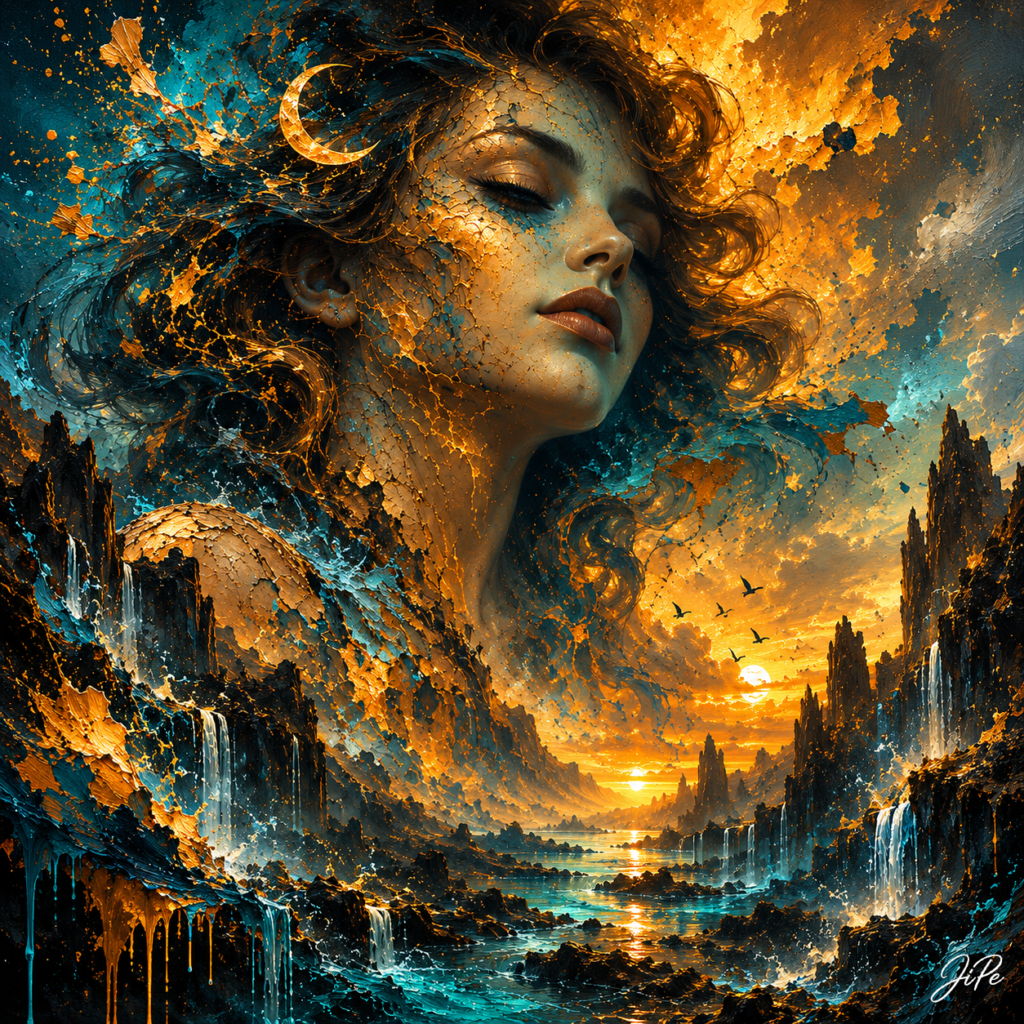
Aetheria’s Secret Kingdom unfolds as a monumental vision suspended between portraiture, mythology, and an imagined world beyond ordinary perception. At its center is a mysterious female presence whose face seems not merely to inhabit the landscape, but to give birth to it. Mountains, waterfalls, turbulent water, celestial light, and fractured surfaces converge around her until the distinction between figure and environment begins to disappear. She becomes at once woman, deity, landscape, and memory—a personification of a hidden realm whose existence seems governed by forces older than human history.

The title introduces Aetheria as both a possible figure and a metaphysical idea. Her name evokes the ancient concept of aether: the luminous substance once imagined to fill the heavens beyond the terrestrial world. In this interpretation, Aetheria may be understood as the guardian, embodiment, or dreaming consciousness of the secret kingdom depicted beneath and around her. The landscape does not appear to exist independently of her; rather, it seems to emerge from her presence, as though mountains and oceans were manifestations of an interior universe.

This relationship between the human figure and the natural world is central to the work. Aetheria dominates the composition without appearing physically solid in the conventional sense. Her body dissolves into currents of turquoise, black, gold, stone, and water. The contours of her shoulder become geological formations; her hair transforms into turbulent atmospheric movement; fragments of her skin resemble ancient surfaces fractured by time. The result is a figure poised between material existence and transformation.

Her closed eyes are particularly significant. Rather than confronting the viewer, Aetheria turns inward. This simple gesture shifts the painting away from conventional portraiture and toward psychological and symbolic territory. She may be sleeping, remembering, meditating, or dreaming the kingdom into existence. Her expression possesses an almost ritual stillness, creating a striking counterpoint to the enormous energy surrounding her.

The crescent moon positioned near her forehead strengthens this association with intuition, dreams, cycles, femininity, and the unseen. It functions almost like an emblem or celestial crown, suggesting that Aetheria belongs not entirely to the physical world. The moon also introduces a temporal ambiguity: although the distant horizon burns with the golden intensity of sunrise or sunset, the crescent remains present above her. Day and night seem to coexist, reinforcing the impression that this kingdom exists outside conventional time.

The landscape itself is constructed as a journey into depth. Dark monumental cliffs frame the scene, while repeated waterfalls descend toward a central body of water. In the distance, glowing horizons pull the eye toward an almost unreachable point of illumination. The perspective creates the sensation of entering an immense sacred valley—a place simultaneously primordial and otherworldly.

Water plays an especially important symbolic role. It moves through nearly every level of the composition, appearing as waterfalls, streams, turbulent currents, and reflective surfaces. Traditionally associated with memory, transformation, purification, and the subconscious, water becomes the connective element between Aetheria and her kingdom. It is as though the landscape possesses its own circulatory system, carrying energy from the monumental figure into the world below.

Against this fluidity stand the black rock formations: sharp, vertical, ancient, and almost architectural. They resemble both natural cliffs and the ruins of an impossible civilization. Their forms give the secret kingdom a sense of age and permanence while also creating a visual counterweight to the flowing water and swirling atmosphere. Nature and architecture become deliberately ambiguous. The viewer cannot be certain whether this world has been shaped by geological forces, constructed by forgotten beings, or generated entirely through Aetheria’s imagination.

The painting’s dramatic palette reinforces this tension. Intense turquoise and deep blue-black are placed against incandescent gold, amber, and orange, producing an almost elemental opposition between water and fire, darkness and illumination, earthly matter and celestial energy. Yet these forces do not simply compete. They penetrate one another. Golden fractures spread across cool surfaces; turquoise currents enter dark geological formations; warm light erupts through areas of shadow.

Gold is therefore more than decorative color. It functions symbolically as a form of inner illumination. Across Aetheria’s face and body, the cracked golden surfaces recall weathered frescoes, ancient icons, geological fissures, and the aesthetic principle of revealing beauty through fracture. Her apparent fragility becomes inseparable from her radiance. The cracks do not diminish her presence—they allow light to enter it.

This idea gives Aetheria’s Secret Kingdom an important psychological dimension. The kingdom can be interpreted not only as a fantastical geographical place, but also as an inner territory. The cliffs may represent barriers of consciousness; the waterfalls, emotional release; the distant golden horizon, awakening or transcendence; and Aetheria herself, the hidden self containing worlds that remain invisible from the outside.

From an art-historical perspective, the work draws upon several traditions while refusing to belong completely to any one of them. Its monumental female figure recalls mythological and allegorical painting, where human forms embody abstract forces such as nature, destiny, wisdom, or eternity. Its impossible integration of portrait and landscape connects it to Surrealism and visionary art, while the heightened scale, theatrical illumination, and dramatic spatial depth carry echoes of Romantic landscape painting and its fascination with the sublime.

At the same time, the surface treatment introduces a distinctly contemporary sensibility. Splashes, fractured textures, flowing pigment, dense painterly passages, and areas resembling impasto disrupt the illusionistic image. The viewer is repeatedly reminded that this apparently coherent world is constructed from layers of material, gesture, fragmentation, and abstraction. Realism and painterly dissolution exist simultaneously.

This tension is crucial. From a distance, Aetheria’s Secret Kingdom reads as an epic, almost cinematic vision. At closer range, however, its surfaces break apart into cracks, splashes, fragments, strokes, and streams of color. The image therefore operates on two perceptual levels: the recognizable world and the material act of its creation. Form continually emerges from abstraction and threatens to dissolve back into it.

Compositionally, the monumental face provides the dominant focal point, while the luminous valley creates a secondary axis drawing the viewer downward and into the distance. The sweeping movement of the hair, clouds, water, and fragmented paint prevents the central figure from becoming static. Instead, the entire image appears to rotate and flow around her. Small birds silhouetted against the glowing sky offer an important sense of scale; their delicate forms emphasize the immense proportions of both the landscape and Aetheria herself.

Yet despite its visual intensity, the emotional center of the painting remains remarkably quiet.

Aetheria does not command her kingdom through physical action. She does not appear as a warrior, ruler, or conqueror. Her authority comes from stillness. The world seems to exist because she remembers it, dreams it, or carries it within herself. This contrast between external turbulence and internal serenity gives the painting much of its emotional power.

The word “Secret” in the title is therefore essential. It suggests that the kingdom is not simply hidden geographically; it may be inaccessible through ordinary sight. Perhaps it can only be encountered through imagination, memory, dreams, or introspection. The viewer is allowed a temporary glimpse into a realm that normally remains concealed.

Ultimately, Aetheria’s Secret Kingdom can be understood as a meditation on the worlds human beings carry within themselves—the landscapes of memory, longing, imagination, loss, beauty, and possibility that cannot be mapped physically. Its mythological imagery gives those invisible territories monumental form.

The work does not explain who Aetheria is or whether her kingdom truly exists. Instead, it preserves ambiguity. Is she dreaming the landscape, remembering it, protecting it—or is the landscape dreaming her?

That unresolved relationship between figure and world lies at the heart of the painting. Aetheria is both the guardian of the kingdom and the kingdom itself. Her fractured surface contains light; her silence contains movement; and within her closed eyes appears to exist an entire universe waiting beyond the threshold of the visible.

Aetheria’s Secret Kingdom ultimately invites the viewer not simply to observe another world, but to consider the possibility that the most extraordinary worlds are those that remain hidden within us.

Lämna ett svar