The Raven Crown

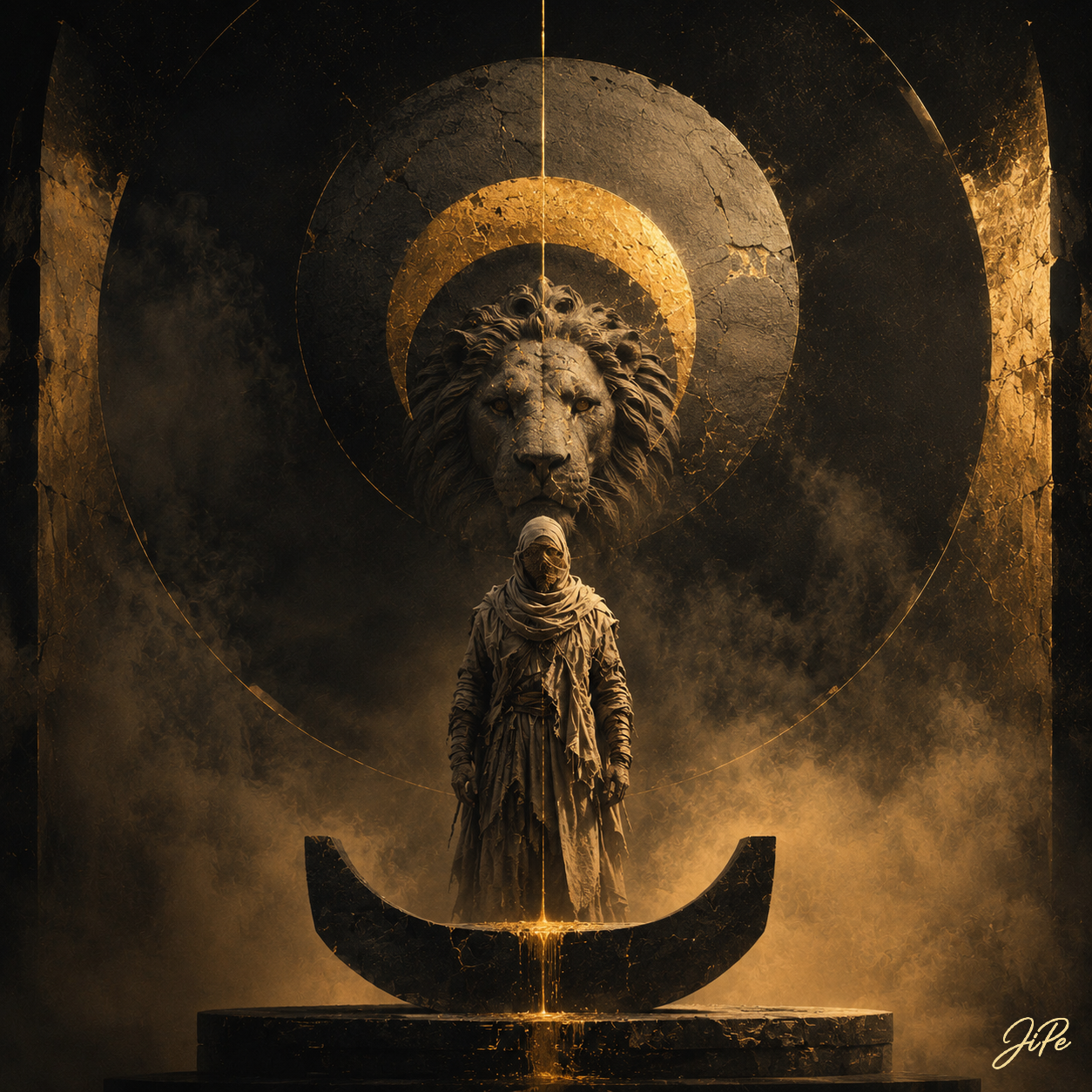
The Raven Crown stands as a monumental meditation on wisdom, ancestry, spiritual authority, and the profound relationship between humanity and the natural world. Rooted in the visual traditions of visionary symbolism, contemporary mythological realism, and monumental portraiture, the work transforms a single human figure into an archetype that transcends historical identity and enters the timeless realm of universal consciousness. Rather than portraying an individual, JiPe presents a guardian—a soul whose authority is earned not through conquest or power, but through memory, endurance, and communion with forces greater than the self.
The title itself is deeply symbolic.
A crown traditionally signifies sovereignty.
A raven signifies wisdom.
Together they become something far more profound.
A consciousness that has learned to lead because it has first learned to listen.
At the heart of the composition stands a weathered figure whose calm, unwavering gaze meets the viewer with extraordinary dignity. The deeply lined face speaks not of age alone, but of experience carried with honor. Black ceremonial markings descend across the skin like sacred inscriptions, suggesting journeys through suffering, transformation, and spiritual initiation. Rather than concealing identity, these markings reveal it, reminding us that true wisdom is often written by life’s greatest trials.
Nothing in this portrait feels decorative.
Every mark has become memory.
Every wrinkle has become history.
Every silence has become understanding.
Hovering above the figure is the immense raven, its wings fully extended in a gesture that simultaneously evokes protection, revelation, and transcendence. The bird does not dominate the human subject; instead, the two appear inseparably united, as though the raven is the visible manifestation of an inner spirit that has accompanied the figure throughout an entire lifetime.
The raven is not merely a companion.
It is consciousness made visible.
Across countless cultures, the raven occupies a uniquely powerful symbolic position. In Indigenous traditions throughout North America, the raven often appears as a creator, teacher, trickster, or bringer of light. In Norse mythology, Odin’s ravens Huginn and Muninn embody thought and memory, travelling across the world before returning with knowledge gathered from every corner of existence. Celtic traditions regard the raven as a messenger between worlds, while many spiritual systems associate the bird with transformation, prophecy, and hidden wisdom.
JiPe does not quote any single mythology.
Instead, he distills centuries of symbolic meaning into one timeless visual language.
The magnificent halo radiating behind both bird and human introduces another profound dimension. Its concentric geometry recalls sacred mandalas, illuminated icons, astronomical diagrams, and celestial maps. Rather than functioning solely as ornamentation, the halo establishes the figure as existing within a spiritual order where the human soul and the cosmos participate in the same universal rhythm.
The light does not glorify the individual.
It reveals the sacred nature of awareness itself.
Compositionally, The Raven Crown achieves remarkable equilibrium through powerful vertical symmetry. The human figure forms the central axis, while the raven’s expansive wings create a monumental horizontal counterbalance. This architectural structure recalls religious altarpieces, Byzantine icons, and monumental portrait traditions while remaining unmistakably contemporary through JiPe’s cinematic scale and painterly textures.
The entire image feels carved from silence.
Nothing is accidental.
Nothing seeks attention.
Everything belongs.
Light plays an essential narrative role throughout the painting. Warm gold radiates through turbulent clouds behind the figure, dissolving into deep charcoal shadows that preserve mystery rather than obscurity. This luminous atmosphere suggests dawn and dusk simultaneously—a symbolic threshold where endings become beginnings and certainty gives way to revelation.
The sky itself appears to witness the ceremony.
Gold functions throughout the work as far more than colour. In JiPe’s visual vocabulary, gold consistently represents transformation, memory, endurance, and spiritual value. Here it illuminates feathers, ornaments, clouds, and sacred geometry, recalling medieval illuminated manuscripts, Japanese kintsugi, Byzantine mosaics, and alchemical symbolism.
Gold does not erase imperfection.
It honours what has survived.
The ceremonial feathers adorning the figure deepen the work’s symbolic richness. Feathers have long represented prayer, freedom, communication with the unseen, and the invisible connection between earth and sky. Hanging beside weathered skin and carefully crafted ornaments, they become visual reminders that identity is formed through relationship—with ancestors, landscape, memory, and spirit.
The individual is never alone.
Every life carries generations within it.
Psychologically, The Raven Crown speaks to the maturation of the human soul. Carl Jung described individuation as the lifelong integration of conscious and unconscious experience into a unified Self. JiPe visualises this process not through abstraction but through archetype. The central figure embodies someone who has travelled through conflict without losing compassion, through suffering without surrendering dignity, and through uncertainty without abandoning wonder.
Wisdom is not inherited.
It is accumulated.
Layer by layer.
Season by season.
Silence by silence.
The immense stillness of the portrait is among its greatest strengths. Despite the explosive energy of the sky and the expansive wings of the raven, the human face remains completely composed. This contrast between outer movement and inner stillness creates profound emotional tension. The figure appears untouched by chaos because it has already passed through it.
The greatest strength…
is often the quietest.
Art historically, the painting occupies a fascinating intersection between Symbolism, Romanticism, visionary realism, and contemporary digital fine art. Monumental scale recalls nineteenth-century explorations of the sublime, while the integration of sacred geometry, mythological symbolism, and painterly surface textures firmly establishes the work within a modern visual discourse. JiPe synthesises these influences into a distinctive artistic language where cinematic atmosphere coexists with timeless spiritual inquiry.
The work is less concerned with depicting mythology than with revealing why mythology continues to matter.
Its symbols remain alive because human questions remain unchanged.
Who guides us?
What deserves reverence?
How does wisdom emerge?
The landscape surrounding the figure quietly reinforces these questions. Water reflects the burning sky, distant formations dissolve into luminous haze, and circling birds extend the raven’s presence throughout the entire environment. Nature itself becomes participant rather than backdrop, suggesting that spiritual awakening is never isolated from the living world.
Everything observes.
Everything remembers.
Everything belongs to the same story.
Perhaps the most compelling aspect of The Raven Crown is its refusal to romanticise authority. The figure wears no royal jewels, no throne, no military insignia. The only crown is the raven itself—a living symbol earned through experience rather than inherited through status.
This is leadership without domination.
Power without violence.
Presence without spectacle.
For contemporary viewers, the painting offers a powerful reflection on a world often consumed by noise, speed, and distraction. It reminds us that the deepest forms of authority emerge not from certainty, but from humility; not from possession, but from relationship; not from speaking the loudest, but from listening most deeply.
The raven does not command.
It watches.
The figure does not conquer.
He remembers.
Ultimately, The Raven Crown is a meditation on the sacred dignity of wisdom itself. It invites us to consider that the highest form of sovereignty is mastery over one’s own spirit, that the greatest teachers are often those who have walked furthest through darkness, and that true crowns are never forged from gold alone—they are woven from memory, resilience, compassion, and an unwavering relationship with the mysteries that surround us.
JiPe presents not a king…
but a keeper of ancient knowledge.
Not a ruler…
but a guardian.
And beneath the silent wings of the raven, we are reminded that the greatest crowns are not placed upon the head.
They are carried within the soul, where wisdom, memory, and eternity become one.