
The Point of Origin
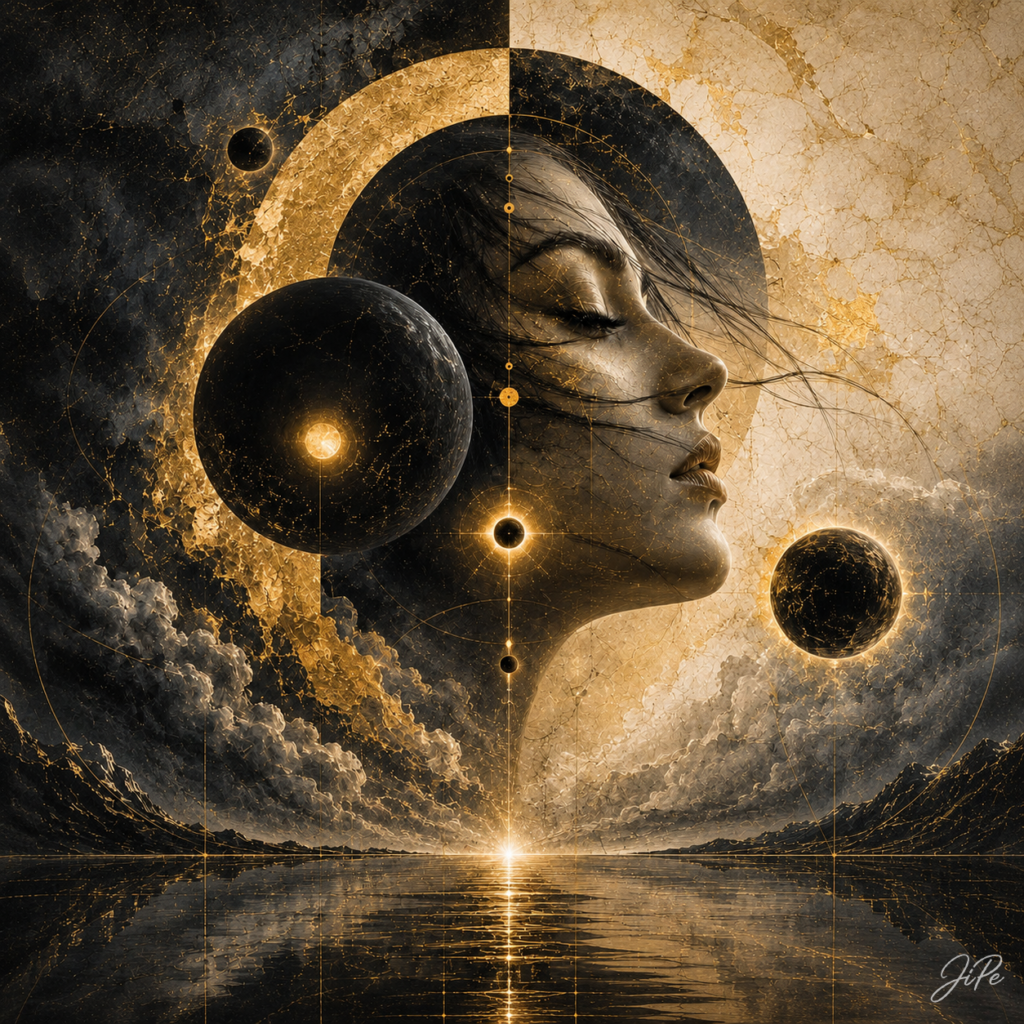
The Point of Origin is a profound exploration of beginnings—not simply the beginning of the universe, but the origin of consciousness, identity, memory, and existence itself. Situated between visionary symbolism, metaphysical surrealism, sacred geometry, and contemporary monumental portraiture, the work examines one of humanity’s oldest and most enduring questions: Where does everything truly begin? Rather than searching for a scientific answer or a theological conclusion, JiPe approaches the question through visual poetry, constructing an image in which cosmology and the human soul become inseparable.
This is not a painting about creation.
It is a meditation on the source from which all creation continuously emerges.
At the centre of the composition rests a serene human face suspended between darkness and light. Neither fully material nor entirely celestial, the figure appears to exist outside measurable time. Eyes gently closed, the expression conveys absolute stillness—not the stillness of sleep, but of profound awareness. Around the figure, celestial spheres orbit within delicate geometric alignments, while luminous horizons dissolve into infinite reflections below.
The title, The Point of Origin, immediately elevates the work beyond physical location. Origin is presented not as a place hidden somewhere in the distant past, but as an eternal presence existing beneath every moment. JiPe suggests that beginnings are not events that occurred once long ago—they are living realities continually unfolding within existence itself.
Every sunrise…
is another beginning.
Every breath…
returns us to the origin.
The central portrait functions as both an individual and an archetype. Although unmistakably human, the face possesses an extraordinary universality. It could belong to anyone, yet simultaneously appears older than history itself. Its calm expression suggests complete surrender to something infinitely greater, transforming the figure into a symbolic bridge between finite consciousness and eternal existence.
The face does not seek answers.
It has become still enough…
to hear them.
Compositionally, the work is governed by extraordinary balance. The entire image unfolds around a perfectly centred vertical axis, creating a visual harmony that recalls sacred architecture, mandalas, and classical principles of proportion. Every celestial body, every circle, every reflection contributes to a carefully orchestrated rhythm that guides the viewer toward the luminous point at the horizon.
Order becomes visible.
Because beneath apparent chaos…
there has always been harmony.
The celestial spheres surrounding the portrait carry profound symbolic significance. Throughout history, circles and planets have represented perfection, eternity, cycles, and the hidden architecture of the cosmos. JiPe transforms these familiar forms into metaphysical symbols rather than astronomical objects. They become worlds of consciousness, each orbiting an invisible centre that cannot itself be seen.
The universe does not revolve around matter.
It revolves around meaning.
At the composition’s lowest point, a brilliant light emerges precisely where sky and reflection meet. This luminous horizon becomes the true ”point of origin” from which the entire visual universe appears to unfold. Every geometric construction, every celestial sphere, every reflection seems connected to this singular source.
It is infinitely small.
It is infinitely vast.
It is the beginning of everything.
The mirror-like water introduces another profound symbolic layer. Reflection has long represented self-awareness, memory, and spiritual contemplation throughout art history. Here, however, reflection transcends literal representation. The water becomes a metaphysical surface where heaven and earth, consciousness and eternity, visible and invisible merge into perfect equilibrium.
Above and below…
become the same reality.
Light is the essential language through which JiPe communicates this philosophy. Golden illumination radiates gently through clouds, celestial bodies, and the figure itself, while deep charcoal shadows preserve mystery without ever suggesting fear. The light appears neither external nor directional. Instead, it seems to arise from within existence itself.
True illumination…
has no source outside itself.
The restrained palette of black, ivory, weathered gold, and muted stone reflects JiPe’s distinctive artistic vocabulary. Gold functions not merely as colour but as symbolic substance, recalling illuminated manuscripts, sacred mosaics, Japanese kintsugi, and alchemical transformation. Every luminous accent carries emotional as well as visual significance, suggesting wisdom accumulated across immeasurable time.
Even the smallest point of light…
contains an infinite horizon.
Subtle references to sacred geometry quietly structure the composition. Delicate circles, intersecting lines, and precise proportional relationships create an invisible framework beneath the visible painting. These geometric elements suggest that reality possesses an underlying intelligence—a universal order that transcends individual perception while remaining accessible through contemplation.
Nothing exists by accident.
Everything belongs…
to a greater design.
Psychologically, The Point of Origin resonates deeply with the philosophical search for the authentic self. Carl Jung described the process of individuation as a return toward the deeper centre of one’s being. JiPe expands this concept beyond psychology into cosmology, proposing that personal awakening mirrors the structure of creation itself.
To know ourselves…
is to remember where we began.
The painting also engages with ancient philosophical traditions that viewed the cosmos as an expression of living consciousness. Rather than portraying humanity as separate from the universe, JiPe dissolves this distinction entirely. The human face becomes landscape. The landscape becomes cosmos. The cosmos becomes consciousness.
There is no boundary.
Only different expressions…
of the same eternal source.
Art historically, the work exists within a rich dialogue between Symbolism, Romanticism, visionary realism, and contemporary metaphysical painting. Monumental scale recalls the sublime ambitions of nineteenth-century masters, while the integration of geometry, abstraction, and portraiture firmly situates the painting within a distinctly contemporary visual language. Yet JiPe avoids imitation, creating instead a highly recognizable artistic identity in which sculptural realism, spiritual symbolism, and cinematic atmosphere merge seamlessly.
Perhaps the work’s greatest achievement lies in its extraordinary stillness. Despite its cosmic scale and celestial complexity, nothing feels hurried. The painting breathes. Every element appears suspended in a timeless moment before creation and after completion simultaneously.
Silence becomes structure.
Stillness becomes revelation.
For viewers, the emotional experience evolves gradually. At first, attention is drawn toward the monumental face and radiant celestial forms. Slowly, however, the gaze descends toward the tiny luminous point at the horizon. What initially seemed insignificant becomes the emotional centre of the entire composition.
The smallest light…
holds the greatest mystery.
Eventually the viewer recognizes that the title refers not only to the universe but also to themselves. The search for origin is revealed as an inward journey rather than an outward expedition. The beginning we seek has never been hidden among distant galaxies.
It has always existed…
beneath consciousness itself.
Ultimately, The Point of Origin is a meditation on unity. It reminds us that every life, every thought, every civilization, every star, and every act of creation emerges from the same unfathomable source. It proposes that beneath diversity lies profound oneness, beneath movement absolute stillness, and beneath every ending another beginning waiting quietly to unfold.
JiPe does not paint the birth of the universe.
He paints the eternal moment from which birth itself becomes possible.
And perhaps the greatest mystery is not discovering where everything began.
Perhaps it is realizing that the point of origin has never been behind us.
It has always existed here…
at the silent centre of every living soul.