Monumental Visionary Fine Art exploring mythology, consciousness, sacred light, and timeless visual storytelling.

Monumental Visionary Fine Art exploring mythology, consciousness, sacred light, and timeless visual storytelling.

Surreal Paintings

Cathedral of the Last Light

Cathedral of the Last Light

Cathedral of the Last Light is a monumental reflection on transcendence, impermanence, and the enduring resilience of hope in the face of inevitable change. Situated between the language of myth and the symbolism of sacred architecture, the painting envisions a sanctuary that exists beyond the boundaries of time—a cathedral not built from stone, but from memory, light, silence, and transformation. Rather than depicting a physical place, the work portrays an inner sanctuary where destruction and renewal coexist, and where the final light before darkness becomes the beginning of another cycle.

The title itself carries a profound ambiguity. A cathedral traditionally represents humanity’s aspiration toward the divine, while ”the last light” suggests an ending: the final ray before night, the final moment before transformation, or the last spark of hope before uncertainty. Yet the painting deliberately refuses a tragic interpretation. Instead, it proposes that every ending contains the hidden architecture of a beginning. The ”last light” is not extinction, but revelation—a final illumination that allows hidden truths to become visible before a new chapter unfolds.

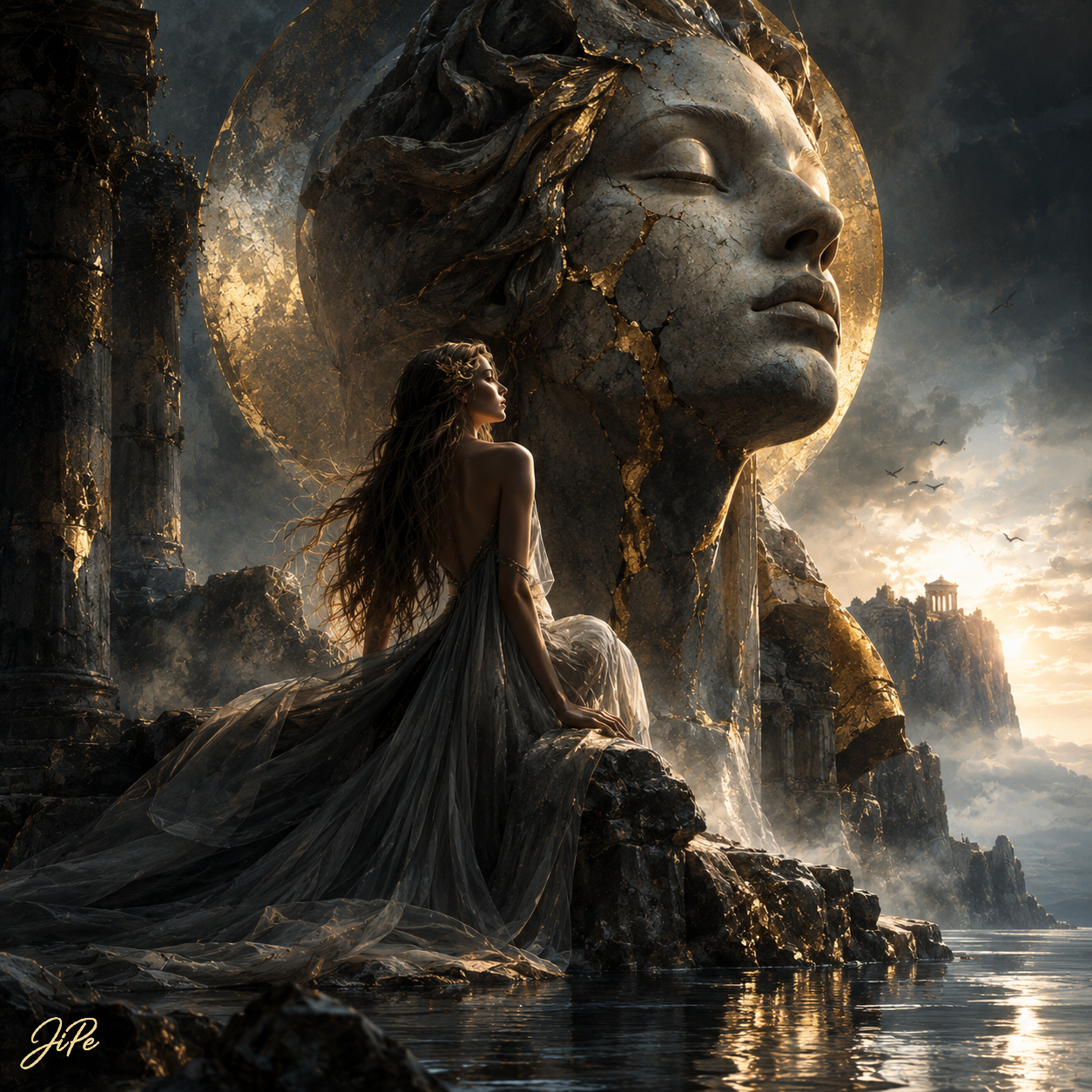
Dominating the composition is a colossal female figure whose face emerges from fractured stone as though the landscape itself has awakened into consciousness. She is neither goddess nor mortal, neither monument nor living being, but an archetypal presence embodying memory, endurance, and spiritual rebirth. Her closed eyes suggest inward contemplation rather than absence, inviting viewers into a state of meditation where silence becomes more eloquent than speech. She does not look upon the world; instead, she appears to listen to it from within.

The monumental scale of the figure establishes an immediate dialogue between humanity and eternity. Tiny architectural structures, distant mountains, and the solitary human figure standing at the staircase emphasize the vast difference between individual existence and the timeless forces represented by the sculpture. Yet this contrast does not diminish humanity. On the contrary, it elevates the solitary observer into a symbolic pilgrim, reminding us that even the smallest human presence possesses the capacity to confront the infinite.

The cracks spreading across the stone surface form one of the painting’s central conceptual themes. Rather than symbolizing decay alone, they speak of endurance through transformation. Inspired by the philosophy of kintsugi, where fractures become sites of beauty rather than flaws to conceal, the luminous golden veins weave throughout the sculpture like living energy. Every crack becomes evidence not of destruction, but of survival. The work suggests that identity is never defined by perfection, but by the visible traces of experience carried through time.

The flowers blossoming from the figure’s fractured crown introduce a striking visual counterpoint to the monumental stone. Delicate orchids, anthuriums, and allium blossoms emerge organically from weathered surfaces, symbolizing regeneration, resilience, and the extraordinary ability of life to flourish where one might least expect it. Their vivid crimson and violet tones become emotional focal points within the restrained palette, representing the persistence of beauty amidst ruin.

Botanically, the flowers also function as metaphors for memory. Unlike the permanence of stone, flowers exist only briefly before fading. Their presence reminds the viewer that life derives much of its meaning from its impermanence. By allowing ephemeral blossoms to emerge from ancient stone, the painting dissolves conventional distinctions between permanence and transience, proposing that both belong to the same eternal cycle.

Behind the figure, an immense golden circle establishes the spiritual architecture of the composition. Echoing the symbolism of halos, eclipses, celestial bodies, and sacred geometry, the circle represents unity, eternity, and the invisible order underlying existence. It functions simultaneously as a rising sun, a celestial portal, and an iconographic halo, refusing any singular interpretation. Weathered and incomplete, it avoids the perfection of mathematical geometry, suggesting instead that transcendence itself is a living, evolving process.

The surrounding landscape resembles the remains of an ancient civilization suspended between dream and memory. Towering cliffs, fragmented monoliths, scattered ruins, and distant waterfalls evoke an environment untouched by ordinary chronology. These architectural remnants do not imply catastrophe as much as continuity. They speak of civilizations that have disappeared, yet whose stories continue through memory, art, and human imagination.

The staircase ascending toward the central monument introduces another significant symbolic layer. Throughout history, stairways have represented spiritual ascent, initiation, and the pursuit of higher understanding. Here, however, the staircase does not culminate in a visible destination. Instead, it leads toward mystery itself. The lone figure standing before its final steps becomes a surrogate for every viewer, poised between knowledge and uncertainty, observation and participation.

Light is the emotional and philosophical center of the painting. It enters dramatically from the distant horizon, piercing storm-filled clouds and illuminating the monumental sculpture with quiet radiance. Rather than functioning merely as atmospheric illumination, the light becomes an active symbolic force. It reveals, transforms, and sanctifies without erasing darkness. The surrounding shadows remain essential, allowing illumination to achieve emotional depth rather than visual spectacle.

The restricted palette reinforces the painting’s timeless atmosphere. Warm ivory, weathered stone, charcoal black, muted earth tones, and luminous gold establish a restrained harmony interrupted only by the vivid blossoms. This careful orchestration of color allows every chromatic contrast to carry symbolic significance. Gold represents continuity, wisdom, and transcendence; black embodies mystery, introspection, and the unknown; crimson introduces life, passion, and renewal.

Technically, Cathedral of the Last Light merges hyper-realistic rendering with richly textured painterly abstraction. Stone surfaces reveal layers of weathering, fractures, and sculptural erosion, while surrounding skies dissolve into expressive brushwork and atmospheric glazes. Delicate gold leaf textures intertwine with organic forms, creating a visual dialogue between precision and spontaneity. This layered treatment of surface reflects the conceptual foundation of the work itself: reality and memory continually shaping one another.

Compositionally, the painting demonstrates remarkable architectural balance despite its complexity. The monumental bust occupies the visual center, stabilized by the circular halo and balanced by the ascending staircase to the right and the radiant opening to the left. Diagonal lines created by cliffs, clouds, and fractured stone introduce subtle movement without disturbing the composition’s contemplative stillness. Every element contributes to an overwhelming sense of quiet monumentality.

From an art historical perspective, Cathedral of the Last Light exists at the intersection of Symbolism, visionary realism, and contemporary monumental figurative painting. Echoes of Romantic landscapes, Renaissance ideals of sacred composition, and modern mixed-media aesthetics merge into a distinctly contemporary visual language. The work recalls the psychological symbolism of Arnold Böcklin, the spiritual luminosity of Gustav Klimt, and the architectural grandeur of classical sacred art, while simultaneously embracing the expressive freedom of contemporary fantasy realism.

Conceptually, the painting reflects upon one of humanity’s most enduring questions: what remains after everything else has passed away? The cathedral of the title is not constructed from physical architecture, but from memory, compassion, resilience, and the invisible structures that survive long after civilizations disappear. The sculpture itself becomes a metaphor for collective consciousness—a repository of experiences accumulated across generations.

The work intentionally remains open to multiple interpretations. Some viewers may perceive the monumental figure as an ancient deity, while others recognize an allegory of Mother Nature, human consciousness, or civilization itself. The blossoms may symbolize rebirth after destruction, the triumph of beauty over decay, or the persistence of hope within darkness. The solitary pilgrim may represent humanity seeking wisdom, or perhaps the viewer standing before the immeasurable mystery of existence.

This openness is fundamental to the painting’s purpose. Rather than offering definitive answers, Cathedral of the Last Light creates a contemplative space where every observer brings personal memories, beliefs, and emotional experiences into dialogue with the image. In doing so, the work continually transforms, becoming as much about the viewer’s inner landscape as the world depicted upon the canvas.

Ultimately, Cathedral of the Last Light is a meditation on endurance. It reminds us that civilizations may fade, monuments may fracture, and light itself may appear to diminish, yet beauty continues to emerge through every rupture. Hope survives not because the world remains unchanged, but because life possesses an extraordinary capacity to renew itself within the very places where endings seem inevitable. Standing before this work, the viewer is invited to enter a silent sanctuary where ruin becomes revelation, where memory becomes architecture, and where the last light is understood not as the conclusion of a journey, but as the first illumination of eternity.

Lämna ett svar