
When the Self Fractures
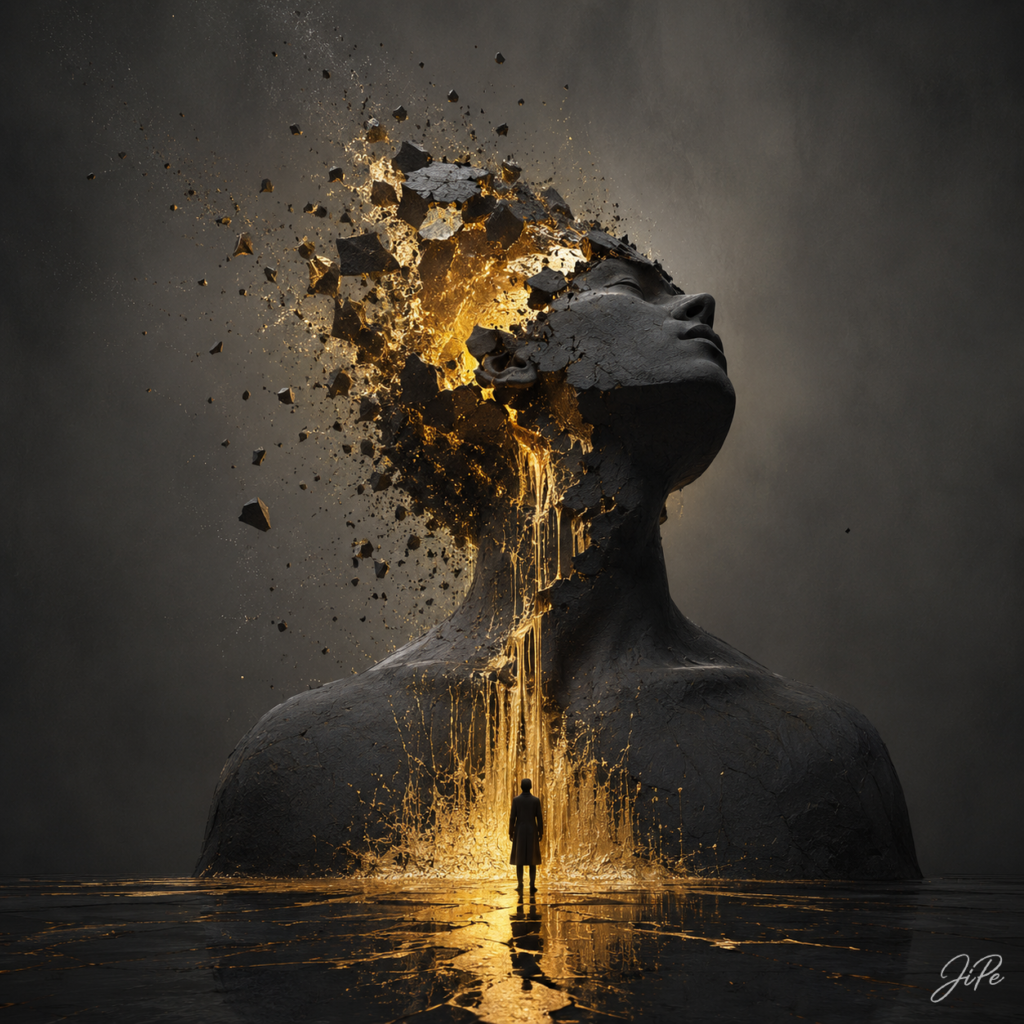
When the Self Fractures is an exploration of one of the most profound experiences of human existence: the moment when identity begins to dissolve in order to become something greater than it has ever been before. In this monumental symbolic composition, JiPe transforms psychological rupture into a visual language of extraordinary beauty, presenting fragmentation not as destruction, but as the first necessary movement toward transformation. The work speaks to the universal experience of losing certainty, confronting one’s inner self, and discovering that what appears to be collapse may in fact be the beginning of awakening.
The title immediately establishes the painting’s philosophical foundation. When the Self Fractures does not refer merely to emotional suffering or personal crisis. It describes the fragile threshold where the identity we have carefully constructed can no longer contain the deeper truths emerging from within. It is the instant when the familiar self begins to crack—not because it has failed, but because it has reached the limits of what it can become.
This is not the breaking of a person.
It is the breaking of illusion.
It is the beginning of becoming.

Dominating the composition is an immense sculptural human figure whose monumental scale recalls ancient colossi carved from stone. The face rises with serene dignity, eyes gently closed, the head tilted upward toward an unseen source beyond the visible frame. The posture conveys neither despair nor resistance. Instead, it embodies surrender—an acceptance of transformation that has already begun.
The face appears timeless.
Gender becomes secondary.
Identity becomes universal.
Rather than representing one individual, the sculpture becomes an archetype of humanity itself, carrying within its silent expression the accumulated experiences of every person who has ever questioned who they truly are.
The most striking visual event unfolds along the upper left side of the head, where the stone structure violently fractures into countless fragments. Chunks of the figure break away into space, suspended between solidity and disappearance. Yet these fragments do not fall into darkness. They explode outward through torrents of radiant molten gold, as though light itself were emerging from within the destruction.
This inversion defines the entire emotional architecture of the painting.
The fracture is not empty.
It is luminous.
The collapse reveals illumination that had always existed beneath the surface.
Throughout JiPe’s artistic language, gold functions as far more than an aesthetic choice. It represents consciousness, transformation, divine presence, memory, and the invisible essence that survives every external change. Here, the molten gold cascading from the fractured head recalls the philosophy of kintsugi, the Japanese art of repairing broken ceramics with precious metal. Yet JiPe expands this symbolism beyond restoration.
The figure is not repaired after breaking.
The breaking itself becomes the revelation.
The cracks are not evidence of weakness.
They are openings through which truth enters the visible world.
At the base of the monumental sculpture stands a solitary human figure, almost insignificant in scale. This small observer introduces one of JiPe’s recurring compositional strategies: the relationship between the individual and the immense forces shaping human existence. Standing before the fractured colossus, the figure becomes both witness and participant.
Is this person looking upon another?
Or are they standing before themselves?
The ambiguity is intentional.
The giant may represent the internal architecture of identity itself—a self so vast that only moments of crisis allow us to perceive its true dimensions.
The flowing stream of molten gold descending through the sculpture’s neck establishes a powerful vertical axis within the composition. Visually, it connects the fractured mind with the earth below, suggesting that insight cannot remain abstract. Illumination must eventually descend into lived experience. Thought becomes action. Consciousness becomes embodiment.
The viewer’s gaze instinctively follows this luminous pathway, descending from the shattered crown to the waiting human figure below. It becomes a symbolic journey from transcendence toward integration.
The surrounding environment is remarkably restrained. JiPe abandons elaborate architectural settings or dramatic celestial landscapes in favour of profound simplicity. Vast charcoal-grey space envelops the composition, allowing the central forms to dominate with extraordinary clarity. This minimalist atmosphere intensifies the psychological focus of the work.
Nothing distracts.
Everything serves the transformation.
Darkness itself becomes a contemplative field upon which light may fully reveal its meaning.
Materiality plays an essential role in the painting’s emotional power. The stone-like skin possesses extraordinary tactile richness, filled with subtle weathering, cracks, and sculptural imperfections. The surface appears ancient, as though shaped by centuries rather than moments. In contrast, the molten gold remains fluid, dynamic, and alive.
Stone represents identity.
Gold represents essence.
One fractures.
The other flows.
From an art historical perspective, When the Self Fractures stands at the intersection of contemporary visionary symbolism, metaphysical surrealism, monumental sculpture, and existential portraiture. Echoes of Auguste Rodin’s expressive surfaces, Renaissance ideals of monumental human form, and Symbolist explorations of inner consciousness resonate throughout the work. Yet JiPe’s distinctive visual language—combining painterly realism, fractured stone textures, luminous gold, and cinematic lighting—creates something unmistakably contemporary.
The work also recalls Carl Jung’s understanding of individuation, the lifelong psychological process through which the fragmented aspects of personality gradually integrate into a more authentic whole. In Jungian thought, encounters with crisis often precede profound transformation because they expose the inadequacy of previous identities. JiPe visualises this psychological process with remarkable poetic clarity.
The head fractures because consciousness is expanding.
The old structure can no longer contain the new self.
Philosophically, the painting challenges one of humanity’s deepest assumptions: that wholeness means remaining unbroken. JiPe suggests the opposite. True wholeness may only become possible after fragmentation has dismantled everything false. Identity built upon certainty often resists growth. Identity broken open becomes capable of receiving wisdom.
The luminous gold therefore represents not healing after trauma alone, but revelation through vulnerability.
The painting speaks equally to personal grief, spiritual awakening, creative transformation, and existential questioning. Every viewer brings different experiences to the image, yet its symbolic openness allows countless interpretations. A philosopher may see the dissolution of ego. A psychologist may recognise emotional integration. A theologian may perceive divine grace. An artist may understand the painful birth of authentic creativity.
The work refuses to limit itself to any single explanation.
It trusts the viewer’s own journey.
Light within the painting remains profoundly significant. It does not descend dramatically from heaven. Instead, it originates from within the fracture itself. This subtle decision transforms the philosophical meaning entirely. Enlightenment is not imposed from outside. It emerges when the rigid structures surrounding the self finally begin to dissolve.
The figure’s closed eyes reinforce this inward movement. External vision has ceased. Inner perception has begun.
Ultimately, When the Self Fractures is not a painting about destruction.
It is a painting about revelation.
It reminds us that every meaningful transformation requires the courage to release identities that no longer serve us. The structures we mistake for ourselves are often only temporary shelters. When they finally crack, something infinitely more enduring becomes visible.
Standing before this monumental work, viewers may first experience awe at its extraordinary craftsmanship—the immense sculptural presence, the cascading gold, the explosive fragmentation, and the elegant simplicity of its composition. Yet with sustained contemplation, another understanding gradually emerges.
The giant is not collapsing.
It is awakening.
The fragments are not being lost.
They are becoming light.
The solitary figure below is not witnessing tragedy.
They are witnessing birth.
In JiPe’s visionary universe, the most profound moments of human existence are rarely those in which we remain intact. They are the moments when certainty gives way to mystery, when carefully constructed identities surrender to deeper truths, and when the fractures we fear most become the very places through which illumination first enters our lives.
For sometimes the self must break apart—not so that it may disappear, but so that, for the very first time, it may become whole.