Monumental Visionary Fine Art exploring mythology, consciousness, sacred light, and timeless visual storytelling.

Monumental Visionary Fine Art exploring mythology, consciousness, sacred light, and timeless visual storytelling.

Fantasy Paintings

The Last Step Before Light

The Last Step Before Light

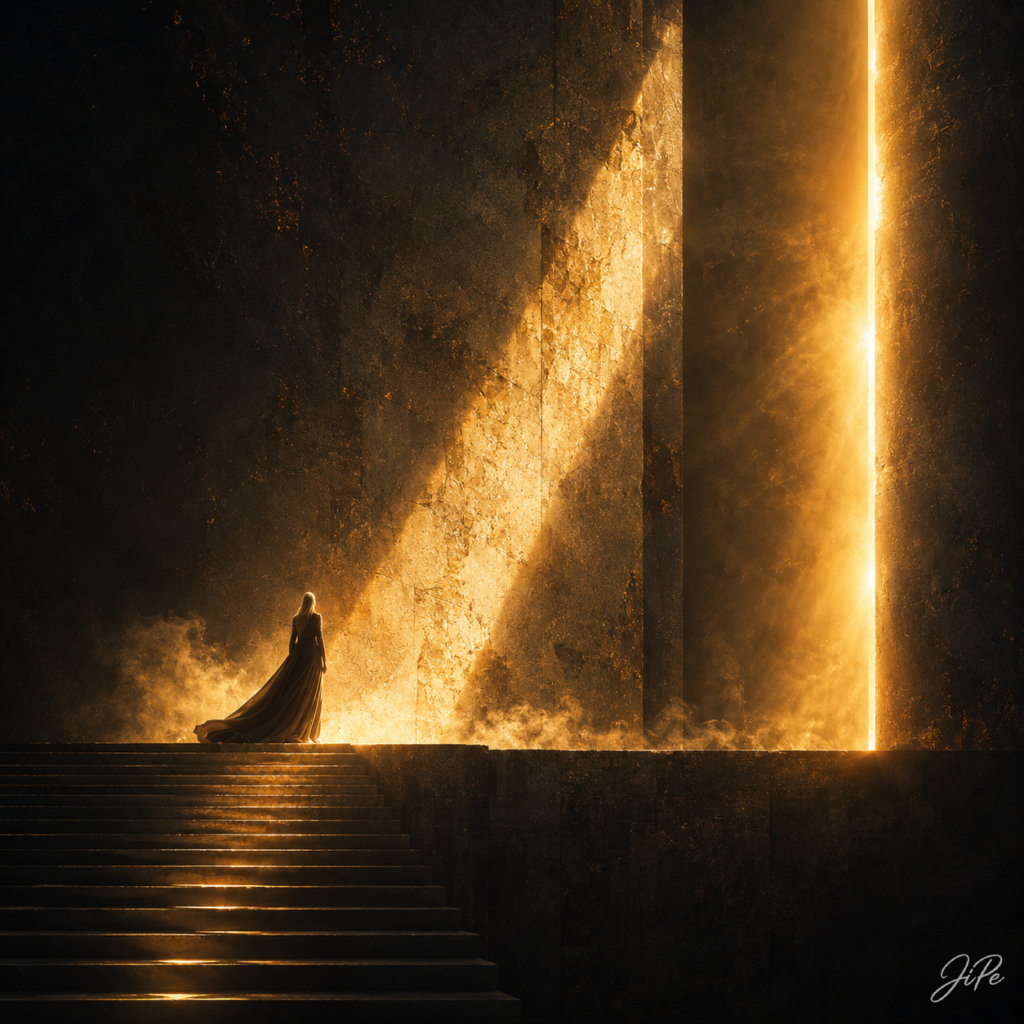
The Last Step Before Light is a profound meditation on the decisive threshold that separates uncertainty from revelation, mortality from transcendence, and the known world from the infinite. Through a composition of extraordinary restraint and monumental scale, JiPe distills one of humanity’s oldest existential questions into a single silent moment: what lies beyond the final step we are willing—or compelled—to take? Rather than depicting a destination, the painting captures the instant immediately before transformation, when every possibility remains suspended between fear and hope.

Unlike traditional narrative art that focuses on action or resolution, The Last Step Before Light celebrates anticipation itself. The solitary figure standing at the summit of the staircase does not yet cross the luminous threshold. Instead, the composition lingers within the tension of hesitation, where the future has not yet become reality. This deliberate suspension transforms a simple architectural scene into a timeless allegory of choice, faith, courage, and awakening.

The work is built upon remarkable visual economy. Vast architectural walls dominate the composition with overwhelming verticality, their immense surfaces disappearing into darkness beyond the edges of the canvas. The monumental scale reduces the human figure to almost microscopic proportions, reinforcing one of JiPe’s recurring philosophical themes: humanity exists within realities far greater than itself. Yet despite this disparity in scale, the viewer’s emotional focus rests entirely upon the lone figure. Physical size becomes irrelevant when measured against the magnitude of conscious experience.

The staircase functions as one of the painting’s central symbolic elements. Across countless cultures, ascending steps have represented spiritual ascent, intellectual growth, initiation, and transformation. Here, however, the staircase does not simply lead upward; it culminates in a moment of profound uncertainty. Every step below has already been taken. Every struggle, every sacrifice, every lesson belongs to the past. Only one final movement remains. In this way, the staircase becomes a visual metaphor for the entirety of human existence—a lifelong ascent toward understanding.

The title intensifies this symbolism. The Last Step Before Light does not describe arrival but proximity. It acknowledges that enlightenment is rarely immediate. There is always one final moment of surrender before revelation, one final uncertainty before clarity, one final act of courage before transformation. JiPe reminds viewers that the greatest thresholds in life are often crossed not with dramatic certainty but with quiet resolve.

Light itself serves as the painting’s true protagonist. Emerging through a monumental vertical opening, it pours into the architectural darkness with overwhelming intensity. This light is neither natural sunlight nor artificial illumination. It possesses an almost metaphysical presence, appearing less like reflected light than like the visible manifestation of consciousness itself. Throughout JiPe’s artistic language, gold consistently symbolises wisdom, transcendence, spiritual awakening, and the eternal. Here, that symbolism reaches one of its purest expressions.

Rather than flooding the entire composition, the light remains carefully contained within the architectural opening. This restraint is essential. Light retains its mystery precisely because it is partially concealed. The viewer cannot see its source, only its presence. By refusing to reveal what lies beyond the threshold, JiPe allows imagination to become an active participant in the work. Every observer projects their own understanding of what the radiant passage may represent—death, enlightenment, redemption, creation, memory, or infinite possibility.

The dialogue between darkness and illumination forms the emotional foundation of the painting. Darkness is not presented as something negative or threatening. Instead, it becomes a necessary counterpart to revelation. Without shadow, light loses meaning. The vast architectural surfaces remain largely submerged in deep charcoal tones, their textured surfaces absorbing rather than reflecting illumination. This visual restraint creates extraordinary contrast, allowing the golden light to appear almost physically tangible.

The architecture itself transcends literal interpretation. It resembles neither temple, palace, nor cathedral, yet subtly evokes all three. Massive vertical planes create an environment that feels both ancient and futuristic, timeless yet impossible to locate within any specific civilisation. JiPe frequently employs monumental architecture not as historical reconstruction but as psychological landscape. These immense structures become external representations of the human mind—vast, mysterious, layered, and only partially illuminated.

Mist and drifting atmospheric particles further reinforce the work’s dreamlike quality. Rather than functioning as environmental effects, they soften the boundaries between physical space and spiritual experience. The atmosphere appears alive, suggesting that the architecture itself breathes with quiet energy. This subtle movement prevents the composition from becoming static despite its remarkable stillness.

The solitary figure occupies a uniquely significant position within the painting. Clothed in flowing dark garments, the individual remains entirely anonymous. There are no identifying features, no visible face, no indications of age, status, or culture. This intentional anonymity transforms the figure into an archetype rather than a portrait. It could represent any human being standing before life’s defining threshold. By withholding identity, JiPe invites viewers to inhabit the figure themselves.

The figure’s posture conveys neither hesitation nor triumph. Instead, it communicates contemplative readiness. There is remarkable dignity in the stillness, suggesting that genuine transformation arises not through force but through acceptance. The individual does not rush toward the light; they simply stand prepared to meet it.

From a compositional perspective, the painting demonstrates exceptional discipline. Every line directs attention toward the luminous opening. The staircase establishes a powerful diagonal movement that naturally guides the eye upward before intersecting with the towering vertical beam of light. This meeting of horizontal journey and vertical revelation subtly reflects the relationship between human effort and transcendent grace—between the path we choose and the mysteries that ultimately exceed our understanding.

The limited colour palette contributes significantly to the work’s emotional resonance. Deep blacks, warm charcoals, muted bronze, and radiant gold dominate the composition. By eliminating unnecessary colour variation, JiPe allows light itself to become the principal expressive element. Gold does not merely decorate the image; it generates its emotional architecture.

Painterly texture further enriches the experience. Subtle weathering across the monumental walls suggests immense age, while visible brushwork preserves the physical presence of the artist’s hand. These textured surfaces prevent the architecture from appearing sterile or mechanical. Instead, they feel lived in, shaped by time, memory, and countless invisible histories.

Art historically, The Last Step Before Light occupies a fascinating intersection between Minimalism, Symbolism, Romanticism, and contemporary visionary painting. The reduced architectural vocabulary recalls minimalist spatial abstraction, while the overwhelming emotional atmosphere aligns with Romantic explorations of the sublime. Simultaneously, its symbolic narrative echoes the traditions of Symbolist painters who transformed physical environments into psychological and spiritual metaphors.

The painting also reflects architectural philosophies found across multiple spiritual traditions. Whether viewed through the lens of ancient mystery schools, medieval pilgrimage, Eastern contemplative practice, or modern existential philosophy, the staircase leading toward light becomes a universal symbol of inner evolution rather than religious doctrine. Its openness allows the work to transcend specific belief systems while remaining deeply spiritual.

Psychologically, The Last Step Before Light speaks to experiences shared by every individual. Throughout life we repeatedly encounter moments that require crossing invisible thresholds: beginning anew after loss, embracing vulnerability, confronting mortality, pursuing truth despite uncertainty, or discovering aspects of ourselves previously hidden. The painting recognises that transformation rarely begins with certainty. More often, it begins with a single step taken despite uncertainty.

Within JiPe’s broader artistic practice, this work represents one of his most refined explorations of silence as an expressive force. Many of his paintings employ monumental figures, symbolic architecture, and radiant gold to explore consciousness and transcendence. Here, however, those familiar themes are distilled into their most essential form. There is no spectacle, no dramatic narrative, no elaborate symbolism competing for attention. Every visual decision serves the singular emotional experience of approaching revelation.

Perhaps the painting’s greatest achievement lies in what it deliberately withholds. The viewer never sees beyond the radiant opening. The mystery remains intact. JiPe understands that true transcendence cannot be fully illustrated; it can only be suggested. By leaving the final destination unseen, the work preserves the sacred quality of the unknown.

Ultimately, The Last Step Before Light is a meditation on faith—not necessarily religious faith, but faith in transformation itself. It proposes that the most important moments of human existence occur not after certainty has been achieved, but immediately before it, when we choose to move forward despite incomplete understanding. Every life contains such thresholds, where the familiar world ends and something entirely new begins.

Standing before this monumental vision, viewers are invited to recognise their own unfinished journey. The staircase becomes their path. The solitary figure becomes their reflection. The radiant opening becomes whatever truth they continue to seek. In this profound silence, JiPe reminds us that enlightenment is rarely found in grand declarations or absolute answers. More often, it begins with the quiet courage to take one final step toward the light.

Lämna ett svar