The Last Dawn

The Last Dawn is a profound meditation on endings that are, paradoxically, also beginnings. Through sweeping atmospheric abstraction, luminous painterly textures, and an extraordinary orchestration of light, JiPe transforms a familiar natural phenomenon—the sunrise—into a universal symbol of transition, renewal, and the eternal rhythm that governs existence. Suspended somewhere between landscape and vision, memory and prophecy, the painting invites viewers to contemplate the fragile boundary where darkness yields to illumination and where every conclusion quietly prepares the birth of something new.
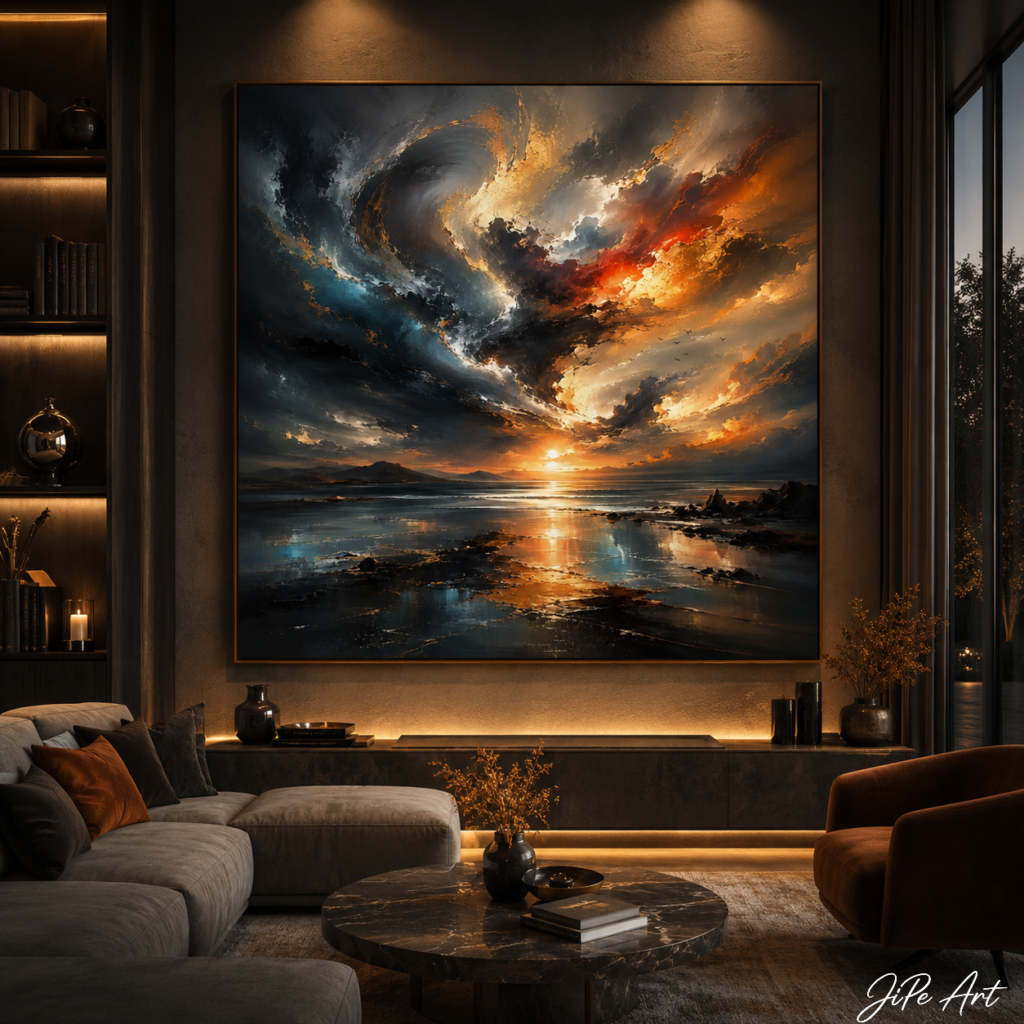
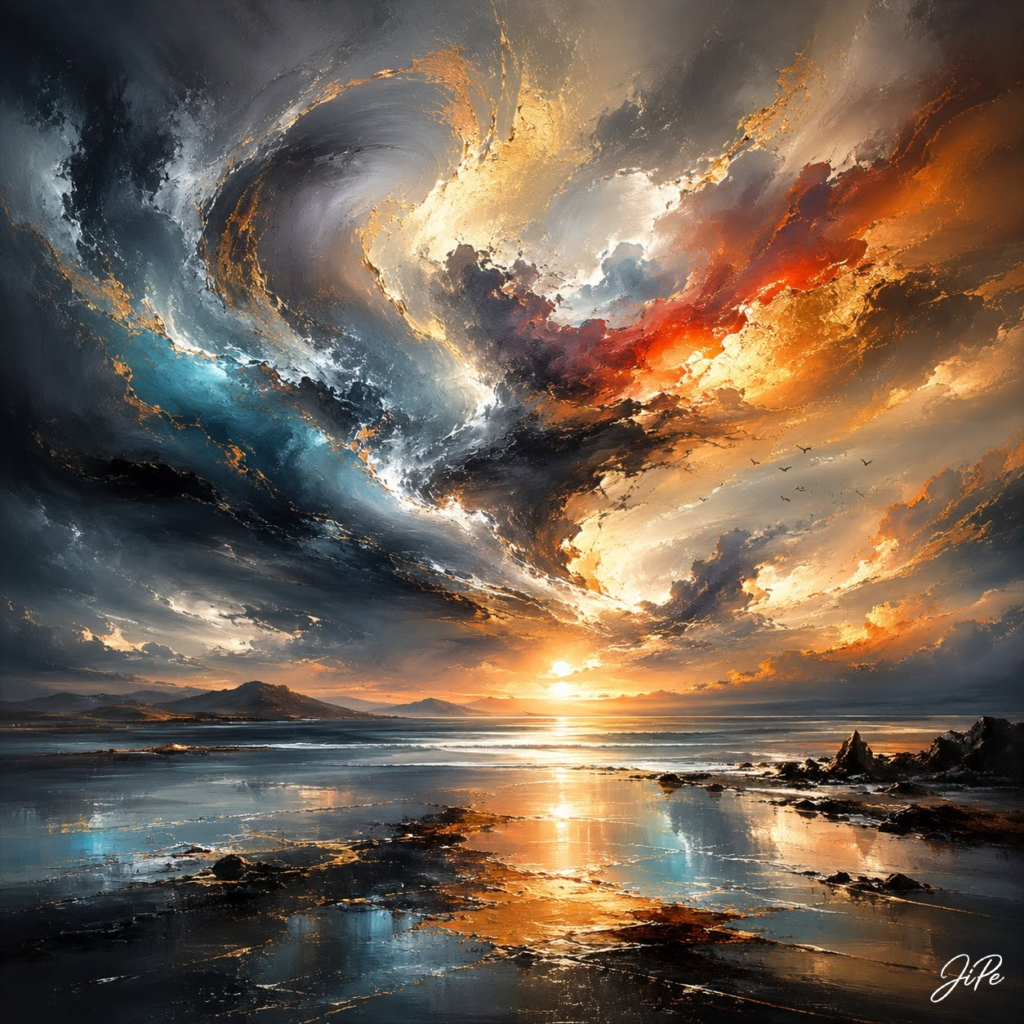
Rather than depicting a literal coastline at sunrise, The Last Dawn exists within a symbolic realm where nature becomes an expression of inner consciousness. The immense sky dominates the composition, unfolding in dramatic spirals of cloud, light, and colour that appear almost cosmic in scale. The earth below remains calm and reflective, while above it the heavens seem alive with movement, suggesting that the true drama unfolds not upon the landscape itself but within the unseen forces that shape both the natural world and the human spirit.
The title immediately introduces a compelling paradox. The Last Dawn suggests finality, yet dawn has traditionally symbolised hope, awakening, and renewal. By combining these opposing ideas, JiPe encourages viewers to reconsider the meaning of endings. The ”last” dawn is not necessarily the end of existence, but perhaps the final sunrise before transformation—the moment in which one identity dissolves so another may emerge. It speaks to the closing of one chapter before the opening of another, reminding us that every ending carries within it the invisible architecture of a beginning.

Light functions as the central protagonist throughout the painting. Emerging from the distant horizon, the rising sun radiates across the tranquil shoreline while simultaneously illuminating vast formations of cloud that twist into monumental, almost celestial structures. The light does not simply reveal the landscape; it appears to create it. Every reflection across the water, every glowing contour within the clouds, and every shimmering trace of gold suggests that illumination itself is the creative force from which reality unfolds.
This philosophy of light has become one of JiPe’s defining artistic signatures. Throughout his work, gold represents far more than visual splendour. It symbolises consciousness, revelation, transcendence, and spiritual awakening. In The Last Dawn, golden light expands through darkness not as an act of conquest but as an act of quiet transformation. The darkness is not destroyed—it is gradually absorbed into harmony, becoming an essential partner in the creation of beauty.
The extraordinary sky commands immediate attention. Vast painterly currents sweep across the heavens in fluid, almost abstract gestures, creating a dynamic interplay between movement and stillness. Deep blue-grey masses collide with radiant whites, warm ochres, brilliant gold, and striking passages of crimson-orange. These swirling formations resemble both storm systems and celestial galaxies, dissolving the distinction between atmospheric weather and cosmic creation.
The red and orange passages introduce emotional intensity without overwhelming the composition. Rather than suggesting violence, they evoke passion, vitality, and the transformative energy often associated with fire. Opposing these warm colours are expansive fields of cool blues and silvery greys, establishing a visual dialogue between opposing forces—heat and cold, movement and stillness, emotion and contemplation. This balance reflects one of the painting’s central philosophical ideas: harmony arises not through uniformity but through the coexistence of opposites.
Below the immense heavens, the shoreline becomes a mirror of the sky. Calm water reflects the radiant light with remarkable subtlety, dissolving the boundary between earth and heaven. Reflection here carries symbolic significance. Water has long represented memory, emotion, and the subconscious. The mirrored landscape therefore suggests that the transformations occurring above also unfold within the inner world of human consciousness. As the heavens awaken, so too does the soul.
The composition demonstrates exceptional spatial intelligence. The vast sky occupies the overwhelming majority of the canvas, intentionally diminishing the physical landscape beneath it. This dramatic imbalance shifts the viewer’s perception away from geographical realism toward existential contemplation. Humanity is notably absent, allowing nature itself to become the central narrator. Without figures to anchor scale or narrative, viewers are invited to project themselves into the scene, experiencing the landscape as a deeply personal psychological space.
Painterly texture plays an equally important role in communicating meaning. Rich impasto surfaces, expressive brushwork, fractured transitions, and layered colour fields create an image that feels both spontaneous and meticulously constructed. The surface appears weathered, as though shaped by time itself. Fine traces of luminous gold weave through the composition like veins of light, recalling the Japanese philosophy of kintsugi, in which fractures become places of beauty rather than flaws to conceal. Here, the sky itself seems healed through light.
From an art historical perspective, The Last Dawn exists at the intersection of several important traditions. The emotional grandeur recalls nineteenth-century Romantic landscape painters, whose vast natural environments expressed humanity’s encounter with the sublime. Simultaneously, the symbolic atmosphere aligns with European Symbolism, where external landscapes functioned as metaphors for spiritual experience. The expressive abstraction of the clouds also echoes aspects of contemporary gestural painting, while the cinematic treatment of light firmly establishes the work within JiPe’s distinctive contemporary visionary aesthetic.
The absence of explicit religious iconography allows the painting to remain universally accessible. Although deeply spiritual in atmosphere, its symbolism transcends specific belief systems. The rising light may represent divine presence, enlightenment, personal resilience, creative inspiration, or simply the perpetual cycles of existence. This openness encourages viewers from diverse cultural and philosophical backgrounds to engage with the work according to their own experiences and beliefs.
Psychologically, The Last Dawn explores the emotional complexity of transition. Human life is shaped by countless endings: the conclusion of relationships, careers, identities, ambitions, and entire phases of existence. Such moments often contain both grief and hope, uncertainty and possibility. JiPe captures this delicate emotional balance by allowing darkness and brilliance to coexist within the same visual space. The painting refuses simplistic optimism while equally rejecting despair. Instead, it acknowledges transformation as both beautiful and demanding.
Time itself becomes a subtle subject within the composition. Dawn is among nature’s most fleeting phenomena—a brief interval during which the world exists between night and day. By choosing this transitional moment rather than the full brightness of daylight, JiPe emphasises the profound significance of thresholds. Transformation rarely occurs in dramatic instantaneity; instead, it unfolds gradually through moments of uncertainty, patience, and quiet revelation.
The distant mountains provide an important visual counterpoint to the fluid sky. Their stable silhouettes introduce permanence into an otherwise constantly shifting environment. These ancient forms remind viewers that while circumstances change endlessly, deeper truths remain. The relationship between mountain and sky mirrors the relationship between enduring identity and evolving experience, between permanence and transformation.
Throughout the composition, birds appear almost imperceptibly against the luminous horizon. Their subtle presence introduces an additional symbolic layer. Traditionally associated with freedom, transcendence, and the movement between earthly and spiritual realms, they reinforce the painting’s broader meditation on passage, awakening, and limitless possibility.
Within JiPe’s broader body of work, The Last Dawn occupies a distinctive place by shifting attention away from monumental human figures toward the expressive power of landscape itself. Yet it remains entirely consistent with his artistic language. The recurring interplay of luminous gold, dramatic atmosphere, symbolic light, textured surfaces, and contemplative silence continues his ongoing exploration of humanity’s relationship with the infinite.
Perhaps the painting’s greatest achievement lies in its remarkable emotional ambiguity. It refuses definitive interpretation. Is this the beginning of creation or the conclusion of an age? Is the approaching light a promise, a farewell, or both simultaneously? Such questions remain intentionally unanswered. The work invites prolonged contemplation precisely because it operates through suggestion rather than certainty.
Ultimately, The Last Dawn is not merely a depiction of sunrise. It is a philosophical reflection on impermanence, renewal, and the enduring resilience of hope. JiPe reminds us that the moments we perceive as endings often become the very foundations upon which new realities emerge. Every sunset prepares another dawn, just as every loss contains the hidden possibility of transformation.
Standing before this luminous landscape, viewers encounter more than a horizon bathed in extraordinary light. They encounter a visual meditation on existence itself—a reminder that even when life appears to arrive at its final threshold, the universe continues its eternal rhythm of creation. In that quiet certainty, The Last Dawn becomes not a farewell to the light, but a celebration of its infinite return.