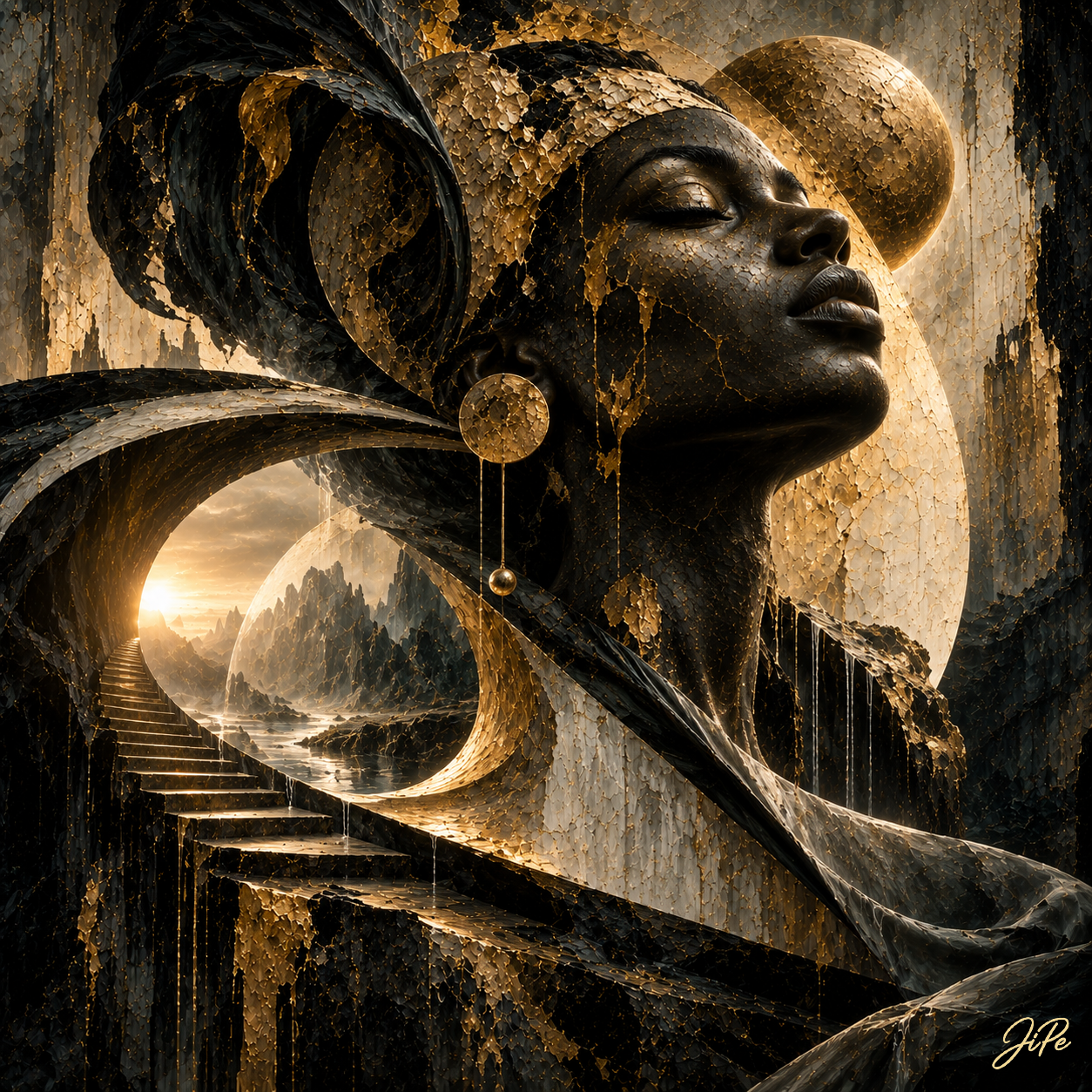

Daughter of the Deep emerges from a darkness that feels less like an environment than a state of being. The human presence is intimate and immediate, yet its boundaries are unsettled, absorbed into another form whose proximity resists any simple distinction between encounter, possession, and belonging. What might otherwise suggest opposition becomes strangely inseparable.
Light appears sparingly, gathering across the face like fragments of something remembered rather than fully revealed. The surrounding darkness carries its own density, making the work feel suspended beneath ordinary measures of distance and time. Within this compressed space, the gaze becomes crucial: calm, direct, and difficult to locate entirely within the human.
The title introduces ancestry without clarifying its nature. To be a daughter of the deep may suggest origin, inheritance, or an affinity with what remains inaccessible from the surface. Yet the work refuses to determine whether this depth is physical, psychological, or something more ancient.
What emerges is not a confrontation between two worlds, but the possibility that their separation was never complete. The lingering uncertainty is whether she has descended into the deep—or whether the deep has always been looking through her.