
The Dream Between Worlds
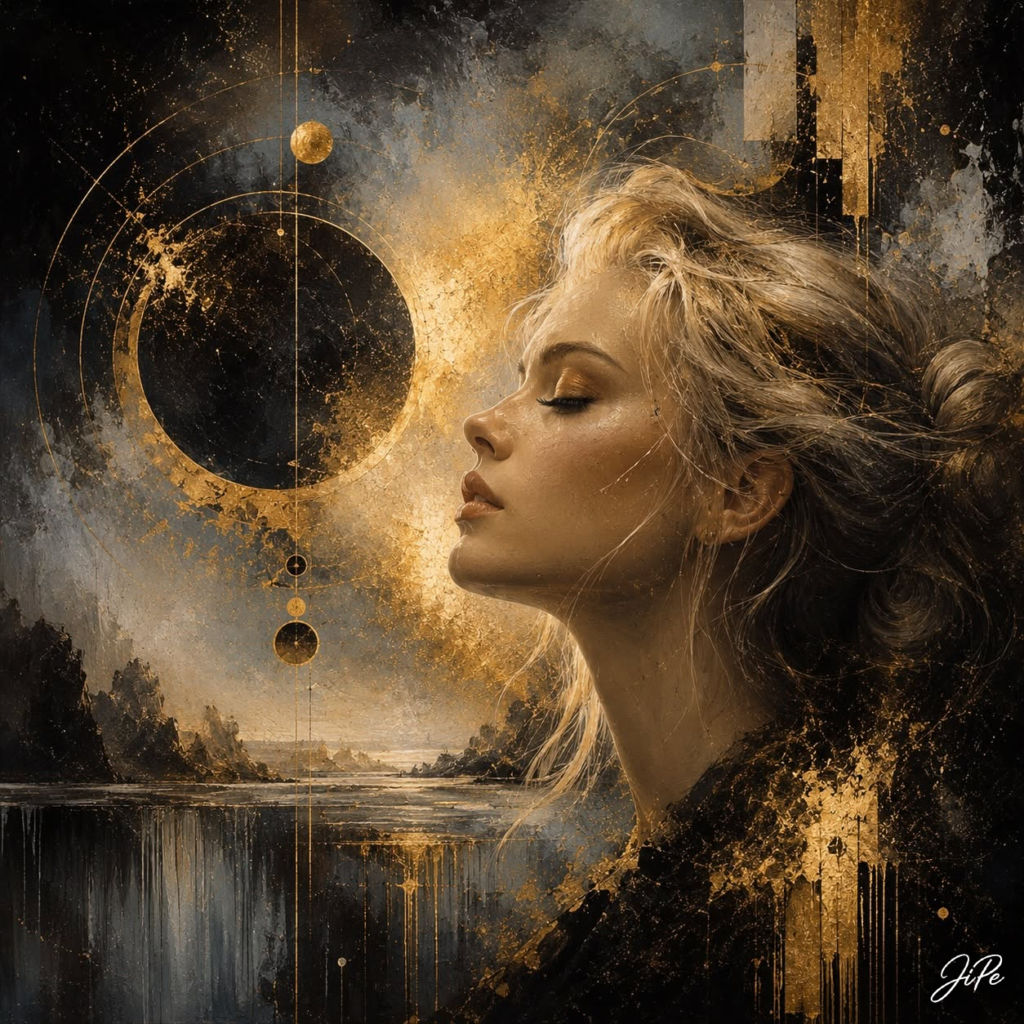
The Dream Between Worlds is a contemplative journey into the liminal space where consciousness, memory, and the cosmos quietly converge. Blending symbolic portraiture with visionary landscape and geometric abstraction, the painting exists within the delicate threshold between waking and dreaming, between the visible world and the unseen dimensions that shape human perception. It is neither a depiction of reality nor an escape from it. Instead, the work proposes that the most profound truths often emerge in the spaces that lie between certainty and imagination.
At the center of the composition is the serene profile of a woman whose eyes remain gently closed, her face turned toward an invisible light. She appears suspended in a moment of complete stillness, detached from the urgency of the external world. Her expression is not one of sleep but of profound awareness—a state where intuition replaces observation and silence becomes the language of understanding. She becomes an archetype rather than an individual, embodying the universal human capacity to journey inward toward deeper levels of consciousness.
The title, The Dream Between Worlds, suggests that dreams are not merely private psychological experiences but symbolic landscapes where memory, imagination, and spiritual insight intersect. Throughout history, dreams have served as gateways between the known and the unknown, revealing truths that remain inaccessible to ordinary perception. This painting embraces that timeless idea, presenting dreaming as a form of transcendence rather than illusion. It proposes that the boundaries separating inner and outer reality are far more fluid than they first appear.
Dominating the left side of the composition is a monumental celestial disc surrounded by elegant concentric circles and delicate geometric alignments. These forms evoke eclipses, planetary orbits, sacred diagrams, and astronomical charts simultaneously. Their measured precision contrasts beautifully with the softness of the portrait, suggesting that emotion and reason, intuition and mathematics, belong to the same universal order. The celestial geometry becomes a visual metaphor for the invisible structures that govern both the cosmos and the human spirit.
The expansive landscape beneath the celestial forms unfolds with remarkable restraint. Quiet waters stretch toward distant mountains that dissolve into atmospheric haze, creating a horizon that appears to exist beyond measurable distance. Rather than functioning as a literal place, this landscape becomes an interior geography—a symbolic realm where thought takes physical form. The calm reflective surface invites contemplation, suggesting that clarity is achieved not through movement but through stillness.
Light serves as the painting’s emotional and philosophical center. Warm golden illumination radiates gently across the composition, embracing both the portrait and the surrounding cosmic architecture. Rather than arriving from a single identifiable source, the light appears to emerge from within the painting itself, dissolving distinctions between subject and environment. It functions not merely as illumination but as consciousness made visible—a quiet presence that reveals rather than overwhelms. Darkness remains an essential companion, allowing the luminous passages to resonate with extraordinary emotional depth.
Gold occupies a central symbolic role throughout the work. Across centuries of artistic tradition, gold has represented divinity, wisdom, transcendence, and incorruptible truth. In The Dream Between Worlds, its meaning expands further. The luminous splashes, weathered textures, and delicate geometric accents suggest that moments of insight rarely arrive fully formed. Instead, they emerge gradually, illuminating fragments of experience until they begin to reveal a larger pattern. Gold becomes the visual language of awakening, quietly transforming abstraction into meaning.
The portrait itself demonstrates remarkable emotional subtlety. The woman’s upward gaze, despite her closed eyes, conveys openness rather than withdrawal. She appears receptive to something beyond ordinary vision, reminding viewers that genuine perception often begins where external observation ends. Loose strands of hair dissolve into the surrounding atmosphere, blurring the distinction between the individual and the cosmos. Identity itself becomes fluid, suggesting that the self is not confined by physical boundaries but participates in something infinitely larger.
Compositionally, the painting achieves exceptional harmony through its balance of asymmetry and order. The portrait occupies the right side of the canvas with graceful presence, while the celestial architecture anchors the left through monumental circular forms. Vertical and horizontal alignments establish an underlying structural rhythm, allowing the viewer’s gaze to move naturally between portrait, landscape, and geometry. Every visual element appears interconnected, creating a sense of quiet inevitability rather than rigid design.
Texture enriches the painting with a tactile presence that recalls weathered frescoes, ancient walls, and layered geological formations. Expressive painterly surfaces, subtle erosion, and luminous gold leaf effects suggest the passage of time without tying the work to any specific historical period. The image feels simultaneously ancient and contemporary, as though it exists outside conventional chronology. This timeless quality reinforces the painting’s exploration of dreams as spaces where past, present, and future coexist.
Within the broader context of contemporary visionary art, The Dream Between Worlds synthesizes influences from Symbolism, Romanticism, metaphysical painting, and geometric abstraction while maintaining a distinctly modern visual language. The emotional introspection of the portrait recalls the Symbolists’ search for inner realities, while the cosmic geometry reflects humanity’s enduring fascination with astronomy, sacred mathematics, and universal harmony. Yet the work ultimately transcends these traditions, creating an original visual philosophy rooted in contemplation rather than narrative.
For art historians, the painting may be interpreted as an exploration of liminality—the threshold state where transformation becomes possible. Throughout mythology, psychology, and spiritual philosophy, liminal spaces have represented moments of profound transition. They are places where old identities dissolve before new ones emerge, where certainty gives way to possibility. In this work, the dream itself becomes that threshold. The celestial landscape, the geometric structures, and the meditative portrait all participate in a visual language that celebrates transition rather than resolution.
The work also reflects a broader contemporary longing for stillness. In a world increasingly defined by speed, distraction, and constant movement, The Dream Between Worlds proposes silence as an act of resistance and contemplation as a form of wisdom. The painting does not seek dramatic action or immediate interpretation. Instead, it rewards sustained attention, inviting viewers to slow their perception until subtle relationships between light, geometry, landscape, and emotion gradually reveal themselves.
Ultimately, The Dream Between Worlds is a meditation on the invisible landscapes that exist within every human being. It reminds us that the deepest journeys are often those undertaken without movement, where memory becomes horizon, light becomes language, and dreams become bridges connecting the finite with the infinite. Standing before this luminous convergence of portrait, cosmos, and abstraction, the viewer is invited to reflect upon the quiet spaces between thought and intuition, waking and dreaming, self and universe. It is within those fragile yet profound intervals that the painting suggests we encounter not only the mysteries of the cosmos, but also the most authentic dimensions of ourselves.