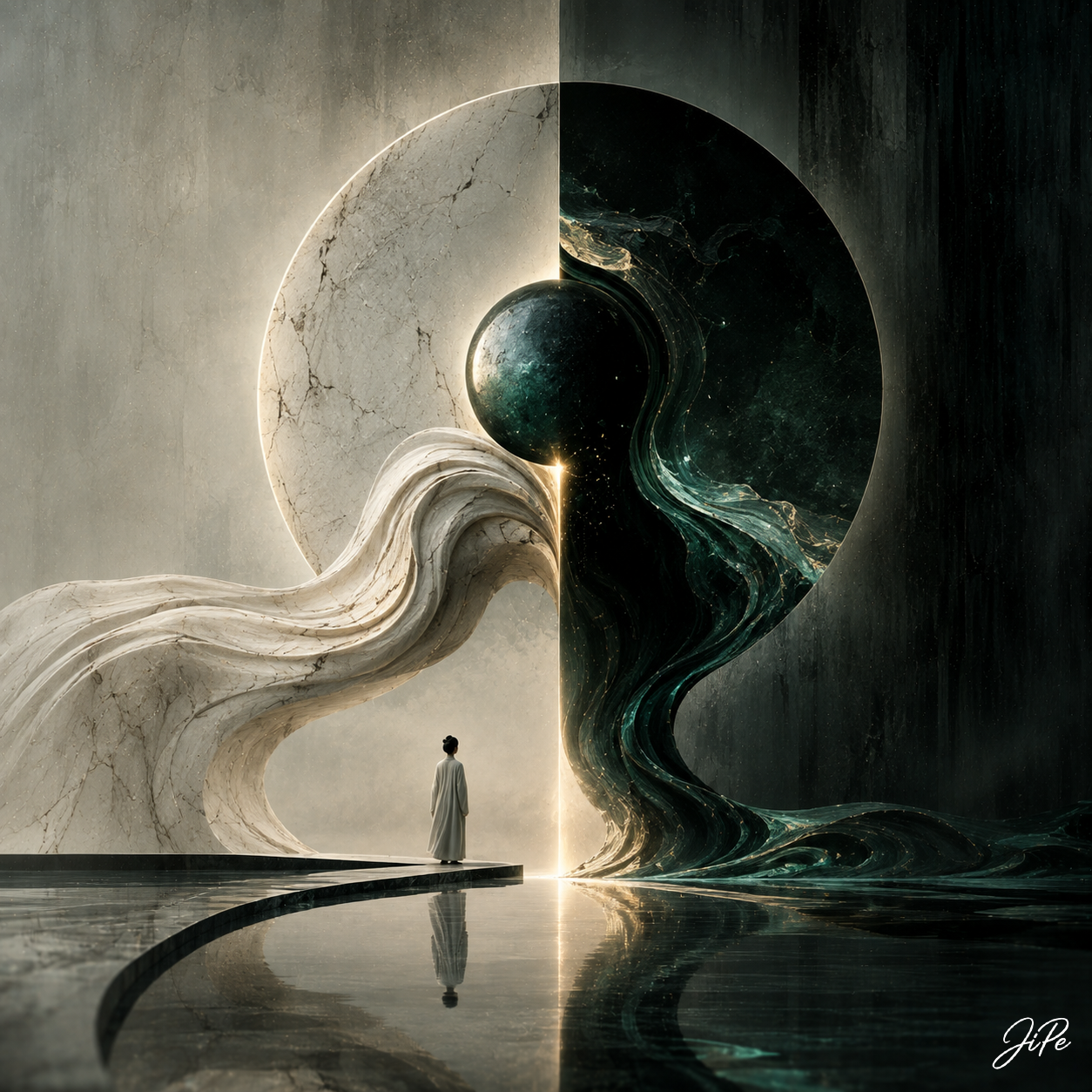

The Silence of the Last Swan holds beauty at the edge of disappearance. Its central encounter feels suspended outside ordinary time, intimate yet strangely ceremonial, as though both presences have entered a moment from which the surrounding world has quietly withdrawn. Movement gathers everywhere, but at the emotional center there is stillness.
The contrast between darkness and radiance creates less a conflict than an uneasy dependence. Each seems to require the other in order to become fully present. Against the vastness of the illuminated horizon, closeness acquires a sense of fragility: what appears eternal may exist only for an instant, and what appears magnificent may already contain the knowledge of its ending.
The title introduces absence before absence has occurred. “Last” transforms the scene into something remembered even while it is happening, giving tenderness the weight of farewell. Yet nothing confirms what is being lost—or whether loss is inevitable at all.
Perhaps the deepest silence here belongs to the moment before separation, when neither departure nor return has yet been chosen. The Silence of the Last Swan remains within that interval, asking whether we recognize the final moment of something precious when it arrives—or only after it has passed.