
The Last Guardian of Worlds
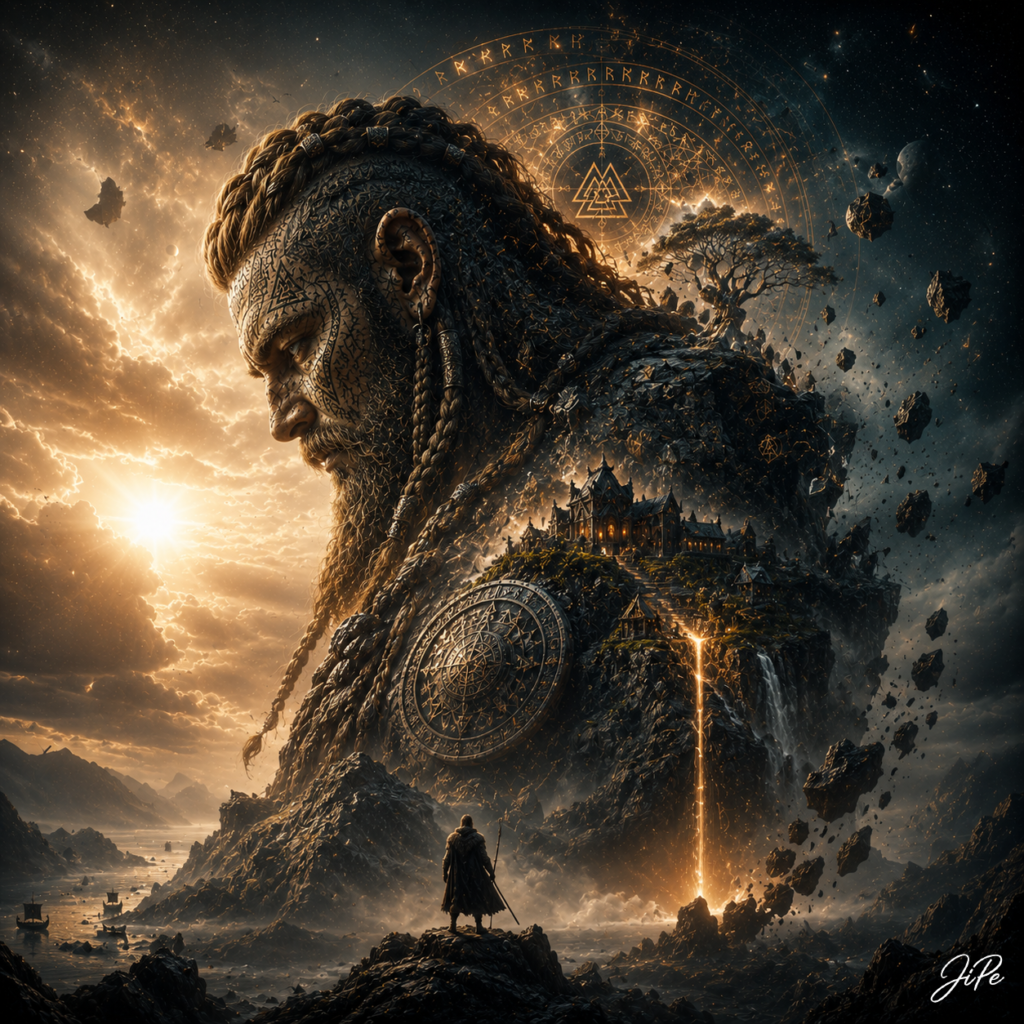
The Last Guardian of Worlds is a monumental meditation on memory, stewardship, and the enduring responsibility of preserving civilizations across the boundaries of time. Standing at the intersection of mythology, visionary symbolism, and contemporary epic fantasy, the painting presents an awe-inspiring guardian whose very existence appears inseparable from the landscape he protects. More than a portrait or a narrative scene, the work unfolds as a visual cosmology in which nature, history, architecture, and consciousness merge into a single living entity.
At first glance, the immense figure dominates the composition with overwhelming presence. His weathered face, adorned with intricate Nordic-inspired markings and braided hair, evokes the timeless wisdom of an ancient protector who has witnessed countless ages rise and fall. Yet despite his colossal scale, his expression remains introspective rather than triumphant. His lowered gaze suggests neither conquest nor authority, but contemplation. He is not the ruler of these worlds; he is their servant, burdened with the silent duty of ensuring their survival.
The title, The Last Guardian of Worlds, immediately expands the narrative beyond the boundaries of a single realm. It implies that countless civilizations once existed and that only one sentinel remains to remember them. Rather than depicting an ending defined by destruction, the painting transforms the idea of ”the last” into one of sacred continuity. The guardian becomes the final link in an unbroken chain of memory, carrying the stories, beliefs, and identities of forgotten worlds into an uncertain future.
The composition itself reinforces this extraordinary symbolism. The colossal figure appears carved from mountains and celestial stone, his body gradually dissolving into cliffs, forests, temples, and waterfalls. Architecture emerges naturally from his shoulders, while rocky formations and cosmic debris surround him as if gravity itself has become secondary to the power of myth. This seamless integration between figure and environment suggests that the guardian is not merely standing within nature; he has become nature itself. Landscape becomes anatomy, and anatomy becomes mythology.
This fusion reflects one of humanity’s oldest artistic concepts: that divine beings and cosmic forces are inseparable from the natural world. Throughout history, mountains have symbolized permanence, trees have represented life and ancestry, and rivers have embodied the flow of time. Here, all of these archetypes converge within a single monumental form, transforming the guardian into an embodiment of the world’s living memory.
Behind the figure, luminous circles inscribed with ancient runes and sacred geometry establish an unmistakable connection to Nordic cosmology. The Valknut-like symbol at the center references themes of destiny, sacrifice, wisdom, and transcendence, while the concentric circles evoke celestial maps, astronomical instruments, and the eternal cycles of existence. These geometric forms introduce an intellectual dimension to the composition, suggesting that the universe itself operates according to hidden structures beyond immediate human understanding.
Rather than functioning as decorative motifs, the runic circles become visual manifestations of knowledge preserved across generations. They remind viewers that myths are not merely stories from the past but sophisticated symbolic languages through which civilizations attempted to understand existence itself.
Equally compelling is the solitary traveler positioned at the bottom of the composition. Reduced to a tiny silhouette against the overwhelming scale of the guardian, this figure establishes the painting’s emotional perspective. Through this dramatic difference in scale, the viewer instinctively identifies with the traveler, experiencing the overwhelming grandeur of the guardian from a deeply human viewpoint.
The traveler represents more than physical exploration. Standing at the threshold between mortality and myth, the figure embodies humanity’s eternal search for wisdom. Every great spiritual tradition contains narratives of individuals who journey toward mountains, temples, or divine beings seeking revelation. Here, the traveler becomes every seeker who has ever questioned the nature of reality, purpose, or destiny.
The visual dialogue between the immense guardian and the solitary wanderer transforms the composition into an allegory of human aspiration. Knowledge appears accessible, yet only through humility.
Light plays a central symbolic role throughout the painting. Warm golden illumination pours from the horizon, flowing through clouds before cascading downward in a radiant vertical stream that resembles both waterfall and celestial energy. This luminous column functions as an axis connecting heaven and earth, suggesting that creation remains in continuous dialogue with the physical world.
Gold dominates the composition not merely for visual richness but for its symbolic significance. Throughout history, gold has represented eternity, divine wisdom, incorruptibility, and spiritual enlightenment. Here, golden light penetrates darkness without eliminating it, expressing a mature understanding of hope. Light is not presented as the absence of shadow but as its necessary companion.
The surrounding atmosphere further enhances this philosophical complexity. Floating fragments of rock and suspended islands challenge conventional perceptions of gravity, implying that the laws governing this realm differ from those of ordinary existence. These impossible geological forms create a dreamlike environment where physical reality yields to symbolic truth. The painting therefore occupies the territory of visionary art, where inner realities become visually tangible.
Texture plays an equally significant role in shaping the work’s emotional depth. The richly weathered surfaces resemble ancient stone worn by centuries of wind and rain. Every crack, carved rune, and sculptural detail contributes to the impression that this guardian has endured unimaginable spans of time. The highly detailed painterly treatment combines digital precision with the tactile richness associated with monumental oil painting, creating an image that feels simultaneously contemporary and timeless.
From an art historical perspective, The Last Guardian of Worlds draws inspiration from several traditions while maintaining a distinctly contemporary identity. Its monumental scale recalls Romantic landscape painting, where nature embodied the sublime power beyond human comprehension. At the same time, its symbolic complexity aligns with nineteenth-century Symbolism, while its mythological vocabulary reflects Northern European folklore and Norse cosmology. The integration of cinematic composition, hyperrealistic rendering, and conceptual abstraction firmly situates the work within the evolving field of contemporary visionary art.
The painting also resonates with modern discussions surrounding cultural memory and environmental stewardship. The guardian may be interpreted not only as a mythical protector but also as a metaphor for humanity’s responsibility toward the worlds it inhabits. His contemplative expression suggests that preservation requires wisdom rather than domination. The civilizations built upon his shoulders symbolize the fragile inheritance passed from one generation to the next, reminding viewers that every culture exists because someone chose to protect its stories.
Psychologically, the guardian may also be understood as an archetype of the Self in Jungian thought—the integrated consciousness that contains both personal identity and collective memory. The traveler approaching him becomes the conscious individual beginning the lifelong journey toward self-realization. In this interpretation, the vast landscape is not external geography but the architecture of the human psyche itself.
Yet the painting resists any single interpretation. It remains deliberately open, allowing mythology, philosophy, spirituality, and personal reflection to coexist within the same visual language. Each viewer is invited to project their own questions onto the guardian’s silent presence, discovering meanings shaped by their own experiences and beliefs.
Ultimately, The Last Guardian of Worlds is a meditation on what endures when empires vanish, monuments crumble, and civilizations fade into memory. It proposes that true guardianship is not measured by power but by remembrance; not by conquest but by preservation. The colossal figure stands as a timeless witness to humanity’s dreams, fears, achievements, and failures, carrying them forward long after individual lives have disappeared.
Standing before this work, viewers are confronted with both their own smallness and their profound significance within the greater story of existence. The painting reminds us that every generation inherits a world shaped by those who came before and that every choice we make contributes to the legacy left for those yet to come. In the quiet gaze of the guardian, we recognize a universal truth: worlds survive not because they are invincible, but because someone chooses, again and again, to protect them.