The Throne Between Worlds

The Throne Between Worlds is a monumental allegorical composition that explores the profound tension between the visible and the invisible, the human and the divine, the temporal and the eternal. Drawing upon mythic symbolism, sacred geometry, classical iconography, and contemporary visionary aesthetics, the artwork invites viewers into a liminal realm where identity, transformation, and spiritual sovereignty converge. Rather than illustrating a specific religious narrative, the artist constructs a symbolic landscape in which every figure, architectural fragment, and celestial element contributes to a meditation on the inner journey toward wholeness and transcendence.
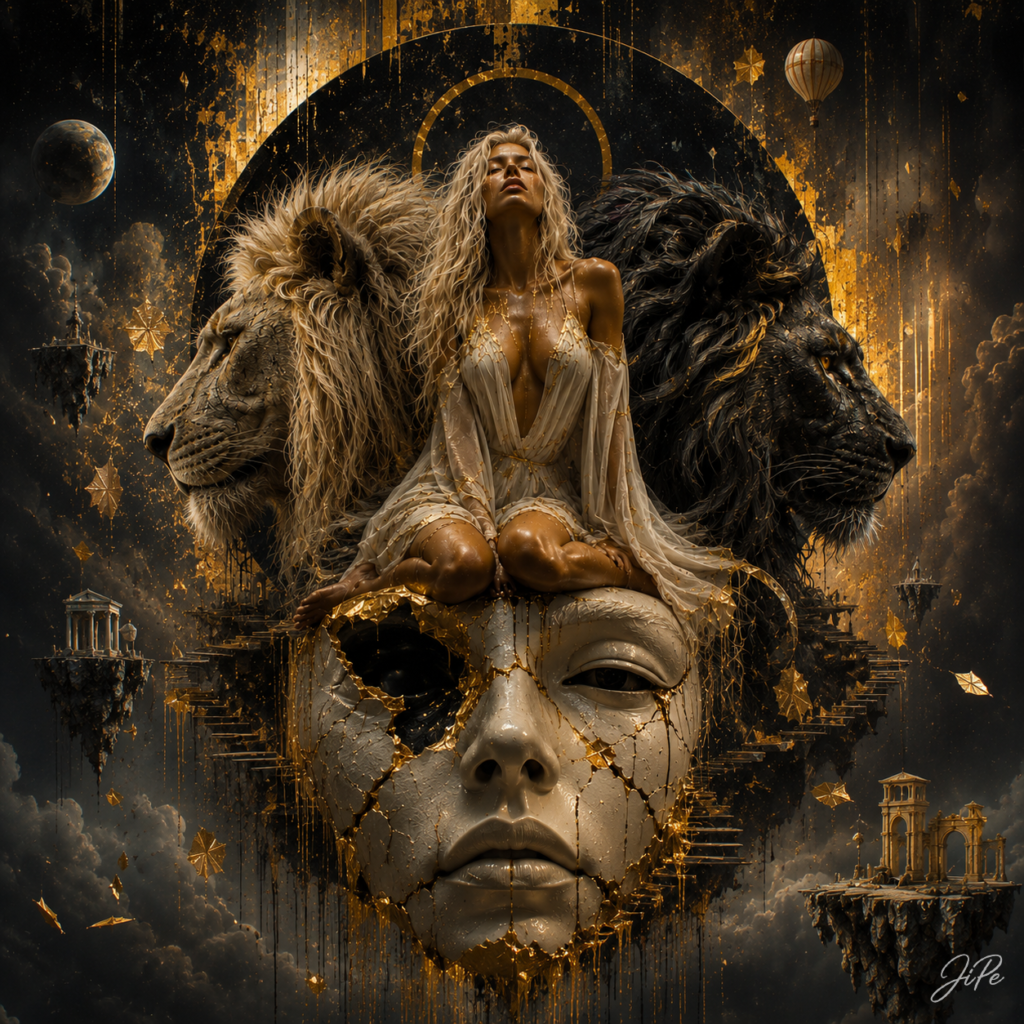
At the heart of the composition sits a solitary female figure, enthroned upon a monumental fractured mask. Her posture is one of quiet authority rather than domination. With her head gently lifted and her eyes closed, she appears suspended in a moment of profound contemplation, existing beyond the distractions of the material world. She neither addresses the viewer nor withdraws entirely from them; instead, she inhabits an interior space of awakening where silence itself becomes an expression of strength. The figure functions as an archetype rather than an individual portrait, embodying the universal human search for identity, wisdom, and spiritual integration.
The throne upon which she rests is unlike any conventional seat of power. It is formed from an immense sculpted face, fractured by deep fissures that have been restored with luminous veins of gold. This striking visual language immediately recalls the philosophy of kintsugi, the Japanese practice of repairing broken ceramics with precious metals, transforming damage into beauty rather than concealing it. Within the symbolic context of the artwork, these golden fractures become metaphors for human experience itself. Memory, suffering, failure, healing, and renewal are not erased but incorporated into the architecture of identity. The throne therefore represents a consciousness shaped by life’s fractures yet illuminated through transformation.
The mask beneath the central figure introduces a rich psychological dimension. Masks have long symbolized identity, illusion, concealment, and revelation across numerous artistic and philosophical traditions. Here, the partially damaged visage suggests the many roles and identities through which humanity moves during life. The figure seated above it implies transcendence over these temporary masks without rejecting them entirely. The artwork proposes that authentic identity emerges not by denying one’s fragmented past but by integrating it into a greater spiritual understanding.
Flanking the central figure are two majestic lions whose contrasting appearances establish one of the composition’s most compelling symbolic dialogues. The lion on the left, radiant and pale, conveys serenity, nobility, and illumination. Opposite it, the darker lion embodies mystery, strength, and the hidden dimensions of existence. Together they evoke the ancient motif of complementary opposites: light and shadow, consciousness and instinct, mercy and justice, day and night. Rather than opposing one another, they exist in harmonious equilibrium, suggesting that genuine wisdom arises through balance rather than exclusion.
Throughout history, the lion has symbolized kingship, guardianship, courage, and spiritual authority. In this composition, the two lions serve as living sentinels positioned at the threshold between worlds. Their calm expressions emphasize disciplined strength rather than aggression. They neither threaten nor submit; instead, they guard the sacred space in which transformation occurs. Their symmetrical placement reinforces the impression that the central figure occupies a realm of profound equilibrium, protected by forces that represent both visible and invisible dimensions of reality.
Behind the enthroned figure unfolds a monumental circular form that dominates the upper composition. This immense dark disc, encircled by luminous golden rings, recalls the symbolic language of eclipses, halos, mandalas, and celestial gateways. It functions simultaneously as halo, cosmic portal, and metaphysical horizon. The circle has historically represented eternity, perfection, unity, and divine order across numerous artistic traditions. Here, its overwhelming scale transforms it into an architectural presence that frames the entire symbolic drama, suggesting that the throne exists at the intersection of finite existence and infinite reality.
Surrounding the principal figures are floating architectural fragments suspended within vast celestial space. Ancient staircases ascend toward invisible destinations, while ruined temples and classical colonnades drift upon isolated stone platforms among the clouds. These structures evoke humanity’s enduring aspiration toward transcendence through philosophy, religion, memory, and civilization. Their fragmentation suggests that no earthly institution alone can fully contain ultimate truth. Yet their continued presence affirms that every cultural and spiritual tradition contributes to humanity’s ongoing search for meaning.
The stairways deserve particular attention as recurring symbols throughout the composition. Their upward movement evokes pilgrimage, spiritual ascent, and the gradual process of self-transformation. Unlike monumental staircases that culminate in clearly visible destinations, these paths disappear into mystery, emphasizing that spiritual growth remains an open journey rather than a completed achievement. The artist thereby resists simplistic conclusions, inviting contemplation rather than certainty.
The celestial environment expands the symbolic vocabulary even further. Distant planets, floating stars, and suspended spheres establish an immense cosmological framework within which the central drama unfolds. These astronomical motifs are complemented by delicate geometric lines that recall sacred diagrams and Renaissance studies of celestial harmony. The universe is presented not as empty space but as an ordered, living structure animated by invisible relationships. The composition therefore suggests that personal transformation participates in a greater cosmic order extending beyond individual existence.
Light functions as the primary narrative force throughout the painting. Brilliant gold flows across surfaces like liquid illumination, binding together architecture, figures, and celestial space into a unified spiritual atmosphere. Historically associated with the sacred in Byzantine iconography and medieval religious painting, gold here transcends its decorative function to become the visible language of transcendence itself. It illuminates broken surfaces, outlines architectural forms, and dissolves the boundaries between material and immaterial reality. Darkness remains present throughout the composition, yet it never signifies absence. Instead, shadow provides the depth through which light acquires its greatest expressive power.
The carefully orchestrated palette of gold, ivory, charcoal, and muted earth tones reinforces the painting’s symbolic equilibrium. Gold signifies enlightenment, divine presence, and transformation, while the darker tones evoke mystery, memory, and the unconscious dimensions of experience. Rather than existing in conflict, these colors coexist within a harmonious visual rhythm that reflects the artwork’s central meditation on integration rather than division.
Stylistically, The Throne Between Worlds occupies a remarkable intersection between Symbolism, Surrealism, classical portraiture, visionary fantasy, and contemporary digital art. The sculptural realism of the figures recalls Renaissance ideals of proportion and anatomical precision, while the dreamlike architecture and impossible spatial relationships evoke the metaphysical landscapes of Symbolist painters and twentieth-century Surrealism. At the same time, the luminous textures, cinematic atmosphere, and intricate digital detailing firmly situate the work within the evolving language of contemporary visionary art.
From an art historical perspective, the painting participates in a long tradition of allegorical imagery in which architectural forms, animals, and human figures become vehicles for philosophical and spiritual reflection. Echoes of ancient mythological guardians, Renaissance personifications of the virtues, and Romantic explorations of the sublime coexist within a thoroughly contemporary visual vocabulary. Rather than quoting historical models directly, the artist synthesizes these traditions into a unified symbolic language capable of addressing modern questions of identity, consciousness, and transcendence.
The composition is meticulously balanced around a powerful vertical axis established by the enthroned figure, the fractured mask, and the celestial circle above. Horizontal symmetry provided by the opposing lions creates a sense of stability, while the surrounding floating architecture introduces dynamic movement throughout the image. Every compositional decision contributes to the impression that the central figure occupies a sacred threshold—a place where inner transformation and cosmic order converge.
Emotionally, The Throne Between Worlds evokes both introspection and awe. Its monumental scale inspires reverence, while its symbolic intimacy invites deeply personal reflection. The viewer is encouraged not merely to observe the scene but to contemplate its implications: What identities do we wear throughout life? How are our deepest wounds transformed into sources of wisdom? What lies beyond the boundaries separating the visible world from the unseen dimensions of existence? These questions remain intentionally open, allowing the artwork to function as a contemplative space rather than a didactic statement.
Ultimately, The Throne Between Worlds is a profound meditation on the human condition and the possibility of spiritual integration. It presents transformation not as escape from brokenness but as its luminous transfiguration. Through its masterful synthesis of symbolic portraiture, architectural imagination, celestial cosmology, and expressive contemporary aesthetics, the artwork affirms that true sovereignty is not measured by external power, but by the capacity to reconcile light and shadow, memory and hope, earth and eternity within the depths of the awakened soul. It stands as a compelling contribution to contemporary visionary art, inviting visitors, scholars, and contemplative viewers alike to reflect upon the timeless mystery of what it means to dwell between worlds while seeking the fullness of one’s authentic self.