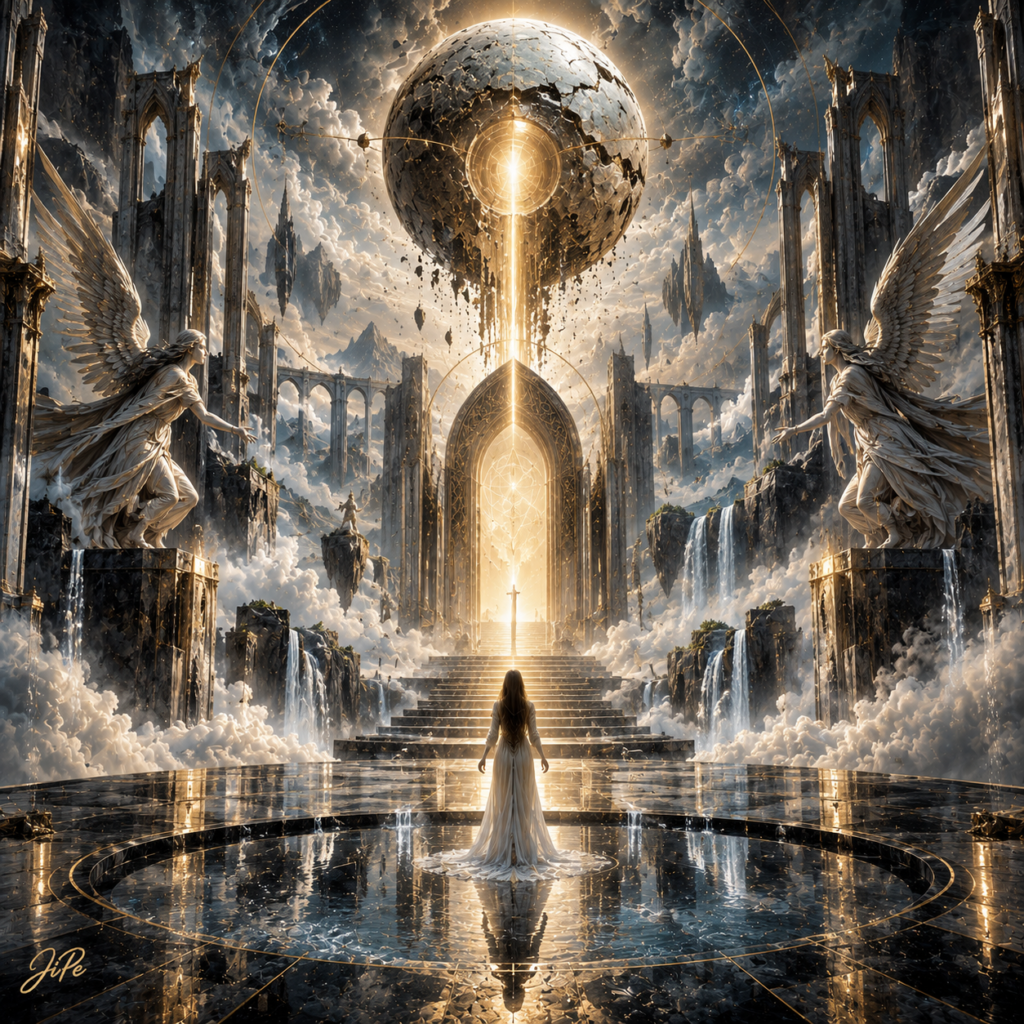
The Gate of the Celestial Realm unfolds around a profound imbalance of scale: a solitary presence stands before an order so vast that ordinary measures of distance and proportion begin to lose their meaning. Yet the figure is not diminished by this immensity. Her stillness becomes a counterweight to it, establishing a quiet tension between human consciousness and the incomprehensible.
Light gathers along a distant axis with an almost gravitational force. It seems to draw the surrounding world toward itself while remaining fundamentally inaccessible—a presence that can be approached but perhaps never possessed. The space between observer and threshold therefore becomes charged with hesitation, expectation, and the possibility of irreversible change.
Within The Gate of the Celestial Realm, passage is less a matter of movement than of readiness. The monumental order ahead suggests a reality governed by principles beyond ordinary perception, while the reflective foreground quietly doubles the scene, unsettling any certainty about where one realm ends and another begins.
The threshold remains open, but nothing guarantees entry. Perhaps the deepest mystery is whether the celestial realm lies beyond the gate at all—or whether the act of standing before the unknown has already placed us within it.