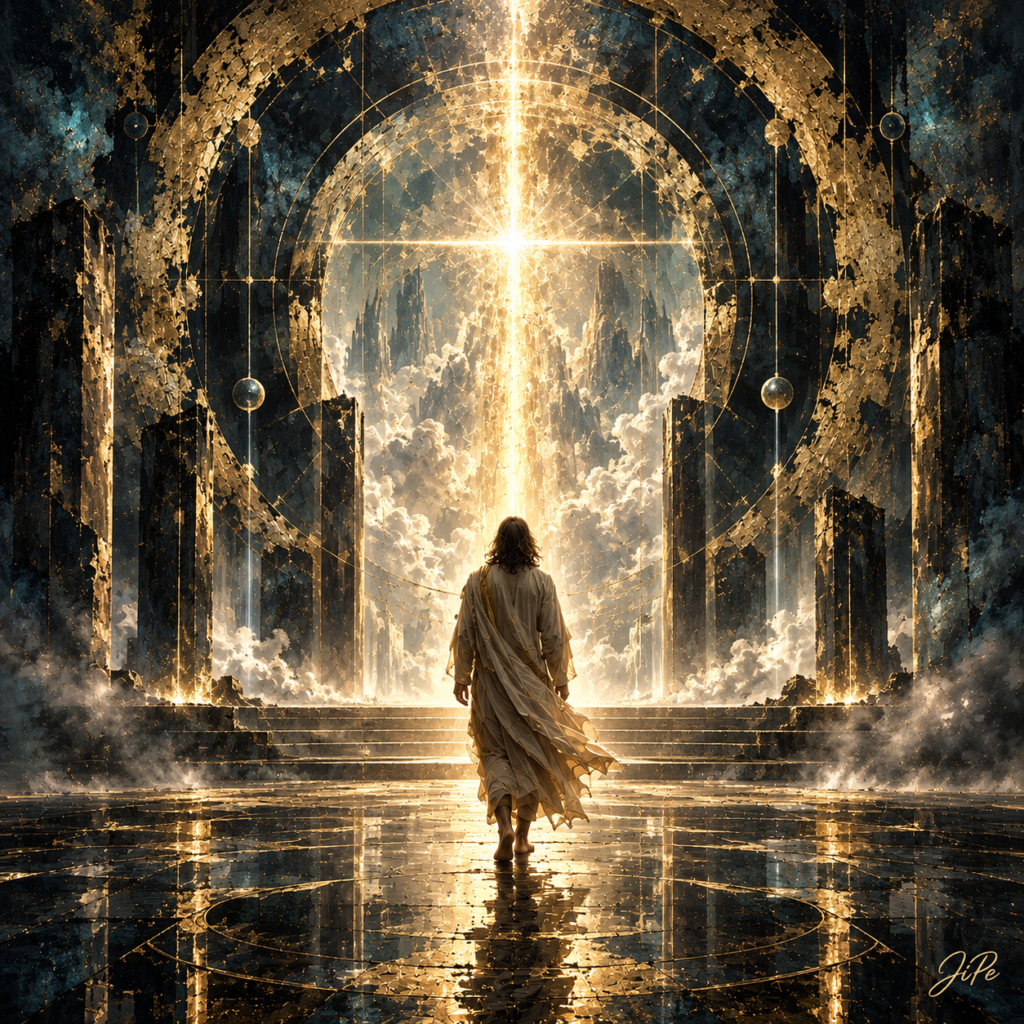
The Gate of Eternity holds a solitary presence before a threshold that seems to exist outside ordinary time. The surrounding immensity is ordered yet unstable, as though architecture, atmosphere, and distance belong to a reality whose laws can be sensed but not fully understood. Against this scale, the figure appears vulnerable, yet the quiet forward movement carries its own gravity.
Light descends with an almost physical force, occupying the boundary between the known and whatever lies beyond it. It offers neither simple comfort nor threat. Instead, it creates a tension between revelation and disappearance: to enter such radiance might mean discovery, transformation, or the dissolution of everything previously understood as self.
The title, The Gate of Eternity, introduces a paradox. Eternity suggests the absence of boundaries, yet here it is approached through one. The threshold becomes less a destination than a question about what must be relinquished when time, identity, and certainty no longer provide orientation.
The figure continues toward the light, but the work withholds the crossing. Perhaps eternity can only be imagined from this side of the gate—and perhaps the final distance is the one that can never be measured.