Monumental Contemporary Symbolism exploring humanity’s encounter with the eternal through light, sacred geometry, mythic architecture, fragmented forms and transcendent landscapes.

Monumental Contemporary Symbolism exploring humanity’s encounter with the eternal through light, sacred geometry, mythic architecture, fragmented forms and transcendent landscapes.

Religious Paintings

Beneath the Eternal Eclipse

Beneath the Eternal Eclipse

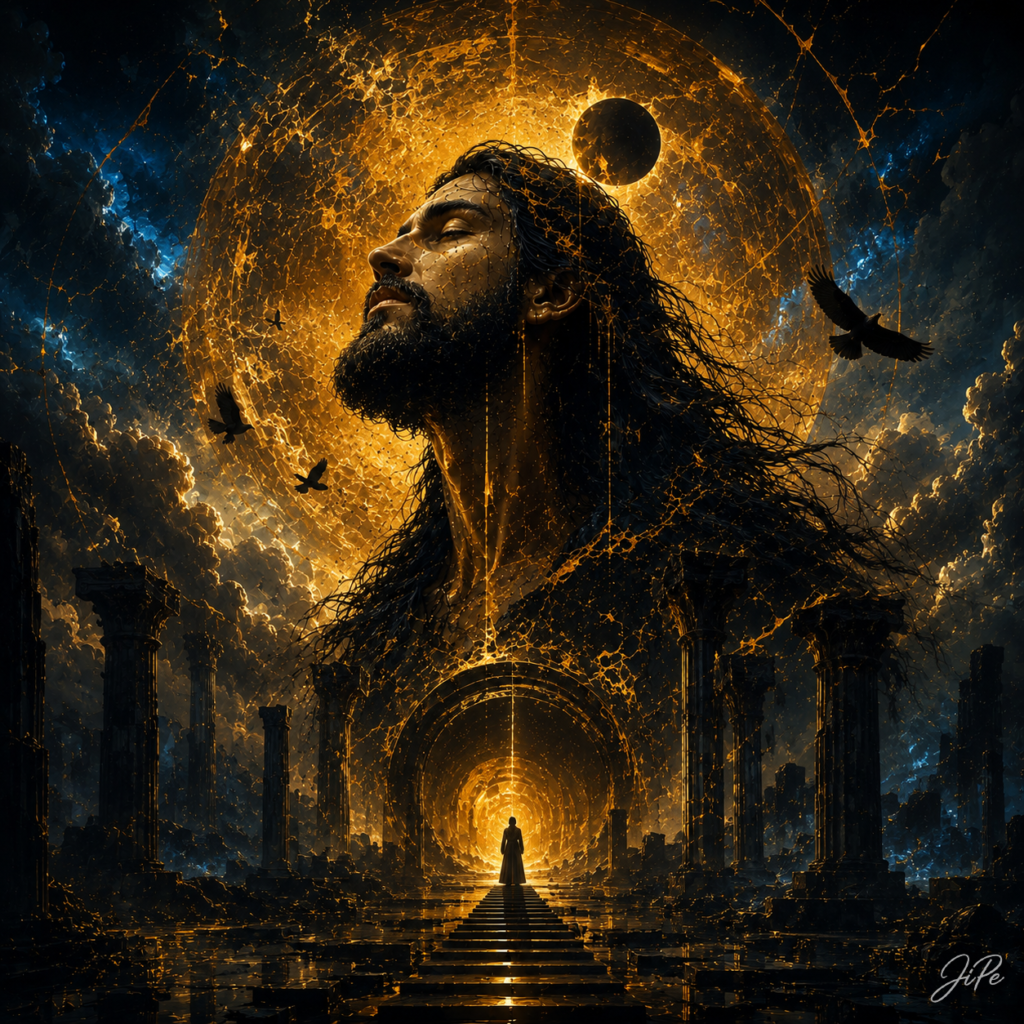
Beneath the Eternal Eclipse is a monumental meditation on transcendence, destiny, and the human encounter with forces that exist beyond the boundaries of ordinary understanding. The work brings together portraiture, cosmic symbolism, ruined architecture, sacred geometry, and dramatic illumination to construct a visionary world suspended somewhere between mythology, dream, and spiritual revelation. At its center rises an immense male figure, his head turned upward toward an eclipsed celestial body, while far below him a solitary human presence stands before a radiant portal. Between these two figures—and between darkness and light—the painting establishes its central mystery.

The title immediately places the viewer within a realm governed by contradiction. An eclipse is normally temporary: a brief alignment of celestial bodies in which light is obscured before eventually returning. By describing the eclipse as eternal, however, the work transforms a passing astronomical event into a metaphysical condition. This is not simply a moment when darkness covers light. It is a world permanently suspended at the threshold between concealment and revelation.

Yet the painting is far from dark in a purely negative sense.

Light is everywhere.

It radiates behind the monumental figure, pours through fractured surfaces, outlines ruined columns, illuminates clouds, and concentrates into the extraordinary portal at the base of the composition. Darkness and illumination are therefore not presented as simple opposites. They coexist, depend upon one another, and together create the visual and philosophical structure of the work.

The eclipse becomes a symbol not of the disappearance of light, but of light partially hidden.

This distinction is fundamental.

At the center of the composition, the colossal male figure appears to emerge from the darkness like an ancient deity, prophet, guardian, or forgotten king. His scale is deliberately impossible. He does not belong to the same physical world as the architecture beneath him; rather, he towers above it as though his body were part of the landscape itself.

His upward gaze gives the figure a profound sense of longing.

He does not look toward the viewer. Nor does he look downward toward the solitary traveler standing beneath him. Instead, his attention is directed toward the black celestial sphere suspended above his head. His expression suggests contemplation rather than fear. There is dignity in his posture, but also vulnerability. Despite his monumental scale, he too appears to be searching for something.

This creates one of the painting’s most compelling paradoxes: the giant and the solitary human figure may be engaged in the same search.

One looks upward toward the eclipse.

The other looks forward toward the portal.

Their scales are radically different, but their gestures are spiritually related.

Both stand before the unknown.

The monumental figure is covered with an intricate network of glowing golden fractures. These fissures spread across his face, neck, hair, garments, and surrounding atmosphere until the distinction between body and universe begins to disappear. He appears simultaneously human and geological—as though carved from some ancient material that has survived unimaginable periods of time.

The cracks evoke weathered stone, broken sculpture, aged fresco, dry earth, and the Japanese aesthetic principle associated with repairing fracture through precious material. Yet here the golden lines do not simply repair a damaged surface. They appear to reveal an internal radiance.

The figure is illuminated through his wounds.

This gives the fragmentation a symbolic meaning beyond destruction. The cracks become pathways through which hidden light becomes visible. Brokenness is transformed into revelation. What appears damaged on the surface may contain something luminous beneath it.

Throughout Beneath the Eternal Eclipse, this idea becomes a recurring visual principle: light emerges from fracture.

The enormous golden circular structure behind the figure strengthens his symbolic importance. It resembles at once a halo, celestial mechanism, astronomical map, sacred disc, and portal. Its scale is so great that only portions of its circumference can be fully understood, suggesting that the visible structure belongs to something larger than the limits of the canvas.

The circle carries deep historical associations. Across cultures and artistic traditions, it has symbolized eternity, wholeness, cosmic order, divine perfection, and the endless recurrence of natural cycles. Within this painting, however, that apparent perfection is fractured. Golden fissures spread across its surface, disrupting the ideal geometry.

Order has been broken.

Yet it remains luminous.

This tension between perfect form and fractured surface lies at the heart of the work.

Above the figure appears the eclipse itself: a dark sphere surrounded by a brilliant corona of golden light. It is visually small compared with the colossal portrait, yet conceptually it dominates the entire image. The black disc interrupts the radiant field behind it, creating a concentrated symbol of absence.

But the eclipse cannot extinguish the light.

Instead, by obscuring its center, it makes the surrounding radiance even more visible.

This creates a powerful metaphor. Some forms of illumination become perceptible only through darkness. Certain truths may reveal themselves most clearly when what was previously visible disappears.

The eclipse therefore represents not merely loss, but transformation of perception.

Around the central figure, deep blue cosmic clouds emerge from the surrounding darkness. Their cool tones provide a dramatic counterpoint to the dominant gold and black. The color relationship creates an elemental tension: gold suggests fire, illumination, divinity, and transcendence, while blue evokes infinity, distance, night, and the unknowable depths of the cosmos.

The monumental figure stands precisely between these forces.

His body becomes a meeting place between darkness and illumination.

Below him, the composition shifts dramatically in scale.

Ancient columns rise from a ruined landscape, forming the remains of what might once have been a temple, ceremonial avenue, forgotten city, or sacred sanctuary. Their architectural language evokes classical antiquity without identifying a specific historical civilization. This ambiguity is deliberate. The ruins function less as archaeological documentation than as symbols of human civilization itself.

Empires rise.

Temples are built.

Beliefs are institutionalized.

Monuments are created in the hope of permanence.

Eventually, they fall.

The ruins therefore introduce the dimension of historical time into a composition otherwise dominated by cosmic eternity.

This contrast is crucial. The eclipse belongs to celestial time. The colossal figure seems to belong to mythic time. The ruins belong to historical time. And the solitary traveler belongs to individual human time.

All four temporal dimensions coexist within the same image.

At the very bottom of the composition, a staircase emerges from the darkness and leads directly toward a radiant circular portal. Standing before it is a lone figure.

This tiny presence is perhaps the emotional center of the entire work.

Compared with the monumental head above, the traveler appears almost insignificant. Yet compositionally, the figure occupies the exact central axis of the painting. The staircase, portal, giant, halo, and eclipse all align around this single human presence.

Smallness therefore does not mean irrelevance.

On the contrary, the scale difference intensifies the existential dimension of the scene. The traveler stands before forces incomparably larger than the self—history, mythology, time, the cosmos, perhaps even eternity—yet continues forward.

The staircase transforms this encounter into a journey.

It begins in darkness and leads toward light.

This movement might initially suggest a straightforward symbolic passage from ignorance toward knowledge or mortality toward transcendence. Yet the painting resists such a simple interpretation because the radiant portal itself remains unknown.

We do not know what lies beyond it.

The light promises revelation, but revelation has not yet occurred.

The traveler stands immediately before the threshold.

Like the eclipse above, the portal is therefore an image of suspended knowledge.

Something exists beyond.

But it remains concealed.

The repetition of circular forms creates a visual relationship between the eclipse and the portal. One is a dark circle surrounded by light; the other is a luminous circle surrounded by darkness.

They function almost as inversions of one another.

Above: darkness within light.

Below: light within darkness.

Between them stands the monumental figure.

This vertical relationship creates the philosophical architecture of the painting. The eclipse and portal become opposite expressions of the same mystery: one conceals illumination while the other appears to offer access to it.

The giant looks toward the first.

The traveler approaches the second.

Perhaps they are ultimately looking toward the same thing.

The birds moving through the composition introduce another symbolic dimension. Their silhouettes are fragile against the colossal scale of the surrounding environment, yet they move freely through the space. Traditionally associated with freedom, spirit, transcendence, migration, and passage between realms, they suggest movement where the monumental figure and architecture remain fixed.

They may also serve as messengers between levels of existence.

Unlike the human traveler, the birds require no staircase.

Unlike the giant, they do not remain bound beneath the eclipse.

They simply cross the threshold between darkness and light.

From an art-historical perspective, Beneath the Eternal Eclipse draws upon several traditions while synthesizing them into a distinctly contemporary visionary language. The monumental figure recalls the heroic and divine scale of ancient sculpture, while the ruined columns evoke classical civilizations and the Romantic fascination with archaeological remains.

The dramatic landscape and overwhelming difference in scale between the human figure and the surrounding world connect the work strongly to the tradition of the sublime.

In eighteenth- and nineteenth-century aesthetics, the sublime described experiences so vast, powerful, or overwhelming that they exceeded ordinary comprehension. Mountains, storms, oceans, ruins, and infinite skies became visual metaphors for humanity’s confrontation with forces beyond its control.

Here, that tradition is expanded into a cosmic and psychological realm.

The viewer confronts not merely the sublime power of nature, but the sublime mystery of existence itself.

There are also clear affinities with Symbolism and visionary art. Rather than depicting a literal event, the painting constructs an imagined reality through archetypal forms: the eclipse, the giant, the portal, the staircase, the ruins, the birds, the circle, and the solitary traveler.

Each element is recognizable.

None has a single fixed meaning.

This openness is essential to the work.

The monumental man may be interpreted as a forgotten god, ancestral consciousness, guardian of the threshold, embodiment of humanity, or even the traveler’s own transcendent self. The portal may signify death, rebirth, enlightenment, memory, another dimension, or the passage from one state of consciousness into another.

The eclipse may represent uncertainty, loss, divine concealment, transformation, or the necessary darkness preceding revelation.

The painting does not demand that one interpretation replace the others.

Instead, meaning accumulates through their coexistence.

The strong chiaroscuro contributes significantly to this ambiguity. Much of the lower architecture remains almost consumed by darkness, while golden light selectively reveals edges, fractures, and surfaces. The viewer never sees the entire world clearly.

This controlled concealment creates a sense that the painting extends beyond what has been revealed.

There are structures in darkness.

There are forms behind clouds.

There are worlds beyond the portal.

There is light behind the eclipse.

The unseen becomes as important as the visible.

In this sense, Beneath the Eternal Eclipse is fundamentally concerned with the limits of perception.

Human beings naturally seek clarity. We construct religions, philosophies, sciences, myths, and works of art in an attempt to understand our place within existence. Yet certain questions remain unresolved: Where do we come from? What lies beyond consciousness? What survives time? Is there meaning beyond what can be measured? What waits beyond the final threshold?

The painting does not attempt to answer these questions.

Instead, it gives visual form to the experience of standing before them.

The traveler represents that human condition with extraordinary simplicity.

He or she has reached the end of the visible path.

The portal waits.

Above, the colossal figure continues looking toward the eclipse.

Neither has received an answer.

And perhaps this is the deepest connection between them.

Scale, power, age, and knowledge may differ, yet mystery remains.

Even the giant stands beneath something greater than himself.

This makes the title particularly significant.

It is not The Eternal Eclipse.

It is Beneath the Eternal Eclipse.

The word “beneath” establishes a condition of existence. Everyone within this world—the traveler, the ruins, the birds, and even the monumental figure—exists under the same celestial mystery.

No one stands outside it.

The eclipse becomes a metaphor for the permanent incompleteness of knowledge.

Something is always hidden.

Something remains beyond sight.

Yet this is not presented pessimistically.

The extraordinary amount of gold throughout the composition suggests that mystery itself can be luminous. The unknown need not be empty. Darkness can surround revelation without destroying it.

Indeed, the work repeatedly suggests that darkness may be necessary for illumination to become visible.

The golden fractures provide the clearest expression of this idea. They spread across the entire composition like a hidden network connecting body, architecture, atmosphere, and cosmos. What initially appears to be damage gradually begins to resemble a universal structure.

The same golden energy exists everywhere.

In the giant.

In the sky.

In the ruins.

In the portal.

In the eclipse.

This visual continuity suggests that the apparently separate elements of existence may belong to a deeper underlying unity.

The cracks are therefore not simply fractures.

They are connections.

Seen this way, the painting transforms from an image of a broken universe into an image of a universe connected through its brokenness.

This distinction profoundly changes its emotional meaning.

At first glance, Beneath the Eternal Eclipse may appear apocalyptic: ruined architecture, cosmic darkness, fractured surfaces, an eclipsed sun, and an immense mysterious figure dominate the scene. Yet sustained viewing reveals something more contemplative.

The world has been damaged, but not extinguished.

The temple has fallen, but the path remains.

The sun is hidden, but its corona burns.

The giant is fractured, but golden light moves through him.

The traveler is small, but continues forward.

And the portal remains open.

Ultimately, Beneath the Eternal Eclipse is a meditation on the human desire to approach what cannot be fully known. It transforms that desire into a monumental symbolic landscape in which personal, historical, mythological, and cosmic dimensions converge.

Its central drama is not destruction.

It is the search for meaning within uncertainty.

The traveler moves toward the light without knowing what lies beyond it. The colossal figure looks toward the eclipse without knowing what remains concealed behind its darkness. Their gestures mirror one another across radically different scales.

Both seek.

Both wait.

Both exist beneath the same mystery.

And this may be the work’s most enduring proposition: that transcendence is not necessarily found when darkness disappears, but in the decision to continue toward the unknown while darkness remains.

The eclipse may be eternal.

The ruins may never be restored.

The destination may never be fully understood.

Yet light continues to emerge through every fracture.

At the end of the ancient path, a solitary figure stands before the luminous threshold, while above him an immense face turns toward a hidden sun. Between them stretches the entire architecture of human longing—the desire to understand what lies beyond the visible world.

In Beneath the Eternal Eclipse, darkness does not represent the end of light. It reveals the place where light becomes most necessary—and where the journey toward it begins.

Lämna ett svar