Monumental Visionary Fine Art exploring mythology, consciousness, sacred light, and timeless visual storytelling.

Monumental Visionary Fine Art exploring mythology, consciousness, sacred light, and timeless visual storytelling.

Religious Paintings

When Heaven Was Wounded

When Heaven Was Wounded

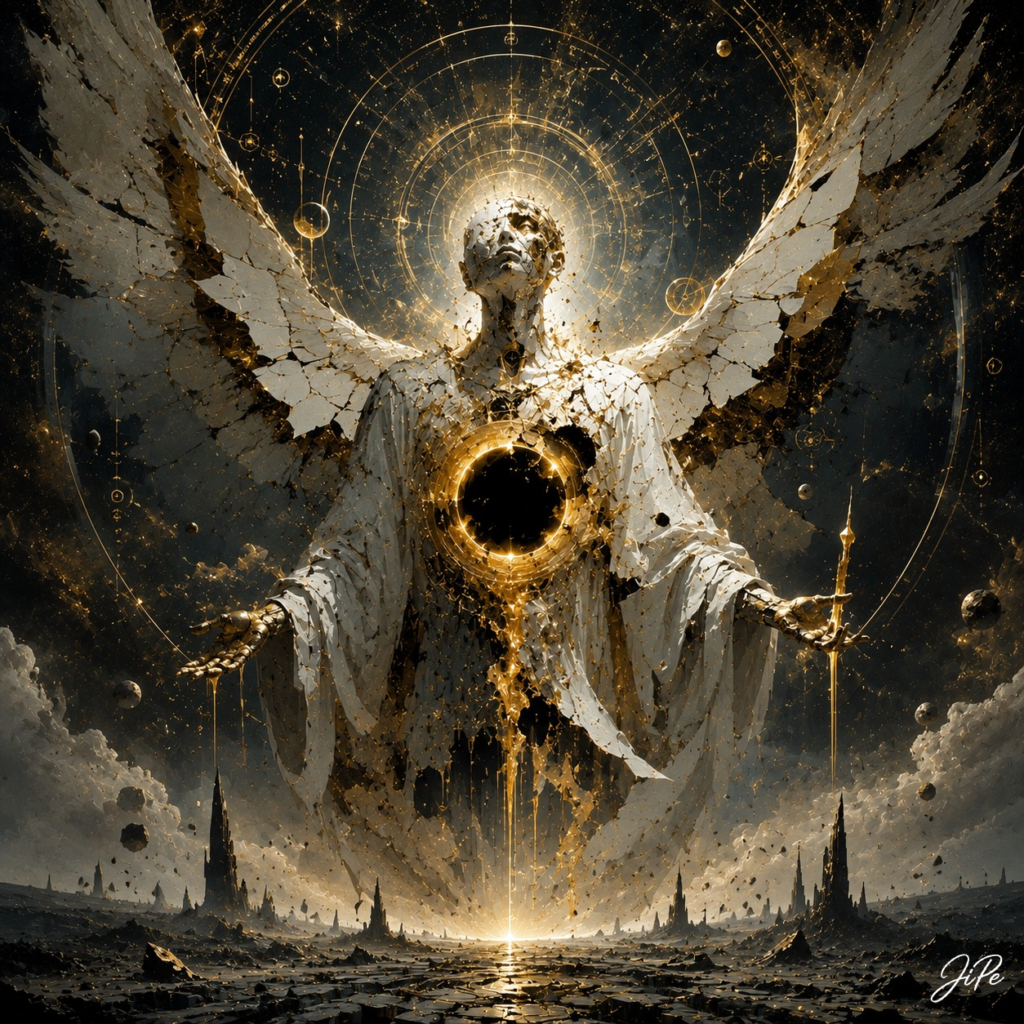
When Heaven Was Wounded is a monumental meditation on divine sacrifice, cosmic fracture, and the paradoxical relationship between loss and transcendence. Combining visionary symbolism, sacred iconography, and contemporary mixed-media aesthetics, the painting transcends traditional religious imagery to explore a universal question: What happens when even the eternal bears the marks of suffering? Rather than illustrating a specific theological event, the work imagines an archetypal moment in which heaven itself becomes vulnerable, revealing that creation, redemption, and transformation are born not despite brokenness, but through it.

At the center of the composition stands a radiant celestial figure suspended between the infinite heavens and a barren earthly landscape. Vast wings extend across the canvas with monumental authority, framing the figure as both guardian and witness. Yet this is not an angel portrayed in triumph alone. Its body is visibly fractured, its luminous surface broken by countless fissures through which golden light emerges. The figure appears simultaneously ancient and newly formed, eternal yet marked by experience, embodying the profound paradox that true divinity is not untouched by suffering but transformed through it.

The title immediately establishes the philosophical and emotional foundation of the work. When Heaven Was Wounded evokes an event beyond ordinary history—a symbolic rupture within the fabric of eternity itself. It invites viewers to imagine a universe in which even the highest realms are capable of sacrifice. In doing so, the painting shifts the concept of suffering away from punishment or defeat and toward compassion, suggesting that the deepest forms of love require vulnerability, and that every act of redemption leaves its own sacred mark.

Perhaps the most striking feature of the composition is the immense void positioned within the figure’s chest. This dark circular opening immediately commands attention, functioning as both absence and presence. It resembles a celestial eclipse, a black sun, a cosmic portal, or the heart of creation itself. Rather than representing emptiness alone, the void becomes a source of paradoxical illumination. Golden light flows from its fractured edges, transforming darkness into the birthplace of radiance.

This symbolic heart can be interpreted in numerous ways. It may represent divine grief, the mystery of sacrifice, the unknowable center of existence, or the infinite space from which both creation and compassion emerge. Its ambiguity is one of the painting’s greatest strengths, allowing the image to resonate across theological, philosophical, and psychological traditions. The void does not diminish the figure—it defines it. The wound becomes the very source of illumination.

Radiating behind the angelic presence, intricate concentric circles establish a magnificent framework of sacred geometry. These celestial diagrams recall medieval cosmological maps, astronomical instruments, and ancient mandalas, suggesting that the universe itself operates according to an invisible harmony. Their extraordinary precision contrasts with the expressive fractures of the figure, creating a visual dialogue between perfect cosmic order and the unpredictable reality of lived experience.

The vertical axis of light descending through the composition serves as the spiritual spine of the painting. Beginning within the luminous halo surrounding the figure’s head, it passes through the wounded heart before continuing toward the distant horizon, where it touches the earth like a divine seed. This uninterrupted connection between heaven and the material world suggests that transcendence is never separate from earthly existence. The light becomes both descent and ascent—a continuous exchange between the eternal and the human.

The expansive wings reinforce the painting’s meditation on duality. Though both are luminous, subtle tonal variations reveal delicate contrasts between purity and weathering, perfection and fracture. Their immense scale suggests protection, while their cracked surfaces reveal that even guardians carry the memory of conflict. These wings are not symbols of escape but of endurance. They remind us that true strength is measured not by invulnerability but by the capacity to continue embracing the world despite its wounds.

The artist’s treatment of texture is central to the emotional power of the work. Heavy layered surfaces, fractured plaster, visible brushwork, and intricate gold-leaf effects create a richly tactile environment that recalls weathered icons, ancient frescoes, and archaeological relics. Time itself appears embedded within every crack. Rather than concealing damage, the painting elevates it, embracing the philosophy of kintsugi, where fractures become sites of beauty, resilience, and renewed meaning.

Gold functions throughout the composition as more than color. It is a visual manifestation of divine presence. Flowing through broken surfaces, dripping from the wounded heart, illuminating celestial diagrams, and outlining sacred architecture, the gold suggests that grace does not erase suffering—it transforms it. Every fracture becomes illuminated from within, emphasizing that healing is not the restoration of untouched perfection but the revelation of deeper beauty.

The barren landscape stretching beneath the celestial figure amplifies the painting’s monumental scale. Jagged formations rise from an endless plain that appears simultaneously earthly and otherworldly. This desolate environment evokes the silence that often accompanies profound transformation. Humanity itself is absent, yet its presence is deeply implied. The emptiness becomes psychological rather than geographical—a space of reflection where viewers may project their own experiences of loss, faith, and renewal.

Despite its immense grandeur, the composition remains remarkably still. Nothing appears hurried or dramatic in a conventional sense. The angel neither descends violently nor ascends triumphantly. Instead, it hovers within an eternal moment suspended beyond measurable time. This stillness creates extraordinary emotional tension, encouraging prolonged contemplation rather than immediate interpretation.

From an art historical perspective, When Heaven Was Wounded establishes dialogue with Byzantine iconography, Renaissance religious painting, Symbolism, Surrealism, and contemporary visionary art. The frontal symmetry recalls sacred devotional imagery, while the fractured textures and expressive painterly surfaces firmly situate the work within the language of contemporary mixed-media painting. The integration of sacred geometry further bridges historical spiritual traditions with modern abstract aesthetics, creating a visual language that feels both ancient and timeless.

The work also resonates deeply with archetypal psychology. Within a Jungian framework, the wounded celestial figure embodies the archetype of the Divine Self transformed through sacrifice. The wound represents the necessary rupture through which consciousness expands, while the radiant gold symbolizes individuation—the emergence of wholeness through the integration of suffering. Rather than portraying perfection as flawless, the painting suggests that ultimate completeness includes every fracture that has ever shaped the soul.

The celestial eclipse within the heart introduces another profound philosophical dimension. Across cultures, eclipses have long symbolized transition, revelation, endings, and rebirth. Here, the eclipse becomes internal rather than astronomical. It is the hidden mystery at the center of existence—the place where darkness and light become inseparable. The painting suggests that the greatest revelations often emerge precisely where certainty disappears.

For contemporary audiences, When Heaven Was Wounded carries extraordinary relevance. In an age marked by uncertainty, fragmentation, and collective vulnerability, the painting offers a radically compassionate vision of resilience. It proposes that brokenness need not signify failure. Instead, wounds may become openings through which wisdom, empathy, and transformation enter the world. The celestial figure does not conceal its fractures; it radiates because of them.

Ultimately, When Heaven Was Wounded is far more than a sacred image. It is a visual theology of compassion, an exploration of cosmic vulnerability, and a profound meditation on the transformative power of grace. Through its monumental composition, luminous gold, sacred geometry, and richly textured surfaces, the work reminds us that heaven is not defined by the absence of suffering, but by its capacity to transform suffering into light. It leaves viewers with a timeless truth: that every wound illuminated by love becomes not a symbol of destruction, but a doorway through which eternity quietly enters the human heart.

Lämna ett svar