
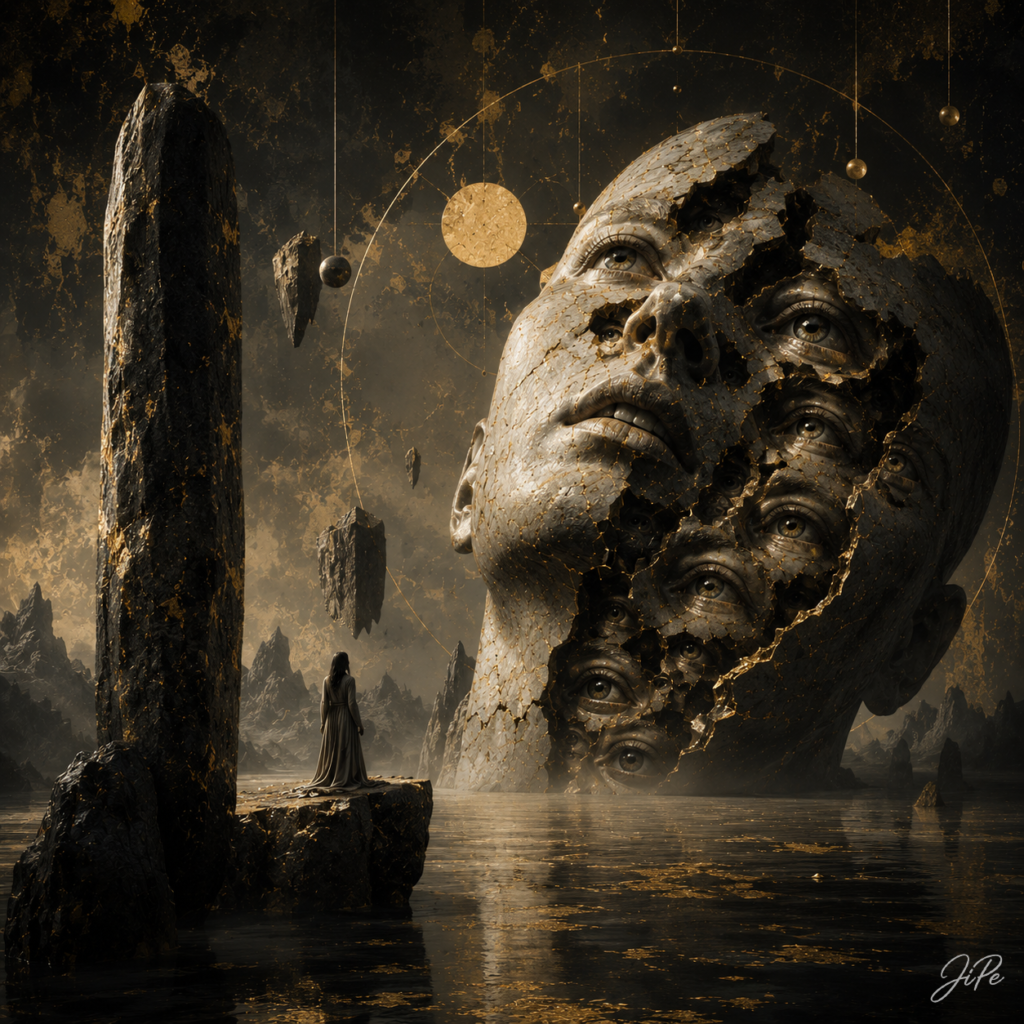
The Eyes of Eternity

The Eyes of Eternity is a profound meditation on consciousness, memory, and the infinite dimensions of perception. Standing at the intersection of surreal symbolism, monumental portraiture, and metaphysical philosophy, the work explores one of humanity’s oldest questions: What does eternity see that we cannot? Rather than offering an answer, JiPe constructs an image that invites contemplation, encouraging the viewer to experience the mystery rather than solve it. The painting becomes less a depiction of a place than an encounter with a state of awareness that exists beyond ordinary perception.
At first glance, the viewer is confronted by an immense fractured face emerging from a silent landscape of reflective waters and ancient monoliths. The monumental head appears both sculptural and alive, its weathered surface cracked by time yet illuminated from within. What transforms this portrait into something profoundly unsettling and beautiful, however, is the revelation concealed within its fractures. Behind the broken façade lies a multitude of watchful eyes, each gazing outward from the depths of the figure’s interior, suggesting that beneath every visible identity exists an immeasurably deeper consciousness.
The title, The Eyes of Eternity, immediately shifts the painting beyond the personal. These are not merely human eyes. They are symbols of perception that transcends individual experience, representing the countless perspectives accumulated across time itself. JiPe transforms the human face into a vessel through which eternity observes the unfolding of existence. The cracks do not reveal decay; they reveal hidden vision.
What appears broken…
is, in truth, awakening.
The central face possesses extraordinary emotional ambiguity. Its upward gaze conveys longing, hope, surrender, and contemplation simultaneously. The expression resists certainty, allowing each viewer to discover their own reflection within it. The closed tension of ordinary identity dissolves into openness, suggesting an individual standing on the threshold between finite existence and infinite awareness.
The fractures become the painting’s emotional architecture.
Every crack is a passage.
Every opening reveals another way of seeing.
Rather than portraying damage as loss, JiPe embraces the philosophy of transformation. The fractured surface recalls the aesthetics of kintsugi, where brokenness is not hidden but honoured as an essential part of an object’s history. Here, however, the golden fissures do more than repair—they illuminate. The wounds become gateways through which deeper perception emerges.
Only what has been broken…
can reveal what was always hidden inside.
The multitude of eyes embedded within the face introduces one of the work’s most compelling symbolic dimensions. Throughout mythology, religion, and philosophy, the eye has represented wisdom, vigilance, divine awareness, and inner awakening. By multiplying this symbol across the fractured interior, JiPe expands perception beyond the limitations of singular identity.
One lifetime sees one story.
Eternity sees them all.
These eyes do not appear threatening. Instead, they carry a profound stillness. They suggest observation without judgement, awareness without possession. They belong neither entirely to the figure nor entirely to the viewer. Instead, they occupy a liminal space between self and universe, reminding us that consciousness may be infinitely more expansive than personal experience allows.
Compositionally, the painting achieves remarkable balance between monumentality and intimacy. The colossal portrait dominates the landscape, yet the solitary human figure standing upon the stone platform quietly anchors the emotional narrative. Tiny beside the immense face, the traveller embodies every viewer who has ever stood before mystery and recognised the limits of human understanding.
Scale becomes philosophy.
The smaller the observer…
the greater the revelation.
The standing figure never gestures, never flees, never speaks. Their stillness mirrors the silence of the landscape itself, transforming the encounter into something almost liturgical. This is not confrontation.
It is recognition.
The observer understands that they are not merely looking at eternity.
Eternity has always been looking back.
Surrounding the scene rise immense monolithic pillars that evoke prehistoric sanctuaries, sacred architecture, and forgotten civilizations. Their vertical presence establishes a visual dialogue between earth and sky, material and spiritual, mortality and transcendence. These ancient forms appear untouched by history, existing outside conventional time.
They are not monuments to power.
They are monuments to endurance.
Floating fragments of stone suspended throughout the atmosphere further dissolve the boundary between physical reality and metaphysical imagination. Gravity itself appears suspended, suggesting a universe governed not by ordinary laws but by symbolic truth. The landscape becomes a psychological realm in which consciousness shapes matter rather than the reverse.
The reflective water surrounding the figures deepens this symbolic complexity. Reflection has long represented self-examination, memory, and hidden identity within the history of art. Here, the still surface mirrors not merely objects but states of being. Water becomes the threshold between visible existence and invisible reality.
Above the monumental head, delicate circular geometries trace invisible cosmic relationships across the composition. These subtle references to sacred geometry reinforce the painting’s underlying philosophical structure. Circles have historically symbolised unity, eternity, perfection, and the cyclical nature of existence. Their presence quietly reminds us that beneath apparent fragmentation lies profound order.
Nothing is isolated.
Everything belongs.
Every fragment remembers the whole.
JiPe’s masterful use of light transforms the work into an experience of revelation. Warm gold emerges gently from within cracks, reflections, and celestial forms, creating the impression that illumination originates from consciousness itself rather than from any external source. Darkness is never presented as evil or threatening. Instead, it functions as fertile space from which understanding gradually emerges.
Light does not conquer shadow.
It gives shadow meaning.
This restrained palette of charcoal blacks, weathered stone, and luminous gold has become a defining characteristic of JiPe’s artistic language. The chromatic contrast evokes both ancient iconography and contemporary abstraction, allowing the work to exist simultaneously outside historical style while remaining deeply connected to artistic tradition.
Psychologically, The Eyes of Eternity resonates strongly with Jungian concepts of the collective unconscious. The hidden eyes may be understood as archetypal memory—countless generations, identities, dreams, and forgotten experiences existing beneath conscious awareness. The monumental face becomes less an individual than humanity itself, containing every life within a single symbolic form.
No one sees alone.
Every vision carries echoes of those who came before.
Art historically, the painting occupies an intriguing dialogue between Symbolism, Surrealism, Romanticism, and contemporary visionary realism. The monumental scale recalls the sublime ambitions of nineteenth-century Romantic painting, while the fractured psychological portrait reflects modern explorations of identity and consciousness. Yet JiPe ultimately creates a distinctly personal visual language in which classical sculpture, spiritual symbolism, cinematic composition, and painterly textures merge into a unified contemporary aesthetic.
The painting refuses narrative certainty. It does not explain who the figure is, where this place exists, or why the eyes have appeared. Instead, it preserves mystery as an essential artistic quality. In doing so, JiPe honours one of art’s highest purposes—not to provide answers, but to deepen the questions we carry.
For the viewer, the experience becomes unexpectedly intimate. Standing before the work, one gradually shifts from observing the monumental face to sensing the countless eyes concealed within it. The emotional direction reverses.
You begin by looking at the painting.
Eventually…
the painting seems to be looking at you.
This subtle psychological inversion transforms passive viewing into active participation. The observer becomes part of the artwork’s symbolic structure, entering the same dialogue between finite awareness and eternal perception that defines the composition itself.
Ultimately, The Eyes of Eternity is not about seeing more.
It is about seeing differently.
It suggests that beneath every identity lies another layer of consciousness, beneath every certainty another mystery, and beneath every lifetime an awareness untouched by time itself. The painting reminds us that eternity is not merely an endless duration but a way of perceiving—a vision unconfined by fear, chronology, or limitation.
Perhaps eternity has never been distant.
Perhaps it has always been watching through every fracture we tried so carefully to hide.
And perhaps the deepest truth of all…
is that the eyes of eternity have always been our own, patiently waiting for us to finally open them.
