Monumental Visionary Fine Art exploring mythology, consciousness, sacred light, and timeless visual storytelling.

Monumental Visionary Fine Art exploring mythology, consciousness, sacred light, and timeless visual storytelling.

Surreal Paintings

Shattered into Light

Shattered into Light

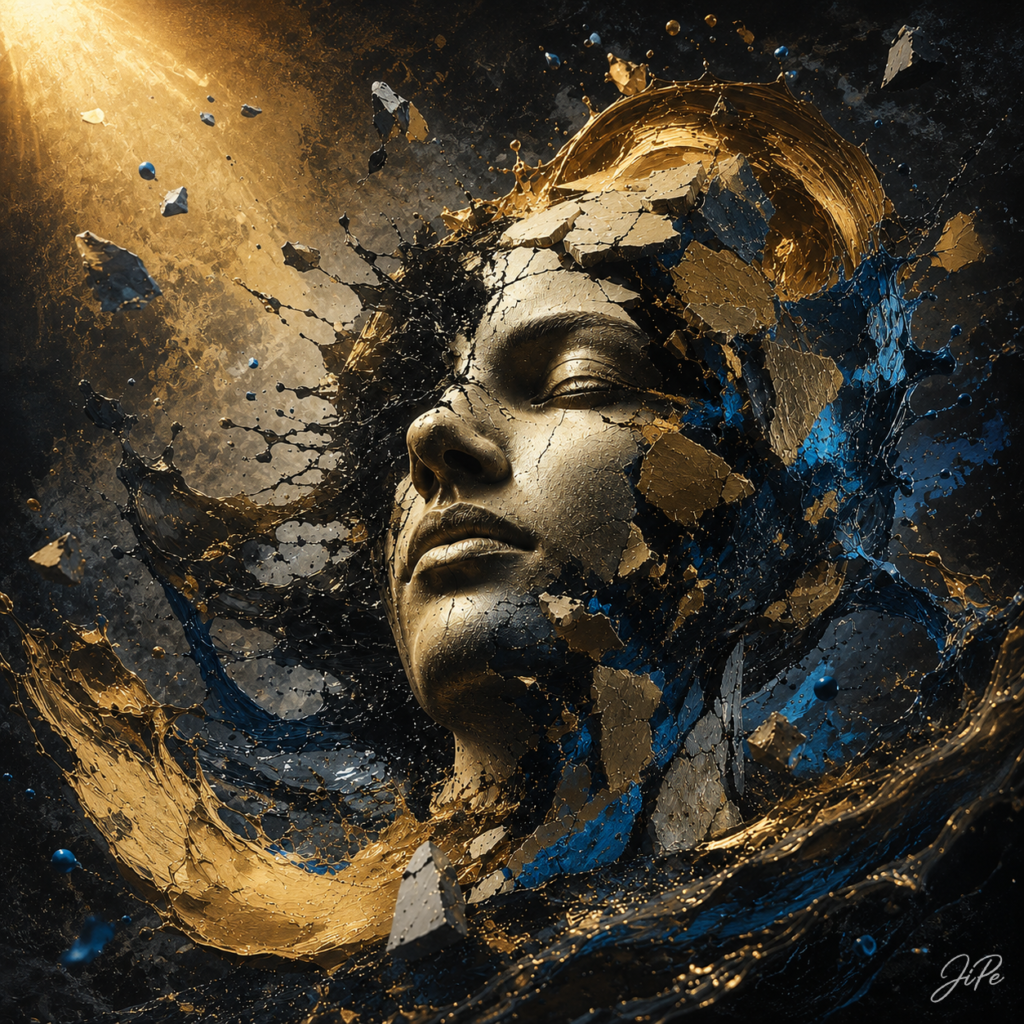
Shattered into Light is a profound meditation on transformation, resilience, and the paradox that true illumination often emerges only after fragmentation. Positioned between symbolic portraiture, contemporary visionary realism, and abstract expression, the work explores the moment when identity ceases to be defined by its apparent wholeness and instead discovers a deeper coherence through fracture. It is not a painting about destruction, but about revelation. Every crack, every suspended fragment, and every burst of radiant color becomes evidence that what appears broken may, in fact, be in the process of becoming complete.

Rather than illustrating a specific narrative, Shattered into Light inhabits the universal territory of inner transformation. It speaks to experiences shared across cultures and generations: loss, renewal, awakening, and the quiet recognition that every meaningful evolution requires the dissolution of an earlier self. The painting presents this process not as tragedy, but as an act of creation. Here, fragmentation is neither an ending nor a failure—it is the architecture through which light enters consciousness.

The composition is dominated by a monumental face emerging from a vortex of motion. The eyes remain gently closed, creating an immediate contrast between the surrounding turbulence and the profound serenity of the central figure. This deliberate stillness establishes the emotional foundation of the work. The figure neither resists nor controls the forces unfolding around it. Instead, it exists in complete surrender to transformation, suggesting that wisdom is often found not through resistance but through acceptance.

The closed eyes invite viewers to consider an inward rather than outward vision. While contemporary culture frequently associates perception with observation, this painting proposes another possibility: that the deepest forms of seeing occur when external distractions are silenced. The face becomes an icon of contemplation, suggesting that true enlightenment is born within the invisible landscape of the mind rather than the visible world.

Surrounding the portrait, the image dissolves into an extraordinary interplay of fractured stone, luminous gold, and vibrant ultramarine blue. Solid form appears to disintegrate into particles suspended between matter and energy. Large fragments drift weightlessly through space while painterly splashes create an impression of elemental movement, as though earth, water, air, and light have converged into a single transformative event.

These fragmented surfaces carry multiple symbolic meanings simultaneously. They evoke geological erosion, suggesting the slow passage of time. They resemble broken sculpture, recalling humanity’s ancient monuments and collective memory. They also resemble pieces of a mask falling away, revealing a more authentic self beneath constructed identity. The ambiguity of these forms allows viewers to discover their own interpretations while reinforcing the painting’s central meditation on change.

The dynamic relationship between gold and blue forms one of the work’s most compelling visual dialogues. Gold radiates warmth, transcendence, and spiritual illumination. It evokes both ancient sacred iconography and the timeless symbolism of inner awakening. Blue introduces a counterpoint of depth, mystery, intuition, and emotional vastness. Rather than opposing one another, these colors exist in continuous conversation. They represent complementary states of existence: consciousness and unconsciousness, fire and water, certainty and uncertainty, memory and possibility.

This chromatic balance transforms the composition into a visual representation of psychological integration. The painting does not celebrate one force over another. Instead, it suggests that wholeness emerges through the coexistence of opposing energies. The brightest moments arise precisely where gold and blue intersect, implying that transformation occurs not by eliminating contradiction but by embracing it.

One of the most striking aspects of Shattered into Light is its extraordinary treatment of materiality. Thick, sculptural textures create the illusion that the image has been carved, weathered, fractured, and reconstructed over centuries. The visible surfaces evoke plaster, stone, cracked earth, mineral deposits, and oxidized metals simultaneously. This layered tactile quality gives the work remarkable physical presence while reinforcing its symbolic exploration of endurance and renewal.

The expressive painterly gestures surrounding the portrait introduce an entirely different rhythm. Sweeping arcs of pigment move with explosive energy, dissolving rigid form into fluid motion. These sweeping movements create a sense of cosmic scale, suggesting that the transformation depicted is not merely personal but universal. The portrait becomes both an individual consciousness and a symbolic representation of humanity itself, suspended within larger cycles of creation and dissolution.

Light occupies a central philosophical role throughout the composition. Rather than functioning solely as illumination, it behaves as an active force capable of reshaping matter itself. A powerful golden radiance descends from the upper left corner, cascading across the fractured surfaces with extraordinary subtlety. This light does not simply reveal existing forms; it appears to generate them. The portrait emerges because of the light rather than despite it.

The title, Shattered into Light, therefore becomes essential to understanding the work. Conventionally, fragmentation is associated with darkness, loss, or absence. Here, however, the opposite occurs. The breaking apart of form allows luminosity to emerge. Every crack becomes a channel through which illumination flows. Every missing fragment creates new space for radiance. The painting suggests that vulnerability is not weakness but openness—that our fractures become the very places where transformation becomes possible.

From an art historical perspective, the work resonates with several traditions while maintaining a distinct contemporary identity. Its monumental portrait recalls the psychological intensity of Symbolism, where external appearances function as metaphors for inner realities. Its material experimentation echoes the tactile innovations of Abstract Expressionism and mixed-media painting. The luminous use of gold references centuries of sacred art, from Byzantine iconography to Japanese kintsugi philosophy, where repaired fractures become marks of beauty rather than imperfections.

The influence of contemporary visionary realism is equally evident. Realistic anatomy exists alongside abstract gesture, creating an image that occupies the threshold between representation and imagination. This deliberate ambiguity allows the painting to transcend literal narrative, operating instead as a symbolic experience that invites prolonged contemplation.

Despite its dramatic visual energy, the emotional atmosphere remains remarkably tranquil. This paradox forms one of the painting’s greatest strengths. The surrounding environment appears to explode outward while the central figure remains completely composed. This contrast transforms the portrait into a meditation on inner stability. External circumstances may fracture identity, relationships, certainty, or expectations, yet an essential core of being remains untouched. The painting quietly proposes that our deepest self exists beyond the events that seek to define it.

The absence of explicit narrative further enhances the work’s universality. No identifiable place, historical moment, or cultural reference limits interpretation. Instead, the composition unfolds within an archetypal psychological landscape where every viewer may recognize aspects of their own experience. Some may see grief transformed into acceptance. Others may perceive creative awakening, spiritual renewal, emotional healing, or the courage required to begin again. The painting deliberately leaves these possibilities open, allowing its symbolism to remain alive rather than fixed.

The circular forms embedded within the composition reinforce this timeless quality. Their subtle presence evokes celestial bodies, sacred geometry, cycles of existence, and eternal return. These recurring motifs suggest that transformation is never isolated but participates in larger rhythms governing both nature and consciousness. Nothing truly disappears; everything changes form.

Ultimately, Shattered into Light is an affirmation of humanity’s extraordinary capacity for renewal. It challenges deeply rooted assumptions that strength requires permanence or perfection. Instead, it celebrates adaptability, vulnerability, and the hidden beauty found within processes of change. The work reminds us that every life is shaped by moments when certainty dissolves, identities shift, and familiar structures fall away. Yet it is precisely within these moments that new possibilities emerge.

Standing before this painting, viewers are invited into a quiet dialogue with their own experiences of transformation. The fractured portrait becomes a mirror reflecting not physical appearance but emotional and spiritual evolution. It encourages contemplation rather than explanation, asking each observer to consider where light has entered their own life through unexpected fractures.

In the end, Shattered into Light is not simply a portrait of a figure suspended between matter and illumination. It is a visual meditation on the enduring resilience of the human spirit. It proposes that our greatest moments of awakening rarely arrive despite our brokenness—they arrive because of it. Every fragment becomes part of a greater whole, every wound becomes a passage toward wisdom, and every fracture becomes a place where light no longer remains outside us but begins to shine from within.

Lämna ett svar