
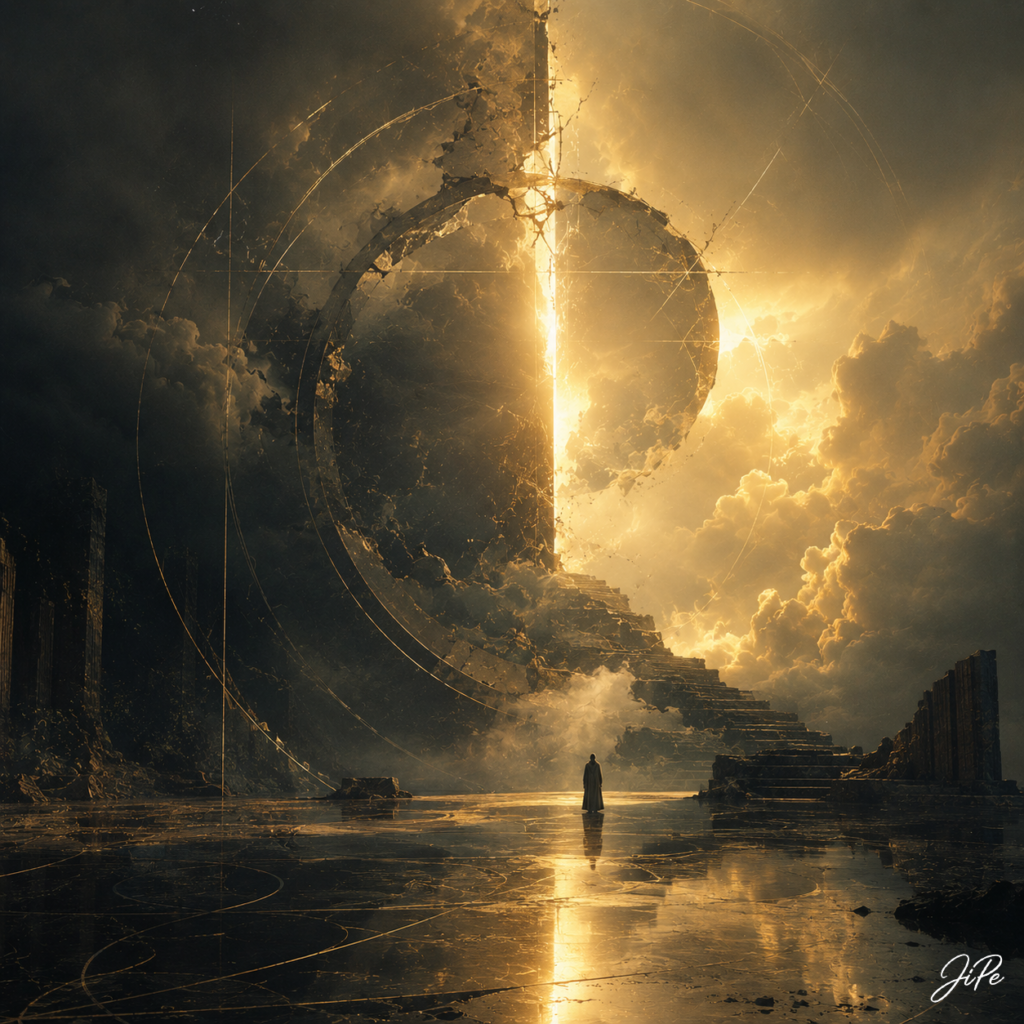
The Light Beyond All Worlds unfolds at the edge of comprehension, where darkness and radiance cease to behave as simple opposites. A solitary presence stands within an expanse whose scale overwhelms ordinary measures of distance and time. Yet the figure’s stillness resists insignificance. Against the immensity surrounding it, consciousness itself becomes a form of presence.
Light enters the work as both promise and disturbance. It breaks through an ordered darkness with such intensity that revelation begins to resemble rupture. The path toward it appears possible, but possibility is not the same as certainty. What lies ahead may be an opening, an ending, or merely the boundary beyond which familiar ways of understanding can no longer follow.
The title extends this uncertainty toward something almost metaphysical. The Light Beyond All Worlds suggests a radiance existing outside the structures by which reality is usually measured—a presence that may belong equally to transcendence, memory, longing, or the unknowable.
The figure remains before the threshold rather than beyond it. Perhaps that distance is essential. Some forms of light may illuminate only while they remain unreachable—and some thresholds may ask not whether we can cross them, but what would remain of us if we did.