
The End of All Noise
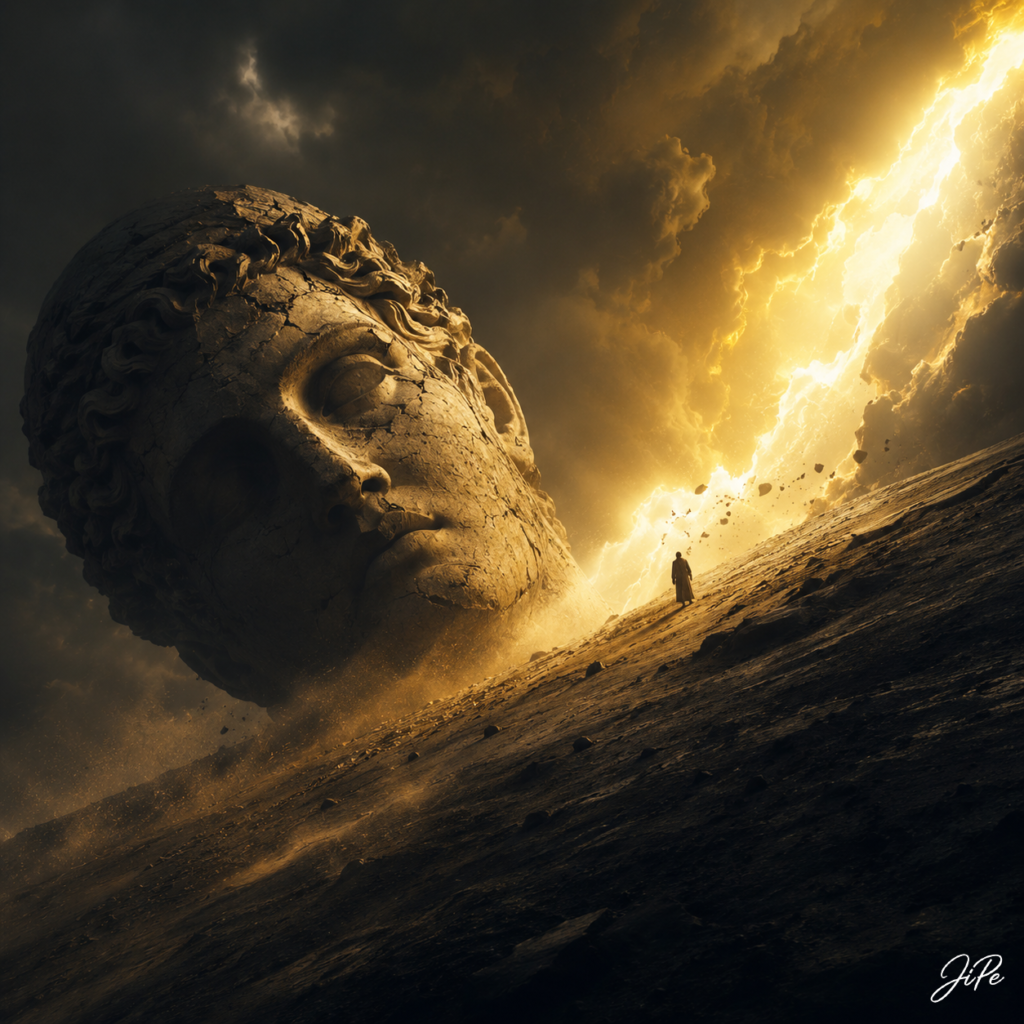
The End of All Noise is a monumental meditation on silence—not as the absence of sound, but as the culmination of wisdom. In this profoundly contemplative work, JiPe invites the viewer beyond the endless turbulence of the visible world into a place where history, identity, ambition, and fear finally lose their voices. What remains is not emptiness, but presence. Not isolation, but clarity. It is a painting about the extraordinary moment when the soul no longer struggles to be heard because it has discovered something infinitely greater than words.
Rather than depicting an ending, the work portrays a beginning.
The silence that follows awakening.
The stillness that arrives after every unnecessary voice has fallen away.
At the centre of the composition lies an immense classical head, weathered by time and partially buried within a vast, barren landscape. Its eyes are closed, its expression peaceful, untouched by the chaos unfolding around it. Cracks spread delicately across its surface, transforming the sculpture into a monument not of perfection, but of endurance. It is ancient, wounded, and profoundly serene.
This giant does not represent defeat.
It represents permanence.
It has survived everything that once believed itself eternal.
The title, The End of All Noise, establishes the philosophical foundation of the painting. Noise here should not be understood merely as sound. It becomes a metaphor for distraction, illusion, ego, conflict, and the relentless activity of the modern mind. JiPe suggests that much of what dominates human existence is ultimately transient—a constant stream of opinions, fears, ambitions, expectations, and identities that obscure deeper reality.
The painting asks a timeless question.
What remains…
when every unnecessary voice finally becomes silent?
Standing upon the immense slope before the sleeping monument is a solitary human figure. Tiny in comparison to the colossal sculpture, the traveller becomes the emotional centre of the composition. Their isolation is not one of abandonment, but of encounter. They stand before something immeasurably older and wiser than themselves, occupying the fragile threshold between ordinary consciousness and profound understanding.
The figure does not climb.
It does not conquer.
It simply stands.
And in that stillness, the encounter becomes sacred.
The extraordinary scale difference between human and monument fundamentally alters the viewer’s perception. JiPe reminds us that individual lives unfold within realities vastly greater than ourselves—time, memory, civilization, mortality, and consciousness itself. Yet the painting never diminishes humanity. Instead, it restores perspective.
True humility is not self-negation.
It is remembering one’s place within something infinitely larger.
The monumental face itself recalls the sculptural traditions of antiquity. Echoes of Greek and Roman ideals emerge through its classical features, suggesting civilizations whose greatest achievements now exist only as fragments. Yet JiPe transforms this historical reference into something universal. The giant is neither god nor emperor.
It is memory itself.
It is civilization asleep.
It is humanity contemplating its own impermanence.
The surface of the sculpture bears countless fractures, weathered textures, and subtle imperfections that evoke the Japanese philosophy of kintsugi. Rather than concealing damage, JiPe celebrates it as evidence of transformation. The cracks become visual records of time itself.
Every fracture remembers.
Every scar carries history.
Nothing truly enduring remains untouched.
To the right of the composition, an immense torrent of radiant golden light tears dramatically through dense storm clouds. It is neither sunrise nor lightning, neither celestial portal nor natural phenomenon. Instead, it functions as a metaphysical presence—an embodiment of truth entering a world that has grown accustomed to darkness.
Light, throughout JiPe’s artistic language, is never merely illumination.
It is consciousness.
It is revelation.
It is the invisible made visible.
What makes this light so compelling is its relationship with the surrounding darkness. Rather than eliminating shadow, it defines it. The painting refuses simplistic oppositions between good and evil or light and darkness. Instead, both exist in dynamic equilibrium.
Without shadow…
light possesses no depth.
Without silence…
truth cannot be heard.
The diagonal landscape further intensifies the emotional experience. Instead of a stable horizon, JiPe constructs an unstable world where gravity itself seems altered. The traveller appears to ascend—or perhaps descend—across an impossible terrain. This tilted perspective subtly destabilizes the viewer, transforming physical space into psychological space.
The journey becomes internal.
The landscape becomes consciousness.
Every step becomes transformation.
The surrounding emptiness is equally significant. Vast expanses of barren earth stretch toward distant mountains beneath immense skies, creating an overwhelming sense of solitude. Yet this solitude never becomes loneliness. Instead, it evokes the contemplative silence sought by mystics, philosophers, and pilgrims across countless cultures.
Some truths require isolation.
Some answers arrive only when distraction disappears.
Some voices can be heard only after every other voice has become silent.
Compositionally, The End of All Noise is a remarkable achievement in visual restraint. JiPe avoids unnecessary complexity, allowing monumental forms and dramatic lighting to carry extraordinary emotional weight. Every element contributes to a singular psychological atmosphere.
Nothing distracts.
Nothing competes.
Everything serves stillness.
The interplay between darkness and gold creates an almost liturgical rhythm across the composition. Rich charcoal tones dominate the earth and sky, while luminous gold breaks through like moments of transcendent understanding. This restrained palette has become one of JiPe’s defining visual signatures, recalling both sacred iconography and contemporary minimalist aesthetics.
Gold is never decoration.
It is the colour of awakening.
It marks the places where eternity touches time.
Psychologically, the painting resonates deeply with Carl Jung’s concept of individuation. The colossal sleeping head may be interpreted as the archetypal Self—the immense totality of human consciousness that remains largely hidden beneath everyday awareness. The solitary traveller represents the individual ego approaching this greater reality with humility rather than conquest.
The Self never needs to awaken.
It has always existed.
Only the traveller must learn to recognize it.
From an art historical perspective, The End of All Noise occupies a compelling intersection between Symbolism, Romanticism, metaphysical painting, and contemporary visionary realism. The monumental solitude recalls the sublime landscapes of Caspar David Friedrich, while the enigmatic architecture of memory evokes Giorgio de Chirico’s dreamlike worlds. Yet JiPe’s visual language remains unmistakably contemporary through its cinematic scale, expressive textures, and philosophical minimalism.
Rather than illustrating silence…
the painting becomes silence.
Rather than depicting contemplation…
it creates the conditions for contemplation.
Perhaps this is the work’s greatest achievement. It refuses spectacle despite its monumental scale. Instead of overwhelming the viewer with visual excess, it gradually slows perception itself. Time appears to decelerate. Attention becomes quieter. One begins to notice not only the image, but one’s own thoughts while standing before it.
And eventually…
even those thoughts begin to fade.
Ultimately, The End of All Noise is a meditation on what survives every collapse. Civilizations fade. Empires crumble. Identities evolve. Voices disappear into history. Yet beneath every transformation remains something constant—an enduring presence untouched by time, waiting patiently beneath the endless noise of human existence.
The painting reminds us that silence is never empty.
It is the place where wisdom gathers.
It is the landscape where the soul finally hears itself.
For perhaps the end of all noise…
is not the end of the journey.
It is the first moment…
we truly begin to listen.