Monumental Visionary Fine Art exploring mythology, consciousness, sacred light, and timeless visual storytelling.

Monumental Visionary Fine Art exploring mythology, consciousness, sacred light, and timeless visual storytelling.

Surreal Paintings

The Edge of Creation

The Edge of Creation

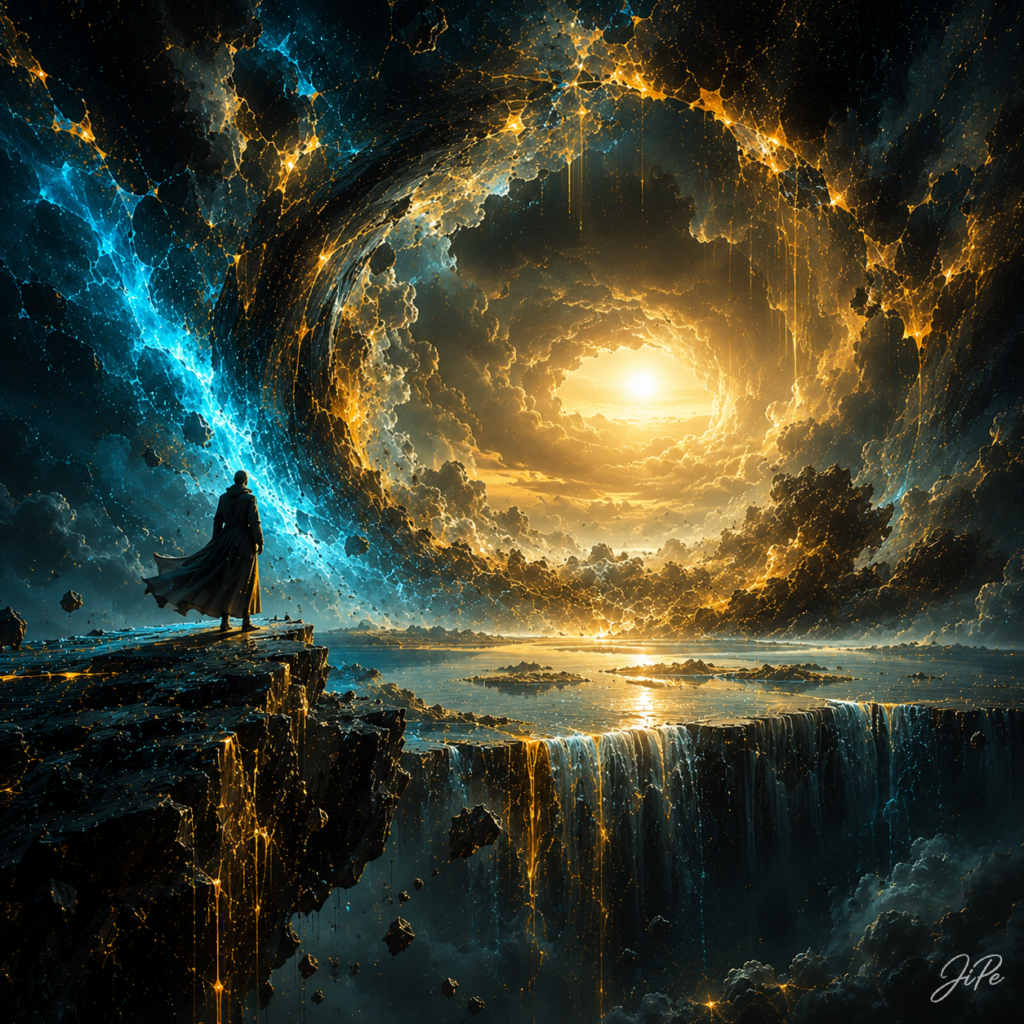
The Edge of Creation is a monumental meditation on origins, infinity, and the eternal human longing to understand what exists beyond the visible horizon. Blending visionary symbolism with contemporary monumental landscape painting, the work invites the viewer to stand at the threshold where the known universe dissolves into mystery. It is not a depiction of a physical place, but of a philosophical and spiritual frontier—a moment suspended between existence and possibility, where creation is perceived not as a completed event, but as an endless act of becoming.

At the heart of the composition stands a solitary figure upon the fractured edge of an immense precipice. Cloaked in darkness yet illuminated by the celestial radiance before him, the traveller embodies humanity itself: small against the immensity of the cosmos, yet uniquely capable of wonder. He neither advances nor retreats. Instead, he pauses in profound contemplation, recognising that some mysteries are not meant to be conquered but encountered. His silence becomes the viewer’s silence, transforming observation into participation.

Before him unfolds a breathtaking cosmic vortex—a vast circular opening of light surrounded by swirling clouds, radiant gold, and deep celestial blues. The luminous centre appears simultaneously as a sunrise, a gateway, a divine eye, and the birth of an entire universe. Its ambiguity is intentional. Throughout history, circles have symbolised eternity, perfection, wholeness, and the infinite cycle of creation. Here, the circular form becomes the visual heartbeat of the composition, suggesting that creation itself is neither linear nor finite but endlessly renewing.

The title, The Edge of Creation, speaks to both physical and metaphysical boundaries. It evokes the imagined frontier where existence emerges from nothingness, while simultaneously referring to the personal thresholds encountered throughout every human life. Each individual eventually arrives at an edge where certainty ends and faith, imagination, or curiosity must continue the journey. The painting therefore explores not only the birth of worlds but the continual birth of consciousness itself.

One of the work’s most compelling features is its treatment of the horizon. Rather than offering a conventional landscape, the world appears to dissolve into an impossible cosmic architecture where oceans become skies and waterfalls spill endlessly into the unknown. Gravity itself seems suspended. This intentional disruption of natural laws transforms the environment into a symbolic realm where physical reality yields to metaphysical truth. The landscape becomes an expression of consciousness rather than geography.

Light functions as the primary narrative force. The brilliant golden core radiates outward through countless layers of cloud, illuminating every surface with extraordinary warmth. Throughout the artist’s body of work, light consistently represents revelation, divine presence, wisdom, hope, and spiritual awakening. Here, illumination appears almost generative, as though the universe itself is continuously unfolding from the radiant centre. Rather than simply revealing creation, the light appears to be actively creating it.

In striking contrast, deep cobalt blues and near-black shadows surround the luminous vortex, introducing an atmosphere of cosmic depth and mystery. Blue has long symbolised infinity, transcendence, contemplation, and the unknown. The dialogue between blue and gold creates a powerful emotional equilibrium between mystery and revelation, silence and expression, absence and presence. Neither colour dominates the other; instead, they exist in perpetual harmony, reflecting the duality that defines both nature and human consciousness.

The fractured cliffs upon which the traveller stands carry equally rich symbolism. Their broken surfaces recall ancient geological formations while simultaneously suggesting the fragile foundations upon which certainty is built. Gold appears to flow through these fractures like veins of living light, echoing the philosophy of kintsugi, where brokenness becomes the source of renewed beauty rather than evidence of failure. The earth itself participates in the act of transformation, reminding viewers that even apparent endings contain hidden beginnings.

Compositionally, the painting demonstrates extraordinary mastery of scale and perspective. The vast circular vortex dominates the upper half of the image, while the solitary figure anchors the lower foreground with quiet emotional intensity. The dramatic contrast between monumental cosmic architecture and the minute human silhouette reinforces one of the oldest artistic explorations: humanity’s relationship to the sublime. Yet unlike Romantic depictions in which nature overwhelms the observer, this painting presents the sublime as profoundly inviting. The universe does not threaten the traveller—it calls him forward.

The waterfalls cascading endlessly over the world’s edge introduce another powerful symbolic layer. Water traditionally represents purification, memory, renewal, and the continuous flow of existence. Here, however, the water appears to spill beyond the limits of reality itself, disappearing into infinite darkness below. The image evokes the notion that creation continually overflows its own boundaries, suggesting that existence is not static but perpetually expanding into new dimensions of possibility.

From an art historical perspective, The Edge of Creation occupies a unique position between visionary symbolism, monumental Romantic landscape, metaphysical painting, and contemporary surreal realism. Echoes of nineteenth-century sublime landscape traditions coexist with modern digital painterly aesthetics and mythic visual storytelling. The work avoids direct narrative illustration, instead creating a symbolic environment where viewers are encouraged to project their own philosophical, spiritual, or existential interpretations.

Psychologically, the painting explores the profound human experience of standing before the unknown. Every life eventually reaches moments where established beliefs no longer provide sufficient answers. The figure’s stillness reflects that universal experience—the recognition that growth begins precisely where certainty ends. Rather than portraying fear of the unknown, the work celebrates intellectual humility and spiritual curiosity as essential aspects of human existence.

The absence of identifiable landmarks or cultural references further strengthens the painting’s universality. This is not a specific mythological location or religious vision but a symbolic landscape belonging equally to science, philosophy, spirituality, and imagination. The cosmic opening may be interpreted as the beginning of the universe, the entrance to eternity, the source of consciousness, or the deepest interior landscape of the human soul. Its openness becomes its greatest strength.

The extraordinary textures throughout the painting enrich its emotional impact. Clouds appear sculpted rather than merely painted, while glowing veins of gold flow through the atmosphere like living energy. Every luminous fracture contributes to a sense that the cosmos itself possesses organic vitality. The tactile quality of the work reinforces the impression that creation is not an abstract concept but a living, breathing process unfolding continuously before our eyes.

Ultimately, The Edge of Creation is a meditation on wonder itself. It reminds us that humanity’s greatest achievements have never emerged from possessing all the answers, but from daring to stand at the edge of the unknown and ask the next question. Through its breathtaking fusion of monumental symbolism, celestial architecture, luminous atmosphere, and philosophical depth, the painting becomes far more than an image of a cosmic landscape. It becomes an invitation to contemplate our place within an infinite universe—a universe that is not complete, but forever unfolding, forever creating, and forever waiting for those willing to step beyond certainty and gaze into the radiant mystery from which all things begin.

Lämna ett svar