Blooming Through the Darkness

Blooming Through the Darkness is a profound allegorical exploration of resilience, transformation, and the enduring capacity of life to emerge from adversity. Through an extraordinary synthesis of symbolic portraiture, botanical imagery, expressive abstraction, and contemporary visionary aesthetics, the artwork presents a compelling meditation on the relationship between suffering and renewal. It is a work that speaks simultaneously to personal experience and universal human existence, inviting viewers to contemplate how beauty, wisdom, and hope often arise from the deepest moments of fracture.
Rather than depicting darkness as an opposing force to light, the artist presents it as the very environment from which transformation becomes possible. The title, Blooming Through the Darkness, encapsulates this central philosophy. Blooming is not portrayed as the absence of hardship, but as the remarkable ability to flourish within it. In doing so, the artwork challenges conventional narratives of triumph by suggesting that growth is inseparable from vulnerability, and that every season of darkness contains the hidden potential for renewal.
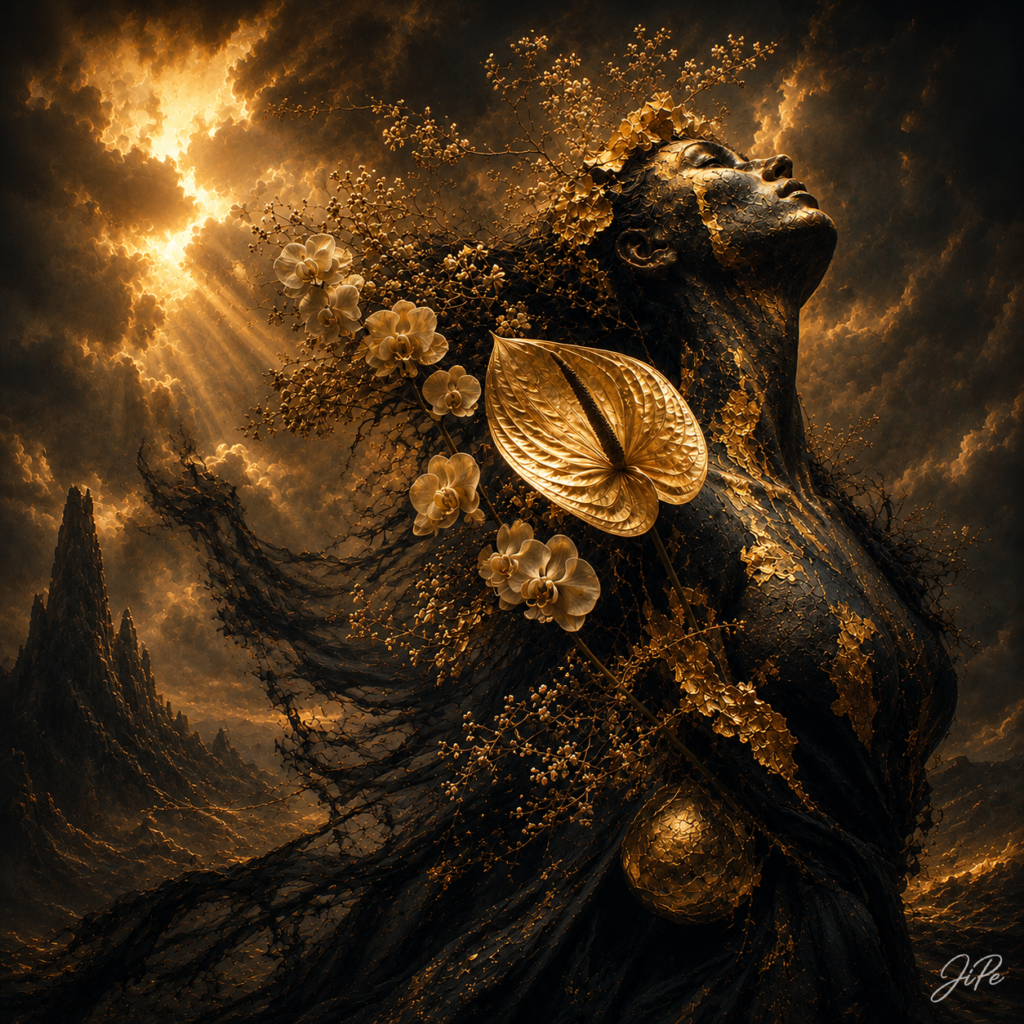
At the center of the composition stands a monumental female figure whose upward gaze immediately commands the viewer’s attention. Her head is lifted toward an unseen source beyond the frame, her eyes gently closed, her expression serene and contemplative. She appears neither passive nor victorious, but profoundly receptive—a figure caught in the quiet moment between endurance and awakening. Her posture communicates surrender without defeat, embodying an inner strength that arises not from resistance but from acceptance and transformation.
The figure herself appears sculpted from dark stone or volcanic earth, her surface textured with intricate fractures illuminated by flowing veins of radiant gold. This visual language immediately recalls the philosophy of kintsugi, the Japanese art of repairing broken objects with precious metals, transforming damage into beauty rather than concealing it. Here, however, the concept is elevated beyond material restoration into a powerful metaphor for the human condition. Every crack becomes evidence of survival rather than weakness. The luminous gold does not erase the fractures but reveals them, suggesting that life’s deepest wounds can become the very places through which wisdom and grace emerge.
The contrast between the figure’s dark, earth-like body and the brilliant golden fissures establishes one of the painting’s central visual dialogues. Darkness is presented not as emptiness but as fertile substance—a rich foundation capable of nurturing life. Gold functions as a symbol of illumination, resilience, and transcendent possibility, flowing through the figure like living energy. The relationship between these two elements reflects an enduring philosophical truth: light possesses its greatest significance when revealed within darkness rather than apart from it.
One of the artwork’s most captivating features is the extraordinary botanical growth emerging from the figure’s hair and shoulders. Delicate branches extend outward in intricate organic patterns, bearing blossoms that appear almost luminous against the surrounding darkness. These flowering branches symbolize regeneration, creativity, and the cyclical rhythms of nature. Rather than existing as decorative embellishments, they become extensions of the figure herself, suggesting that inner transformation inevitably manifests as outward growth.
The blossoms scattered throughout the composition introduce a profound symbolic counterpoint to the fractured body. Flowers have long represented impermanence, beauty, hope, and spiritual awakening across diverse artistic traditions. Here they emerge directly from the spaces where darkness and light converge, reinforcing the idea that beauty is not separate from suffering but born through it. Their delicate forms soften the monumentality of the figure while reminding viewers that even the most fragile expressions of life possess extraordinary resilience.
Dominating the foreground is a magnificent golden anthurium leaf whose sculptural elegance immediately captures attention. Unlike ordinary foliage, the leaf appears fashioned from precious metal, transforming a botanical form into an icon of enduring vitality. The anthurium, traditionally associated with hospitality, abundance, and lasting affection, carries additional symbolic resonance through its remarkable longevity and vibrant appearance. Rendered entirely in gold, it becomes an emblem of spiritual flourishing—a reminder that genuine growth is measured not only by outward beauty but by inner permanence.
Beneath the leaf rests a radiant golden sphere partially embedded within the figure’s form. This subtle yet significant detail introduces another layer of symbolic meaning. The sphere recalls ancient images of seeds, celestial bodies, and the philosophical concept of potentiality. Positioned near the heart of the composition, it suggests that the source of renewal lies hidden within, awaiting the appropriate season to emerge. It becomes a visual metaphor for dormant possibility, affirming that every individual carries unseen capacities capable of unfolding even after profound hardship.
The dramatic landscape surrounding the figure contributes significantly to the painting’s emotional atmosphere. Jagged mountains rise from a shadowed horizon, their rugged forms echoing the fractured textures of the central figure herself. Rather than serving merely as background, the landscape mirrors the internal emotional terrain explored throughout the composition. It represents the difficult paths, obstacles, and wilderness experiences that accompany every transformative journey. Yet despite its severity, the environment is not devoid of hope. It remains open to the heavens, suggesting that even the harshest landscapes participate in the possibility of renewal.
Above, the sky unfolds in magnificent clouds pierced by radiant shafts of golden light. These luminous openings function as more than atmospheric effects; they become theological and philosophical symbols of revelation. Light descends gently rather than dramatically, illuminating the figure without overwhelming her presence. The artist deliberately avoids depicting a singular, visible source of illumination, allowing the radiance to remain mysterious and universal. In doing so, the painting speaks across cultural and spiritual traditions, permitting viewers to interpret the light according to their own experiences of grace, insight, healing, or transcendence.
Color plays an essential role in communicating the work’s emotional depth. The restrained palette of charcoal black, warm earth tones, ivory blossoms, and luminous gold creates an atmosphere that is simultaneously solemn and uplifting. Gold dominates not through excess but through carefully orchestrated emphasis, drawing attention toward transformation rather than ornamentation. The dark tones provide profound visual weight, allowing every illuminated detail to acquire greater symbolic significance.
The richly textured surface reinforces the painting’s tactile presence. Layers of cracked stone, flowing metallic accents, botanical delicacy, and painterly abstraction create an impression of continual becoming. Nothing within the composition appears static. Even the seemingly solid figure suggests ongoing transformation, as though life continues to emerge from within her fractured surface. This sense of organic evolution reflects the artwork’s larger meditation on growth as an ongoing process rather than a completed state.
Stylistically, Blooming Through the Darkness occupies a remarkable intersection between Symbolism, Romanticism, Surrealism, and contemporary digital painting. The monumental treatment of the human figure recalls classical sculpture, while the dreamlike botanical forms evoke Symbolist explorations of inner consciousness. The atmospheric landscape resonates with the emotional grandeur of Romantic painting, whereas the intricate textures and luminous detailing firmly establish the work within the evolving language of twenty-first-century visionary art.
From an art historical perspective, the painting continues a long tradition of allegorical representations in which nature serves as a reflection of psychological and spiritual experience. Like the Pre-Raphaelites, the artist imbues botanical forms with symbolic significance. Echoes of Gustav Klimt appear in the use of gold as both decorative and metaphysical substance, while the fractured surfaces recall contemporary explorations of restoration and resilience. Yet the work ultimately transcends these influences through its unique synthesis of mythic symbolism and modern visual storytelling.
The composition itself demonstrates exceptional structural balance. The upward movement of the figure’s gaze establishes a powerful vertical axis that directs the viewer toward the radiant heavens, while the branching forms create graceful lateral rhythms that soften the monumentality of the central figure. The golden anthurium leaf acts as both compositional anchor and symbolic focal point, bridging the organic and the transcendent within a single elegant form.
Emotionally, Blooming Through the Darkness invites prolonged contemplation rather than immediate interpretation. It resonates with experiences of grief, healing, personal growth, and spiritual renewal without prescribing a singular narrative. Viewers may encounter reflections of their own struggles within the fractured figure or find hope in the blossoms that quietly emerge from darkness. The artwork’s strength lies precisely in this openness, allowing universal symbolism to meet deeply personal experience.
Ultimately, Blooming Through the Darkness is a luminous meditation on the resilience of the human spirit and the transformative power of hope. Through its masterful integration of symbolic portraiture, botanical metaphor, expressive texture, and radiant light, the artwork affirms that life’s most profound beauty often emerges not despite adversity, but because of it. It reminds us that brokenness need not signify an ending, but may instead become the fertile ground from which wisdom, compassion, and new life quietly bloom. As both a contemporary work of visionary art and a timeless philosophical statement, it offers visitors, collectors, scholars, and contemplative viewers an enduring reflection on one of humanity’s deepest truths: that even in the darkest landscapes, the possibility of flowering remains.