Monumental Visionary Fine Art exploring mythology, consciousness, sacred light, and timeless visual storytelling.

Monumental Visionary Fine Art exploring mythology, consciousness, sacred light, and timeless visual storytelling.

Fantasy Paintings

The Path of the Eclipse

The Path of the Eclipse

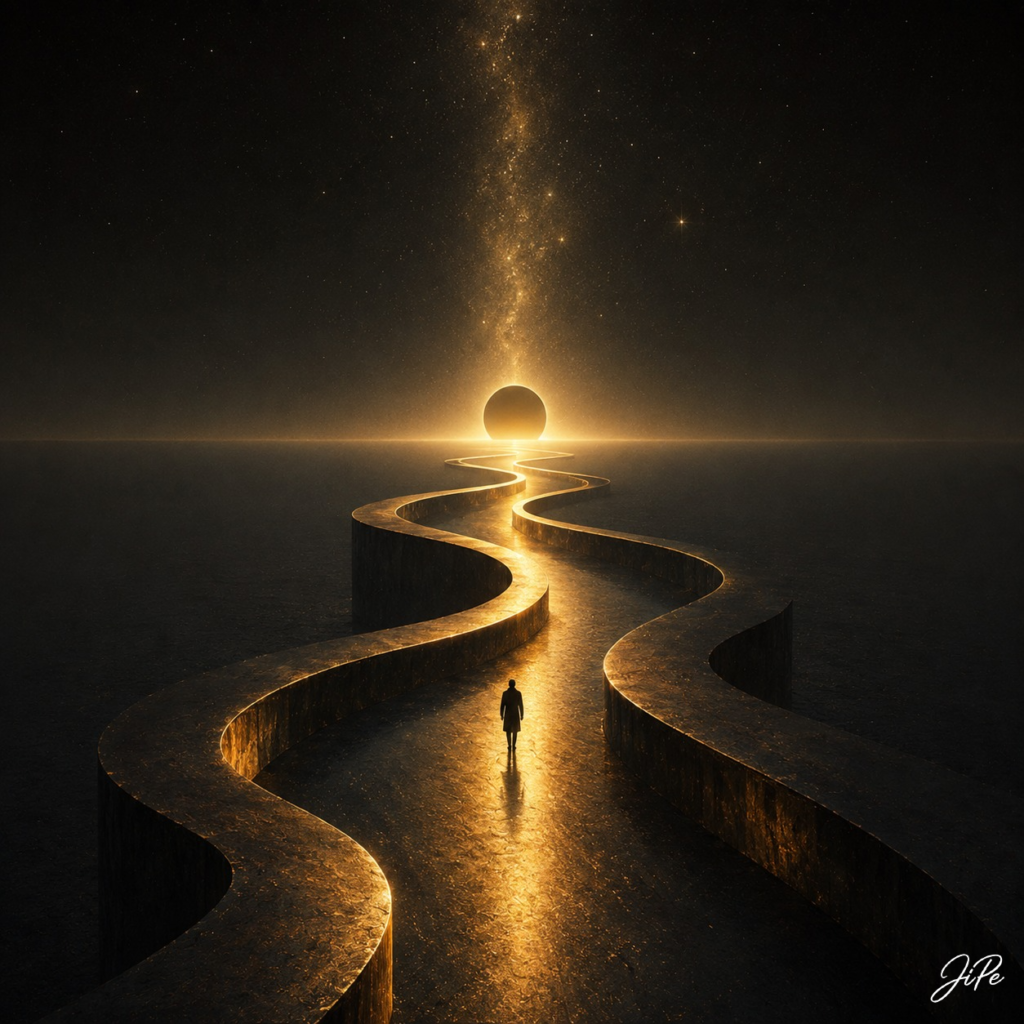
Some journeys are measured in distance. Others are measured in transformation. The Path of the Eclipse belongs to the latter. It is a visual meditation on destiny, self-discovery, and the mysterious intervals in which darkness and illumination become inseparable. Rather than depicting a traveler moving toward a physical destination, the painting portrays the universal pilgrimage of consciousness—a journey through uncertainty toward a truth that can only be revealed by passing through shadow.

At first glance, the composition appears almost disarmingly simple. Against an immense expanse of darkness, a solitary figure walks along a luminous golden path that winds endlessly toward a distant eclipse resting upon the horizon. Above it, the Milky Way rises like a celestial pillar, connecting the heavens to the earth in a single uninterrupted axis of light. Yet beneath this elegant minimalism lies a remarkably sophisticated symbolic architecture in which every line, every proportion, and every source of illumination contributes to a deeper philosophical narrative.

The title itself offers the first clue to the work’s meaning.

An eclipse is never simply an astronomical event.

Throughout human history it has symbolized transition, revelation, endings, hidden truths, and moments when ordinary perception briefly gives way to something infinitely larger. It is the meeting point between light and darkness—not as opposing forces, but as necessary partners in the unfolding of existence.

JiPe transforms this ancient symbol into an inner landscape.

The eclipse becomes neither catastrophe nor miracle.

It becomes awakening.

The solitary figure occupies the emotional centre of the painting despite its small physical scale. Reduced almost to a silhouette, the traveler loses individual identity and becomes an archetype—a reflection of every person who has ever searched for meaning beyond certainty. Gender, age, nationality, and history dissolve. What remains is the universal human condition: walking forward despite never fully knowing what lies ahead.

This anonymity invites the viewer into the work.

The traveler is no longer someone else.

The traveler becomes us.

Perhaps the most striking formal element is the serpentine pathway itself. Rather than leading directly toward its destination, it curves rhythmically across the immense landscape like a living organism. It recalls rivers, ancient pilgrimage roads, flowing energy, or the invisible movement of time itself.

Its graceful geometry quietly challenges the modern obsession with efficiency.

Life’s deepest transformations rarely occur along straight lines.

Growth unfolds through hesitation.

Discovery requires detours.

Understanding is accumulated one bend at a time.

The golden path therefore becomes far more than architecture.

It becomes a metaphor for consciousness itself.

Every curve suggests a choice.

Every turn implies surrender to a larger rhythm.

The painting proposes that the journey is never an obstacle separating us from meaning—it is meaning.

The surrounding darkness is equally essential to the composition. Rather than functioning as emptiness, it creates extraordinary psychological space. Vast expanses of negative space surround the illuminated path, producing an atmosphere of profound silence. This restraint reflects one of JiPe’s defining artistic strengths: the confidence to remove rather than accumulate visual information.

The darkness is not threatening.

It is contemplative.

It allows thought to breathe.

Within this silence, every element gains symbolic weight.

Light functions throughout the painting as an active presence rather than a passive illumination. The golden pathway reflects a radiance that appears to originate simultaneously from the distant eclipse and from within itself. This ambiguity is significant. The source of enlightenment cannot easily be separated from the act of seeking it.

One illuminates the other.

The destination creates the journey.

The journey reveals the destination.

Above the horizon, the celestial column of stars extends vertically into infinity. Visually, it creates an axis mundi—the ancient symbolic concept of a world axis connecting earthly existence with transcendent reality. Countless civilizations have imagined such cosmic bridges: sacred mountains, trees of life, temple pillars, or rivers flowing between worlds.

Here, JiPe replaces these traditional symbols with pure light.

The universe itself becomes architecture.

The composition achieves remarkable equilibrium through its geometric precision. The horizontal horizon establishes calm, while the vertical celestial axis introduces transcendence. Between them winds the organic movement of the path, producing a harmonious dialogue between order and unpredictability. The result is both mathematically elegant and emotionally expansive.

Materially, the pathway possesses an almost sculptural quality. Its weathered metallic surface reflects warm golden light while retaining subtle imperfections that suggest endurance rather than perfection. These textures recall ancient stone polished by generations of unseen travelers, implying that this is not merely one person’s journey but humanity’s collective pilgrimage across time.

The restrained colour palette enhances the painting’s timelessness. Gold dominates the visual experience, contrasted against profound charcoal blacks and subtle earth tones. Occasional hints of atmospheric warmth soften the composition without diminishing its monumental stillness. The limited palette allows light itself to become the principal narrative force.

Psychologically, the eclipse carries profound significance. Modern culture often associates darkness with fear or absence. This painting proposes something far more nuanced. Here, darkness becomes necessary for revelation. Only through eclipse does the surrounding halo become visible. Only through shadow does hidden radiance emerge.

Transformation therefore requires obscurity.

The unknown is not an interruption of life.

It is one of its essential teachers.

Art historically, The Path of the Eclipse occupies a fascinating position between metaphysical landscape, minimalist symbolism, conceptual contemporary art, visionary realism, and architectural surrealism. Echoes of Romantic notions of the sublime coexist with contemporary minimalism, while sacred geometry quietly informs the overall structure without becoming overtly decorative.

The work also engages with existential philosophy. The traveler moves forward not because certainty has been granted, but because movement itself becomes an act of faith. The painting refuses dramatic action or narrative climax. Instead, it captures the quieter heroism of perseverance—the decision to continue despite incomplete understanding.

In this respect, the work resonates deeply with the human experience.

Every life contains eclipses.

Moments when familiar light disappears.

Moments when identity dissolves.

Moments when answers retreat beyond the horizon.

Yet these same moments often become the birthplace of entirely new perspectives.

One of JiPe’s most remarkable achievements is his ability to evoke overwhelming scale while preserving emotional intimacy. The universe appears infinite, yet the solitary traveler never feels insignificant. Instead, the figure seems perfectly placed within a cosmos that acknowledges rather than diminishes human existence.

This delicate balance between humility and belonging defines the emotional atmosphere of the painting.

Nothing is forced.

Nothing is explained.

Everything is invited.

The work ultimately becomes less a depiction of an external landscape than a visual philosophy. It reminds us that every meaningful transformation unfolds somewhere between illumination and uncertainty. The eclipse is not an ending but a threshold. The winding road is not delay but preparation. The distant horizon is not escape but possibility.

Standing before The Path of the Eclipse, the viewer gradually realizes that the destination is almost irrelevant. The true subject is the quiet courage required to continue walking when the way ahead cannot yet be fully understood.

For perhaps enlightenment has never been the absence of darkness.

Perhaps it has always been the willingness to walk through it.

And perhaps every eclipse, however mysterious it may appear, is simply another name for the moment when the soul learns to recognize its own light.

Lämna ett svar