Queen of the Forgotten Dawn

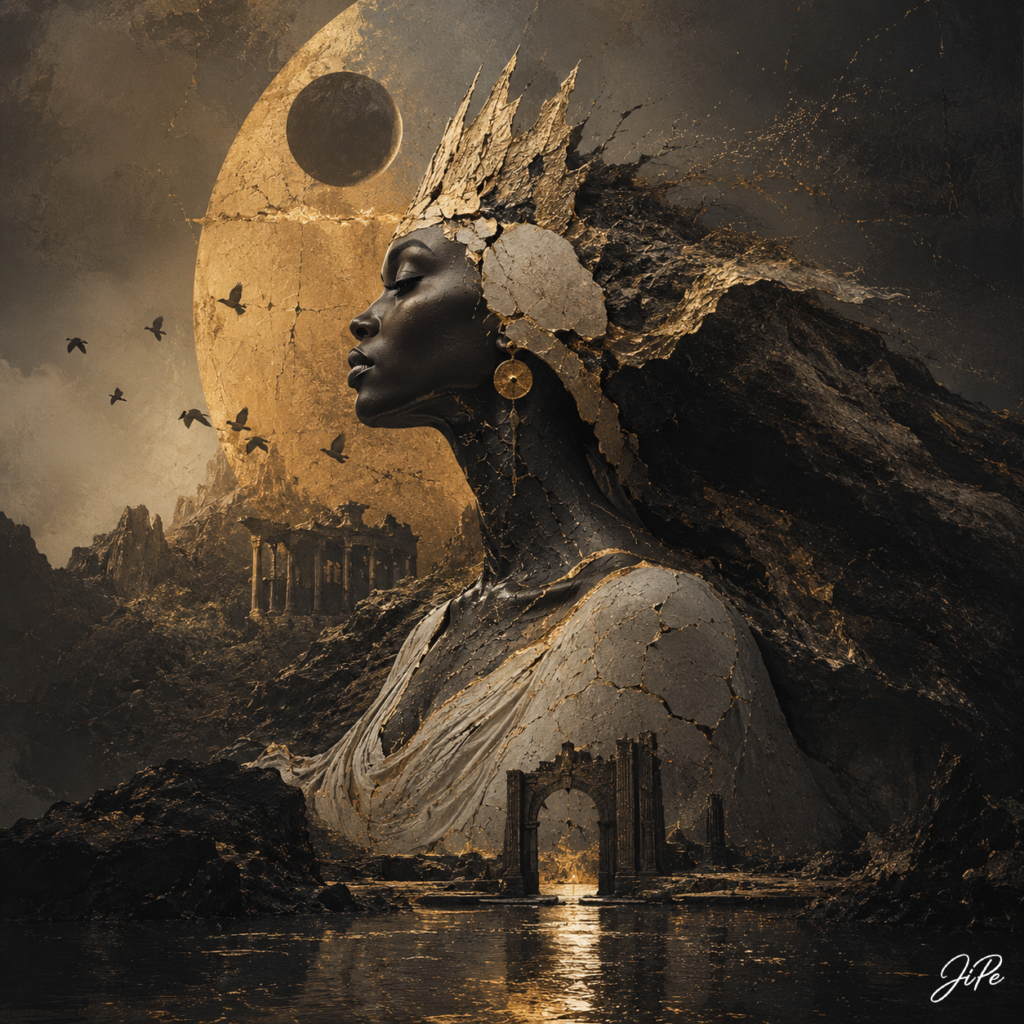
Queen of the Forgotten Dawn is a monumental reflection on forgotten civilizations, feminine sovereignty, and the timeless endurance of memory. Existing somewhere between mythology and dream, the work presents not the portrait of a historical queen, but the embodiment of an ancient consciousness that has survived the collapse of kingdoms, the erosion of monuments, and the passing of countless ages. It is an image of quiet authority—one that reigns not through conquest, but through wisdom, resilience, and the silent permanence of the spirit.
The painting unfolds as a visionary landscape where architecture, nature, and the human figure merge into a single symbolic universe. Here, the queen is inseparable from the land itself. Mountains become extensions of her presence, ruins become fragments of her memory, and the flowing darkness of her hair dissolves into the surrounding landscape, suggesting that identity transcends the limits of the physical body. Rather than standing within the world, she has become part of its very foundation.
The title, Queen of the Forgotten Dawn, evokes a paradox.
A dawn represents beginnings.
Something forgotten belongs to the distant past.
Together they suggest that every new beginning carries echoes of something ancient—a truth humanity once understood but gradually allowed to fade into silence.
The queen therefore becomes the guardian of that forgotten wisdom.
Her profile dominates the composition with remarkable serenity. Her eyes remain gently closed, creating an immediate sense of introspection rather than observation. She does not engage with the external world because her vision reaches inward, toward memory, intuition, and spiritual understanding. This inward gaze transforms her into an archetypal figure whose authority originates not from power over others, but from profound self-awareness.
Her expression is neither triumphant nor sorrowful.
It exists beyond emotion.
It reflects acceptance.
This calmness becomes one of the painting’s most powerful emotional qualities, inviting viewers into contemplation rather than spectacle.
Crowning her head is a fractured golden diadem that appears simultaneously ancient and alive. Its broken geometry recalls archaeological fragments while the luminous gold suggests enduring vitality. Throughout the composition, gold functions not as ornament but as symbolic energy. It flows across surfaces, fills fractures, illuminates cracks, and transforms broken forms into sources of extraordinary beauty.
This treatment evokes the philosophy of kintsugi, where fractures are not concealed but honored.
The crown is broken.
Its authority is not.
The queen’s strength emerges precisely through what has survived.
Behind her rises a monumental celestial disc interrupted by a dark eclipse. This striking combination of light and shadow introduces one of the painting’s central symbolic themes: transformation through cycles rather than permanence. Across cultures, eclipses have represented moments of transition, hidden revelation, and cosmic renewal. Here, the eclipse becomes the visual counterpart to the queen herself—suggesting that true illumination often arrives through periods of darkness rather than despite them.
The luminous disc also functions as a halo, subtly elevating the queen beyond historical identity into the realm of timeless archetype.
She becomes neither goddess nor monarch.
She becomes memory itself.
Her flowing hair dissolves into geological textures that merge seamlessly with mountains, cliffs, and weathered earth. This remarkable fusion eliminates any distinction between humanity and landscape, presenting consciousness as inseparable from the natural world. The earth does not merely surround her.
It continues her.
Stone becomes flesh.
Flesh becomes landscape.
Landscape becomes history.
Scattered throughout the environment stand fragments of ancient architecture. Weathered temples, broken gateways, and forgotten sanctuaries emerge almost imperceptibly from the terrain, suggesting civilizations long vanished from human memory. Yet they are not depicted as ruins of failure. Instead, they become sacred remnants—silent witnesses to the continuity of culture beyond historical chronology.
Among these structures, the illuminated gateway positioned near the water becomes particularly significant. Framed by reflective surfaces and glowing with subtle golden light, it functions as a symbolic threshold between visible reality and hidden dimensions of experience. Every doorway within mythology carries the possibility of transformation.
To cross is to change.
To remain is also a choice.
The painting never reveals which path has been taken.
The surrounding water introduces another essential symbolic layer. Calm, reflective, and almost mirror-like, it represents memory, subconscious awareness, and the passage between worlds. Throughout human history, water has served as both boundary and bridge, separating the known from the unknown while simultaneously connecting them.
Its stillness mirrors the queen’s inner composure.
Nothing disturbs its surface.
Yet beneath it lies immeasurable depth.
Flying birds crossing the distant sky subtly animate the composition. Their movement contrasts with the queen’s profound stillness, introducing the passage of time into an otherwise timeless world. Birds have long symbolized freedom, transcendence, and communication between earthly and celestial realms. Here, they become living reminders that while civilizations vanish, life’s continual movement persists.
The composition demonstrates exceptional architectural harmony. The monumental profile dominates the right side of the image, balanced by the expansive celestial disc and distant ruins on the left. Flowing diagonals guide the viewer through the landscape before returning naturally to the queen’s face, creating a visual rhythm that feels simultaneously dynamic and meditative.
Nothing appears accidental.
Every line leads somewhere.
Every shape contributes to silence.
Materially, Queen of the Forgotten Dawn reveals extraordinary painterly sophistication. Rich layered textures evoke weathered stone, cracked plaster, eroded marble, and metallic gold leaf simultaneously. Thick impasto-like surfaces give the painting remarkable physical presence, while subtle translucent glazes create atmospheric depth that allows light to emerge organically from within the composition.
The restrained palette of charcoal black, warm ivory, weathered earth, and luminous gold enhances the emotional resonance of the work. Rather than relying on dramatic chromatic contrasts, the painting achieves intensity through the interaction between darkness and illumination.
Gold becomes the language of memory.
Black becomes the language of time.
Together they create extraordinary visual poetry.
From an art historical perspective, the work draws upon several traditions while maintaining a distinctly contemporary identity. Its monumental female figure recalls classical ideals of timeless beauty, while its symbolic landscapes resonate with Romantic explorations of the sublime. The psychological ambiguity reflects the influence of Symbolism, where visible forms become vehicles for invisible ideas. Simultaneously, its cinematic lighting, layered mixed-media textures, and sophisticated digital painterly techniques firmly place the work within the expanding field of contemporary visionary art.
The painting also invites dialogue with mythology across multiple cultures. The queen may evoke forgotten goddesses, sacred priestesses, or legendary rulers without belonging exclusively to any single tradition. This universality allows viewers to approach the work through their own cultural memories and symbolic associations.
She belongs everywhere.
Because she belongs to no single place.
Psychologically, Queen of the Forgotten Dawn explores the relationship between identity and collective memory. Modern life often emphasizes constant progress toward the future, yet the painting suggests that true wisdom emerges through dialogue with what has been forgotten. The queen does not mourn lost civilizations.
She carries them.
She becomes their continuation.
This concept transforms the artwork into a meditation on inheritance—not genetic inheritance, but spiritual inheritance. Every generation receives stories, symbols, beliefs, and values shaped by countless lives that came before. Even when forgotten consciously, they continue to influence imagination, creativity, and identity.
The queen is therefore not preserving ruins.
She is preserving meaning.
Her silence speaks more powerfully than words.
Her stillness contains the movement of centuries.
Emotionally, the work achieves remarkable equilibrium between melancholy and hope. While ancient structures suggest inevitable decline, the luminous gold, radiant celestial light, and enduring presence of the queen affirm that beauty survives transformation. Nothing remains unchanged, yet nothing meaningful is ever entirely lost.
Memory changes form.
Wisdom changes language.
Light changes direction.
But essence remains.
Ultimately, Queen of the Forgotten Dawn is a profound meditation on resilience, forgotten knowledge, and the enduring sovereignty of the human spirit. It proposes that every civilization leaves behind more than architecture and artifacts; it leaves invisible echoes that continue to shape those willing to listen. The queen becomes the living embodiment of those echoes—a timeless figure who reminds us that true greatness is measured not by empire or conquest, but by the ability to preserve beauty, wisdom, and compassion across the immense passage of time.
The forgotten dawn is not merely the beginning of a day.
It is the awakening of memory.
The queen is not merely its ruler.
She is its eternal guardian.
Through its masterful integration of monumental symbolism, luminous painterly textures, mythological resonance, and contemplative emotional depth, Queen of the Forgotten Dawn stands as a powerful celebration of humanity’s enduring connection to its forgotten origins. It invites viewers to pause before the relentless movement of history and remember that beneath every new sunrise lies the quiet light of ancient truths waiting to be rediscovered.