Monumental Visionary Fine Art exploring mythology, consciousness, sacred light, and timeless visual storytelling.

Monumental Visionary Fine Art exploring mythology, consciousness, sacred light, and timeless visual storytelling.

Surreal Paintings

Before the Eternal Self

Before the Eternal Self

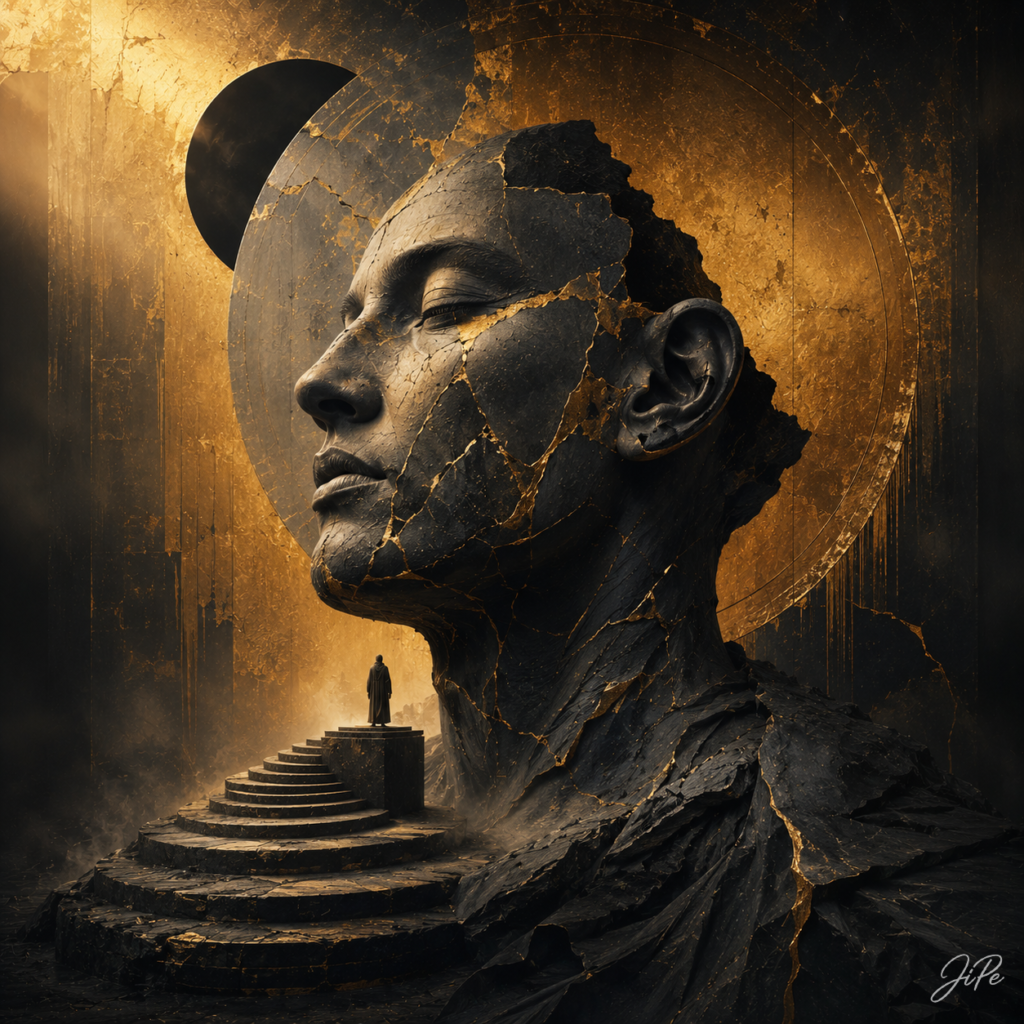
Before the Eternal Self is a monumental contemplation of identity, transcendence, and the timeless essence that exists beneath the changing masks of human existence. Blending visionary symbolism, contemporary surrealism, sacred geometry, and monumental figurative composition, JiPe presents an image that exists outside ordinary reality, inviting viewers into a space where the finite self stands before something infinitely older, wiser, and more enduring. The painting is not concerned with external events or narrative chronology; instead, it explores the silent encounter between the temporary individual and the eternal consciousness that has always existed beyond time.

At its core, the work poses a profound philosophical question:

Who are we before memory, before fear, before identity itself?

Rather than answering, JiPe creates a visual meditation in which the viewer becomes an active participant. The painting transforms observation into introspection, encouraging us to look beyond appearance and toward the deepest layers of our own being.

Dominating the composition is an immense celestial gateway, where fractured circles, ascending architecture, and a radiant column of light converge into an overwhelming cosmic presence. The monumental forms appear suspended between creation and dissolution, as though the universe itself has paused in a sacred moment of transformation. Ancient stairways disappear into luminous clouds while geometric circles dissolve into fragments, suggesting that eternity cannot be contained by perfect forms but continually recreates itself.

The title, Before the Eternal Self, shifts the painting beyond conventional ideas of personality or biography. The ”self” here is not the psychological identity we construct throughout life, but something immeasurably deeper—a consciousness untouched by time, circumstance, or mortality. JiPe proposes that beneath every changing version of ourselves lies an essence that has neither beginning nor end.

The self we know…

may only be the surface.

The eternal self…

has always been waiting beneath.

The solitary figure standing before the monumental light becomes the emotional centre of the composition. Tiny against the immense architecture of the cosmos, the individual embodies every human being standing before mystery. Their stillness is not hesitation but reverence. They neither ascend nor retreat. Instead, they remain suspended within the sacred silence that precedes transformation.

Some journeys begin with movement.

The greatest ones…

begin with stillness.

Compositionally, JiPe masterfully orchestrates scale to reinforce philosophical meaning. Monumental architectural forms tower above the observer, while sweeping celestial geometry creates a sense of infinite expansion. Yet despite this overwhelming grandeur, the eye inevitably returns to the solitary figure. This subtle balance between the immense and the intimate allows viewers to recognize themselves within the painting’s symbolic narrative.

The smallest presence…

often carries the greatest question.

The vertical beam of radiant light functions as the painting’s symbolic axis. Throughout human history, vertical light has represented revelation, divine presence, enlightenment, and the connection between earthly existence and transcendent reality. Here it rises through fractured celestial structures, suggesting that true illumination does not descend from perfection but emerges through transformation.

Light is not merely illumination.

It is recognition.

The monumental staircase ascending toward the celestial opening reinforces this symbolism. Stairways have long represented spiritual ascent, wisdom, and inner evolution across countless artistic and religious traditions. JiPe deliberately leaves portions of the staircase obscured within clouds, reminding us that no complete map exists for the inward journey.

The final steps…

can never be borrowed.

They must be lived.

Surrounding the luminous centre are delicate circles and geometric constructions that quietly reference sacred geometry. These subtle forms evoke the hidden mathematical harmony underlying existence, suggesting that beneath apparent chaos lies a profound universal order. The fragmented circles symbolize cycles of birth, dissolution, renewal, and awakening—eternal rhythms that continue long after individual identities fade.

Nothing truly disappears.

Everything returns…

transformed.

The atmospheric landscape surrounding the central vision exists in a liminal state between earth and heaven. Massive clouds dissolve into radiant brilliance while dark architectural remnants fade into silence at the composition’s edges. JiPe intentionally avoids defining a recognizable location. Instead, he creates what might best be described as an interior landscape—a psychological and spiritual terrain where consciousness itself becomes architecture.

This is not a place.

It is a state of being.

Light is undoubtedly the painting’s primary language. Warm gold radiates through clouds, reflections, and fractured forms, creating extraordinary visual depth. Rather than functioning as simple illumination, the gold appears almost alive, flowing through the composition like spiritual energy. In contrast, deep charcoal shadows preserve mystery rather than diminishing it.

Darkness does not oppose the light.

It prepares the soul to receive it.

JiPe’s restrained palette of gold, ivory, weathered stone, and profound darkness recalls both ancient sacred iconography and contemporary mixed-media abstraction. The luminous surfaces evoke the traditions of Byzantine mosaics, illuminated manuscripts, and Japanese kintsugi, where gold signifies healing rather than decoration. Throughout the painting, fractures become places where illumination enters the visible world.

What appears broken…

becomes the doorway through which eternity speaks.

Psychologically, Before the Eternal Self resonates with concepts found in depth psychology and contemplative philosophy. Carl Jung described individuation as the gradual encounter with the deeper Self beyond the ego. JiPe expands this idea into a universal visual metaphor. The figure standing before the cosmic gateway is not merely confronting a higher power—they are approaching the forgotten centre of their own existence.

The greatest discovery…

is rarely something new.

It is remembering…

what has always been there.

Art historically, the work establishes a compelling dialogue between Romantic notions of the sublime, Symbolist explorations of spiritual reality, and contemporary visionary art. Monumental scale evokes nineteenth-century painters who sought to express humanity’s relationship with the infinite, while the abstract geometry and minimalist architecture firmly root the painting within a modern visual language.

Yet JiPe’s artistic voice remains unmistakably his own. His distinctive integration of sculptural forms, sacred symbolism, cinematic atmosphere, and luminous gold creates a visual language that feels simultaneously timeless and contemporary. Every compositional decision serves the painting’s central meditation on transformation, memory, and transcendence.

One of the work’s most remarkable achievements is its refusal to impose certainty. The painting offers no explicit theology, mythology, or doctrine. Instead, it creates an open symbolic field where viewers from different philosophical, spiritual, or cultural backgrounds may encounter their own understanding of eternity.

It does not tell us what to believe.

It reminds us…

to look.

For many viewers, the emotional experience unfolds gradually. Initial admiration of the monumental architecture and dramatic light slowly gives way to something quieter. The solitary traveller begins to feel less like another person and more like ourselves. The distance between observer and artwork dissolves until the painting becomes an inward mirror.

You begin by watching someone stand before eternity.

Eventually…

you realize that you are standing there as well.

Ultimately, Before the Eternal Self is a meditation on the profound mystery of identity. It suggests that beneath every name, every memory, every success, every wound, and every fleeting role exists something untouched by time—an eternal presence patiently waiting beneath the noise of ordinary life.

The painting reminds us that the deepest journey is never outward into unknown worlds, but inward toward the part of ourselves that has never been lost.

Perhaps eternity is not a destination beyond life.

Perhaps it is the silent reality that has always existed beneath every moment we have ever lived.

And perhaps the greatest revelation is this:

Before we become anything…

we have already belonged to the Eternal Self.

Lämna ett svar