
Echoes Before Dawn
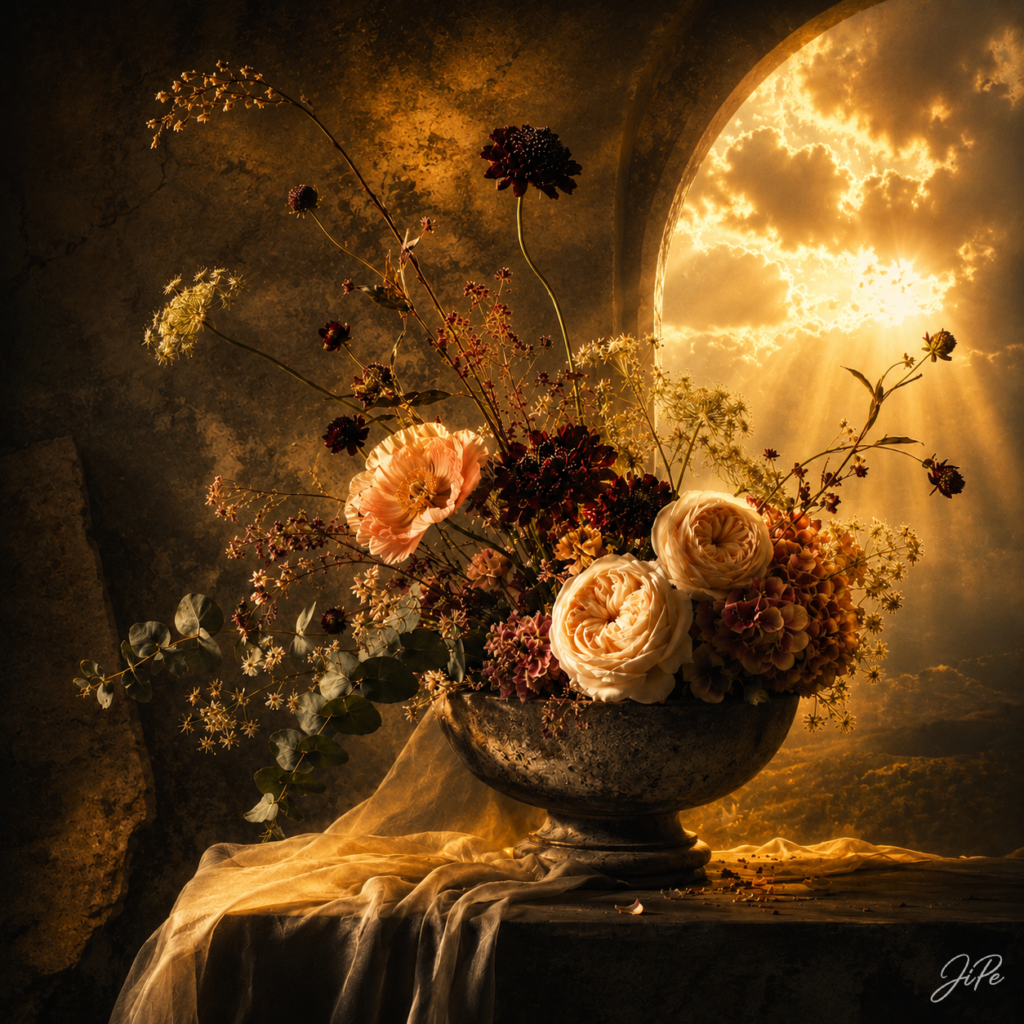
Echoes Before Dawn is a contemplative still life that explores the quiet dialogue between beauty, memory, and the promise of renewal. Rooted in the traditions of classical floral painting while infused with the symbolic language of contemporary visionary art, the work transforms an arrangement of flowers into a profound meditation on time, impermanence, and hope. Rather than presenting nature as a decorative subject, the painting invites viewers to experience flowers as living metaphors—silent witnesses to the fragile cycles of existence and the enduring resilience of life.
At the center of the composition rests an elegant stone vessel overflowing with blossoms gathered at different stages of bloom. Cream-colored roses, delicate wildflowers, deep burgundy dahlias, and softly fading botanical forms create a carefully orchestrated balance between vitality and transience. Every flower possesses its own identity, yet together they form a harmonious visual symphony where diversity becomes unity. Their arrangement appears effortless, although every stem and blossom has been composed with remarkable precision, allowing natural spontaneity and artistic intention to coexist.
The monumental arched opening behind the arrangement introduces an architectural presence that elevates the composition beyond the conventions of traditional still life. Through the opening, an immense golden sky unfolds, illuminated by radiant sunlight breaking through dramatic clouds. This luminous horizon becomes more than a background—it serves as a symbolic destination, suggesting that every ending contains the possibility of a new beginning. The contrast between the intimate foreground and the infinite landscape beyond creates a compelling dialogue between the temporary and the eternal.
Light is the defining force of the painting. Warm golden rays stream through the opening, gently embracing each petal, leaf, and fold of fabric. Rather than merely illuminating the scene, the light becomes an active participant in the composition, revealing textures while simultaneously suggesting an invisible spiritual presence. It transforms ordinary botanical forms into vessels of quiet transcendence, allowing the viewer to perceive beauty not only through color and form but through atmosphere itself.
The title, Echoes Before Dawn, reinforces this sense of suspended transition. The painting occupies an ambiguous moment that feels poised between night and morning, between silence and awakening. It captures the emotional interval before transformation becomes visible—the quiet breath before the first light fully emerges. In this space, memory and expectation coexist, creating a contemplative atmosphere that encourages reflection rather than certainty.
The stone vessel carries significant symbolic weight within the composition. Its weathered surface evokes permanence, history, and the passage of generations. Unlike the flowers it contains, the vessel appears timeless, suggesting continuity amidst inevitable change. Together, the flowers and the stone create a visual dialogue between what flourishes briefly and what endures across centuries. This relationship reflects one of the oldest themes in the history of art: the tension between mortality and permanence.
The flowing translucent fabric cascading across the stone table introduces another subtle layer of meaning. Its delicate folds soften the solidity of the architectural setting while suggesting movement, grace, and the invisible passage of time. Drapery has long served painters as a symbol of transition, concealment, and revelation. Here it gently bridges the earthly materiality of the still life with the luminous openness beyond the arch, reinforcing the painting’s central theme of transformation.
The carefully restrained palette of warm ivory, soft blush, deep burgundy, muted olive, and radiant gold contributes significantly to the work’s emotional resonance. Gold dominates the atmosphere without overwhelming it, functioning as both light and symbol. Throughout art history, gold has represented divinity, enlightenment, and incorruptible beauty. In Echoes Before Dawn, it becomes the visual language of hope itself, suggesting that even the most fragile moments are touched by something enduring.
Compositionally, the painting demonstrates exceptional balance between classical order and organic freedom. The generous negative space surrounding the floral arrangement allows the viewer’s eye to rest before naturally returning to the richly detailed centerpiece. Vertical botanical forms create elegant upward movement, while the circular vessel anchors the composition with stability and calm. The sweeping curve of the stone arch frames the distant light, establishing a graceful rhythm that unites architecture, nature, and atmosphere into a cohesive visual experience.
Within the broader tradition of art history, Echoes Before Dawn engages in dialogue with the great still-life painters of the Dutch Golden Age while simultaneously embracing the symbolic ambitions of nineteenth-century Symbolism and the atmospheric qualities of contemporary visionary art. Like the vanitas paintings of the seventeenth century, it acknowledges the fleeting nature of earthly beauty. Yet rather than emphasizing mortality through melancholy, the work offers a more hopeful interpretation. It suggests that impermanence is not merely a reminder of loss, but an essential condition that gives beauty its emotional depth.
For art historians, the painting may also be understood as a contemporary reinterpretation of the hortus conclusus—the enclosed garden that has historically symbolized contemplation, purity, and spiritual refuge. Here, however, the garden is distilled into a single vessel of flowers positioned before an opening toward the infinite. This subtle transformation shifts the focus from enclosed perfection to expansive possibility, inviting viewers to contemplate not only the beauty they see but the unseen future that lies beyond the illuminated horizon.
Ultimately, Echoes Before Dawn is a meditation on hope carried through silence. It reminds us that beauty often speaks most powerfully in moments of stillness, and that the quiet hours before dawn contain the seeds of renewal. The flowers, though destined to fade, radiate extraordinary presence precisely because of their impermanence. Bathed in luminous golden light and framed by an eternal sky, they become symbols of resilience, gratitude, and the timeless rhythm through which every ending gently prepares the way for a new beginning.