
The Ruins of a Celestial Passage
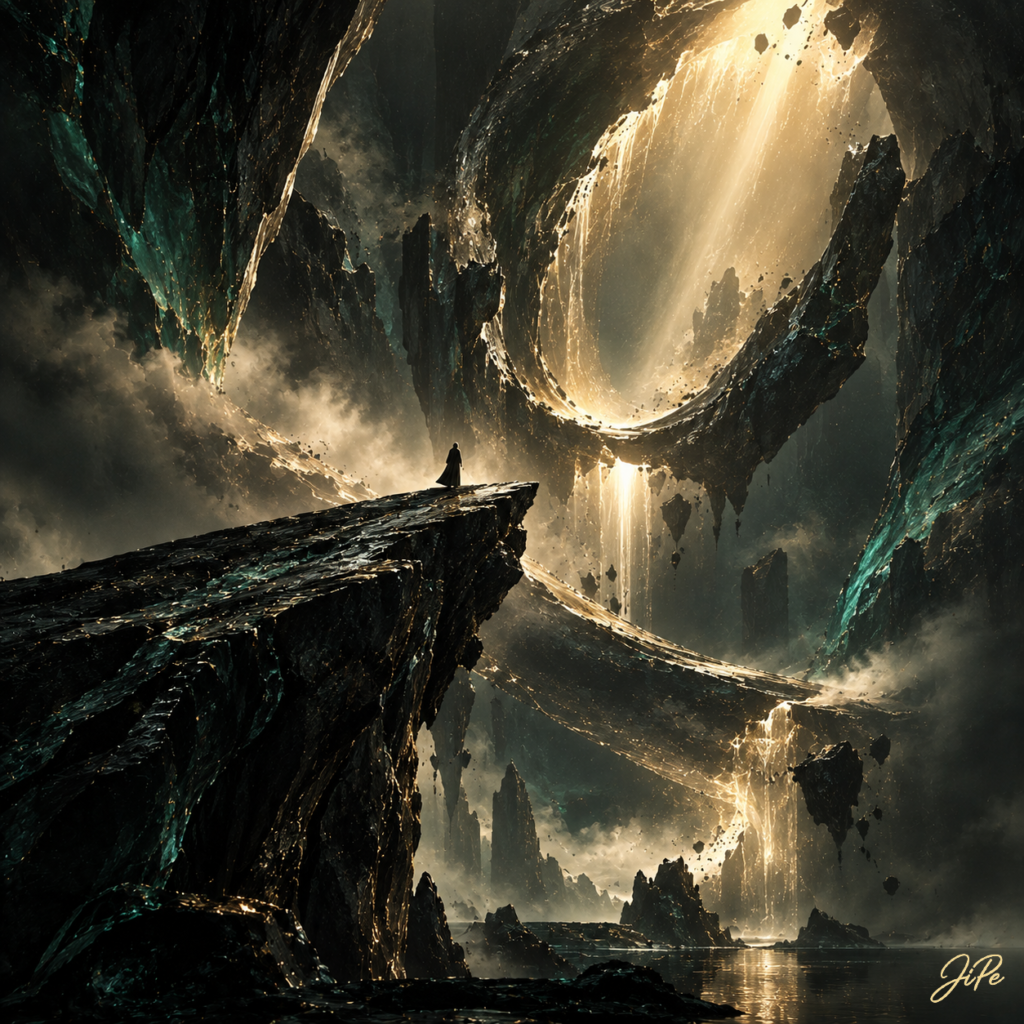
The Ruins of a Celestial Passage opens upon the aftermath of something too vast to name. A solitary presence stands at the edge of an immense rupture, where scale overwhelms ordinary measures of distance and the surrounding world appears suspended between collapse and continuation. Silence becomes almost architectural, holding together what gravity and time seem to have abandoned.
Light enters this fractured space with unsettling authority. It does not restore what has been broken, nor does it reveal what once existed. Instead, it traces the remains of a passage whose destination has become unknowable. The tension lies precisely there: something has survived, but perhaps only enough to make absence perceptible.
The title suggests that even pathways imagined as eternal may become ruins. What appears celestial is therefore not exempt from loss; transcendence itself seems capable of leaving remnants. The small human presence intensifies this thought, standing before forces whose history exceeds any individual memory.
Yet the passage is not entirely closed. Light continues through the fracture. Whether it marks an ending, an invitation, or merely the lingering radiance of something already gone remains uncertain. Perhaps some thresholds survive only as the desire to cross them.