Bob Marley

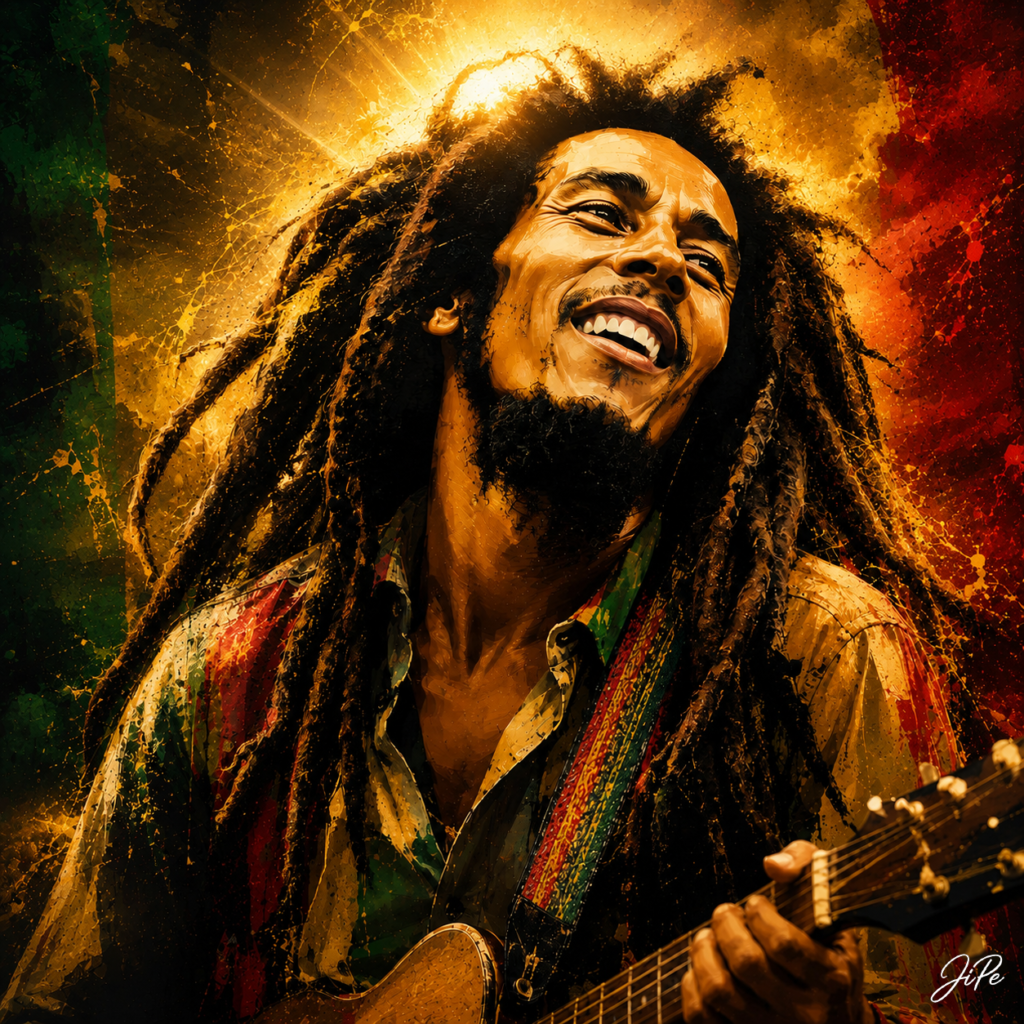
Bob Marley is a vibrant tribute to one of the most influential cultural figures of the twentieth century—a musician whose legacy transcended entertainment to become a universal symbol of peace, freedom, unity, and spiritual awakening. Rather than functioning as a conventional portrait, the artwork seeks to capture the essence of Marley’s enduring philosophy. It portrays not merely the man himself, but the emotional and cultural energy that continues to resonate through his music and message decades after his passing.
At the center of the composition, Marley is depicted in a moment of pure expression. His joyful smile, closed eyes, and relaxed posture suggest complete immersion in the music, conveying an experience that feels deeply personal while simultaneously becoming universal. The guitar held in his hands is more than an instrument; it is a visual extension of his voice—a symbol of communication, resistance, healing, and hope. Music becomes the invisible force that binds every element of the composition together.
The portrait is executed in a dynamic contemporary style that combines painterly realism with expressive abstraction. Bold textures, energetic splashes of paint, and layered brushwork infuse the image with movement, reflecting the rhythmic vitality that defined Marley’s performances. Rather than pursuing photographic precision, the artwork embraces emotional realism, allowing texture and color to communicate feeling as powerfully as facial expression.
Light occupies a central symbolic role throughout the composition. A radiant golden halo of luminous energy surrounds Marley’s head, elevating the portrait beyond biography into the realm of cultural iconography. This glowing aura should not be interpreted as religious symbolism alone, but as a metaphor for inspiration, creativity, and the enduring influence of an individual whose ideas continue to illuminate generations around the world. The light appears almost musical in nature, expanding outward like invisible sound waves that dissolve the boundary between performer and audience.
The color palette reinforces the portrait’s symbolic language. Rich gold dominates the composition, representing wisdom, vitality, and timeless significance, while the unmistakable accents of green, yellow, and red evoke the cultural identity of Jamaica and the broader visual heritage associated with Rastafarianism. Rather than functioning as decorative references, these colors establish an immediate cultural context while celebrating Marley’s profound connection to his homeland, his beliefs, and the global community that embraced his message.
The expressive treatment of the background avoids literal environments, replacing them with an energetic field of abstract textures and radiant illumination. This intentional absence of a defined setting shifts attention away from historical specificity and toward the emotional presence of the subject. Marley exists within a timeless visual space where music, memory, and cultural identity merge into a single symbolic atmosphere. The painting therefore becomes less about documenting an individual moment and more about visualizing a lasting legacy.
Compositionally, the portrait achieves a compelling balance between intimacy and monumentality. The close framing establishes an immediate emotional connection with the viewer, while the upward tilt of Marley’s face and the expansive burst of golden light create a sense of elevation and openness. His gaze remains inward rather than outward, inviting the audience not to observe a performance, but to witness an intimate moment of creative transcendence. The surrounding abstract energy amplifies this sensation, suggesting that the music extends far beyond the physical boundaries of the canvas.
Within the broader context of contemporary portraiture, Bob Marley demonstrates how modern figurative art can merge realism with symbolic storytelling. The work draws inspiration from Pop Art’s celebration of cultural icons, Expressionism’s emotional intensity, and contemporary mixed-media aesthetics, while maintaining a distinctive visual identity rooted in fine art rather than commercial imagery. The result is a portrait that feels both immediate and timeless, honoring a universally recognized figure without reducing him to nostalgia or celebrity.
For art historians, the painting may be understood as part of a long artistic tradition in which exceptional individuals become archetypal figures representing broader human ideals. Like portraits of poets, philosophers, saints, and revolutionaries throughout art history, Marley is presented here not simply as a historical personality but as a cultural symbol. His image embodies values that continue to resonate across national, linguistic, and generational boundaries: freedom, compassion, resilience, equality, and the transformative power of artistic expression.
The work also reflects the enduring relationship between music and visual art. Throughout history, artists have sought ways to translate rhythm, harmony, and emotion into visual form. In this painting, flowing textures, radiant light, and expressive brushwork evoke the improvisational quality of music itself. The composition appears to pulse with invisible sound, allowing the viewer to experience not only Marley’s likeness but also the spirit of the songs that made him a global voice for justice and humanity.
Ultimately, Bob Marley is a celebration of hope expressed through art. It reminds us that true influence is measured not only by artistic achievement but by the ability to inspire empathy, courage, and unity across cultures. The portrait captures a fleeting moment of joy, yet within that single expression lies an enduring message—that music possesses the remarkable power to heal divisions, awaken the human spirit, and remind us of our shared humanity. More than a portrait of a legendary musician, this artwork stands as a luminous tribute to a legacy that continues to resonate wherever people seek freedom, peace, and the universal language of song.