
Ancient Portal in a Cavernous Abyss
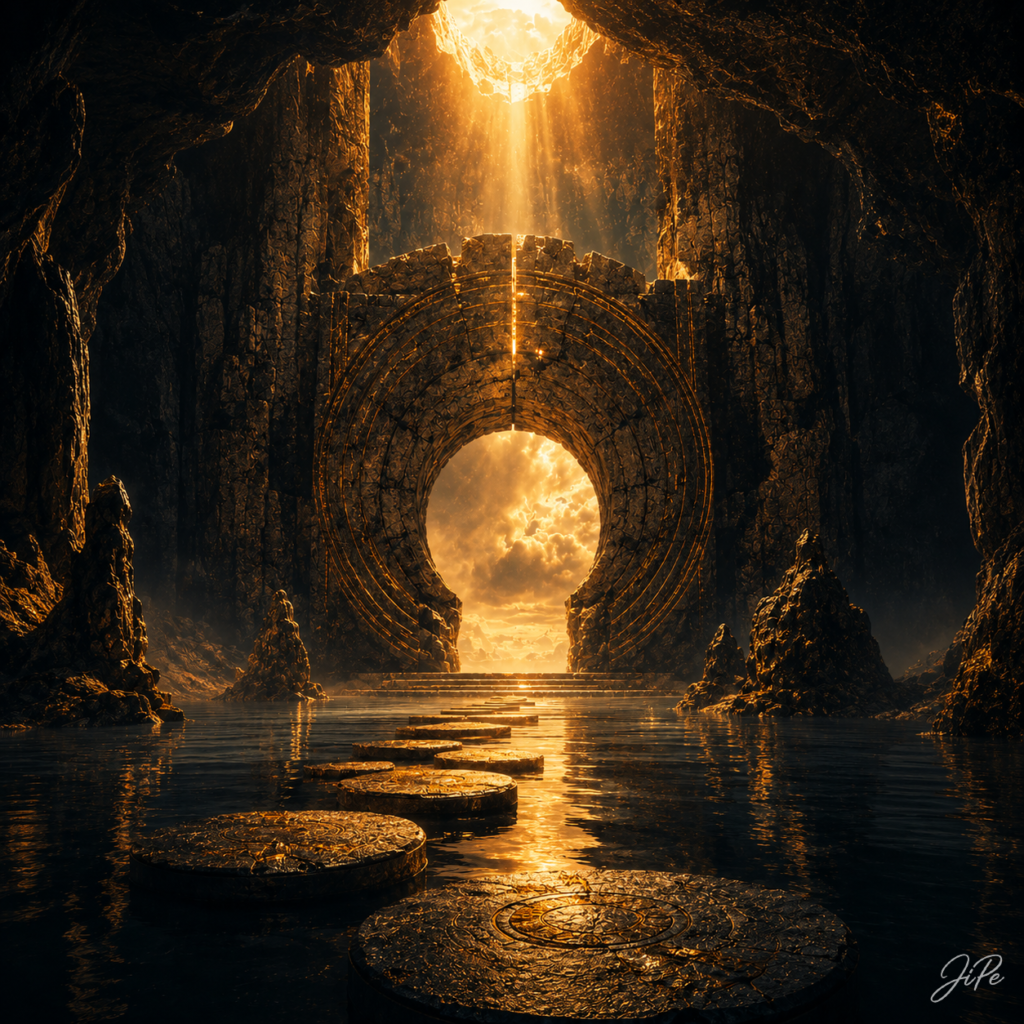
Ancient Portal in a Cavernous Abyss is a monumental meditation on mystery, transcendence, and the enduring human desire to cross the threshold between the visible and the invisible. Set deep within an immense subterranean sanctuary, the painting evokes a forgotten civilization whose architecture was conceived not merely as construction, but as a bridge between worlds. Every stone, every reflection, and every shaft of golden light contributes to a visual language that speaks of timeless wisdom, sacred geometry, and the eternal search for higher understanding.
At the center of the composition stands an immense circular gateway carved from weathered stone, illuminated by radiant light descending from an opening high above. The portal dominates the space with quiet authority, its monumental scale suggesting that it was built for purposes far beyond ordinary human experience. Rather than functioning as a literal entrance, it becomes an archetypal symbol of transition—a place where physical reality dissolves and spiritual possibility begins.
The circular form carries profound symbolic significance throughout the history of art and philosophy. It represents eternity, unity, cosmic order, and the endless cycle of transformation. Here, the ancient gateway appears simultaneously complete and fractured, hinting at civilizations long vanished and knowledge partially forgotten. The subtle interruption at its highest point introduces a quiet tension, reminding the viewer that even the most enduring monuments bear the marks of time, while their deeper meaning remains untouched.
The surrounding cavern functions as a sacred interior landscape rather than a geological environment. Towering rock walls envelop the architecture like the nave of an ancient cathedral, transforming nature itself into a place of contemplation. Darkness fills the immense chamber, yet it is never oppressive. Instead, shadow becomes a necessary counterpart to illumination, creating an atmosphere where mystery is preserved rather than diminished. The viewer senses that countless stories have unfolded within these silent walls, each leaving only fragments behind.
Light is the true protagonist of the composition. Descending from the opening above, brilliant golden rays cascade through the darkness with almost tangible presence. They illuminate the ancient stone surfaces, reveal intricate textures, and transform still water into a luminous mirror that doubles the architectural forms. Rather than serving a purely descriptive function, the light becomes a symbolic force—a visual manifestation of revelation, consciousness, and the arrival of understanding. It does not conquer the darkness; it coexists with it, suggesting that wisdom emerges not by eliminating mystery but by learning to inhabit it.
The pathway of circular stepping stones crossing the reflective water introduces a deeply human dimension to the monumental setting. Unlike the overwhelming scale of the surrounding architecture, these carefully placed stones imply deliberate movement and personal choice. Their measured rhythm transforms the viewer into an imagined traveler, invited to progress step by step toward the portal without certainty of what lies beyond. The absence of a visible human figure strengthens this invitation, allowing every observer to project themselves into the narrative.
Water serves as another powerful symbolic element throughout the work. Its calm surface reflects both the architecture and the descending light, dissolving the distinction between reality and reflection. Across artistic traditions, water has represented memory, purification, intuition, and transformation. Here, it functions as both mirror and threshold, suggesting that the journey toward higher knowledge requires not only physical movement but also inward reflection. Every ripple subtly reminds us that perception itself is fluid, constantly reshaped by experience.
The restrained palette of deep charcoal, obsidian black, weathered stone, and luminous gold reinforces the painting’s timeless character. Gold has long symbolized enlightenment, divinity, and incorruptible truth, and in this work it becomes far more than a color. It permeates the atmosphere, appearing to emanate from the architecture itself, as though the ancient structure continues to preserve an energy that transcends historical time. The contrast between glowing warmth and profound darkness creates extraordinary visual depth while strengthening the painting’s emotional resonance.
Compositionally, the work achieves remarkable balance through symmetry, perspective, and carefully orchestrated spatial rhythm. The circular gateway anchors the entire composition, while the stepping stones establish a graceful visual progression leading naturally toward its luminous center. Vertical rock formations reinforce the monumentality of the space, and the descending beam of light creates a powerful axis that unites heaven, architecture, water, and earth into a single harmonious structure. Every element contributes to an experience of stillness, inviting prolonged contemplation rather than immediate interpretation.
Within the tradition of contemporary visionary art, Ancient Portal in a Cavernous Abyss draws inspiration from Symbolism, Romanticism, and Surrealism while maintaining a distinctly contemporary visual language. The monumental architecture recalls humanity’s fascination with forgotten civilizations and sacred monuments, yet its purpose remains intentionally undefined. This ambiguity allows the portal to transcend specific mythology, becoming a universal metaphor for transformation, revelation, and the unknown.
Art historians may interpret the painting through the enduring archetype of the sacred threshold, a motif found across civilizations from ancient temples and ceremonial gateways to medieval cathedrals and visionary landscapes. The circular portal, reflective water, and descending light all belong to a symbolic vocabulary that has long represented initiation, spiritual awakening, and passage between different states of existence. Yet the work avoids direct historical references, allowing its imagery to remain open to personal interpretation while engaging with universal themes that resonate across cultures and eras.
Ultimately, Ancient Portal in a Cavernous Abyss is an invitation to contemplate the spaces that exist beyond ordinary perception. It reminds us that the greatest discoveries are often made not by seeking definitive answers, but by approaching the unknown with curiosity, humility, and wonder. The ancient gateway stands as a timeless symbol of possibility—an eternal passage suspended between darkness and light, history and imagination, the finite and the infinite. It invites each viewer to consider that every meaningful journey begins not with certainty, but with the courage to take the first step toward the mystery that lies beyond the threshold.