Monumental Visionary Fine Art exploring mythology, consciousness, sacred light, and timeless visual storytelling.

Monumental Visionary Fine Art exploring mythology, consciousness, sacred light, and timeless visual storytelling.

Figurative Paintings

Born of Gold

Born of Gold
Born of Gold

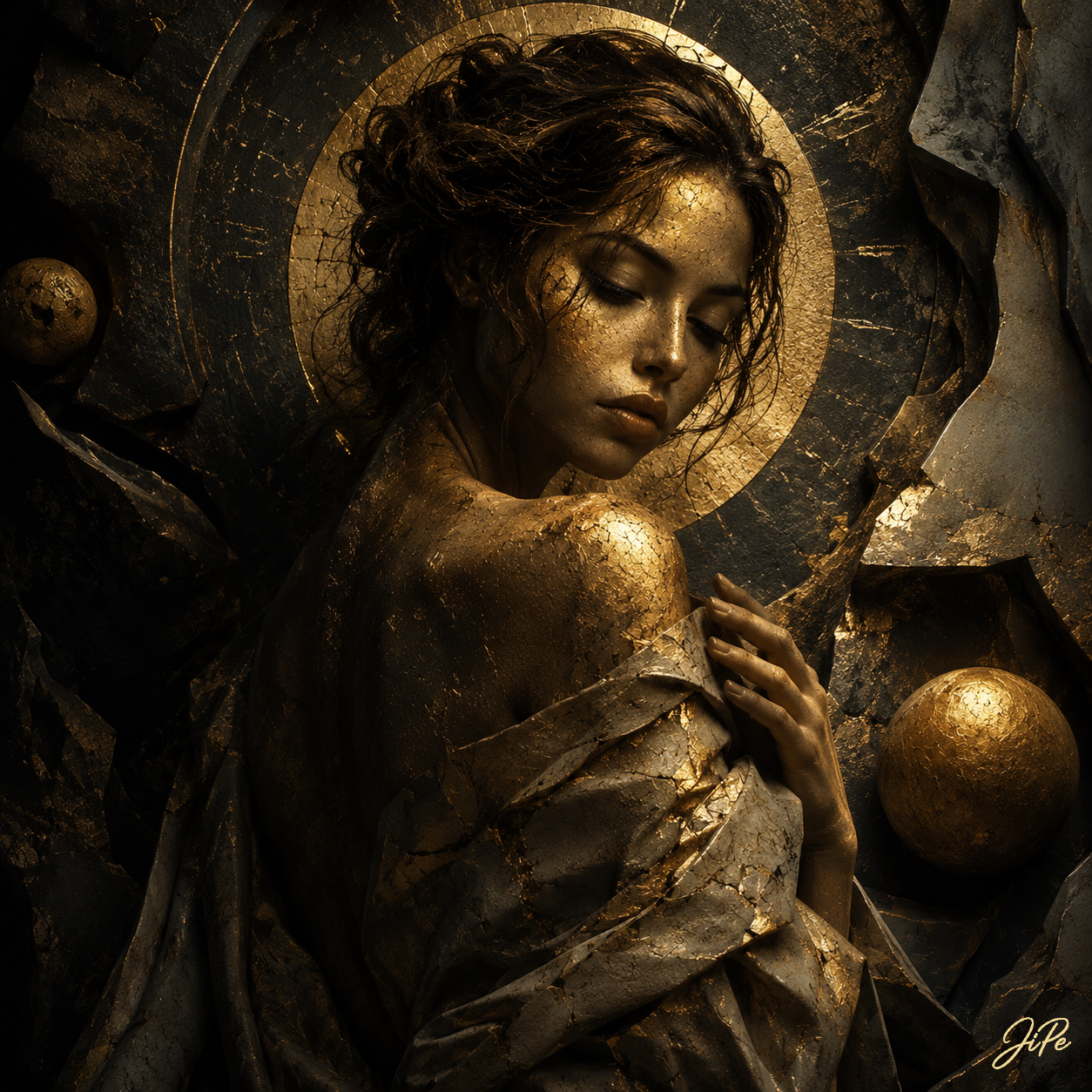
Born of Gold is a celebration of transformation, identity, and inner radiance. Existing at the intersection of symbolic realism, contemporary portraiture, and visionary abstraction, the painting explores the idea that true strength is not inherited through perfection, privilege, or circumstance, but forged through experience. It is a meditation on resilience and renewal—a visual expression of the moment when the human spirit emerges refined by hardship, illuminated from within rather than adorned from without.

The title, Born of Gold, immediately introduces the central paradox of the work. Gold is traditionally associated with wealth, royalty, and permanence, yet within this painting it symbolizes something far more profound. The figure is not covered in gold because she possesses material riches; she appears born from it because gold has become a metaphor for wisdom earned through transformation. Every luminous fragment suggests that beauty is not something applied to the surface but something revealed through life’s deepest experiences.

At the center of the composition rises a solitary female figure emerging from still water. Her posture conveys absolute serenity. Her head is gently tilted upward, her eyes peacefully closed, and her expression suggests complete surrender—not surrender to defeat, but to acceptance. She neither resists nor seeks control. Instead, she exists in perfect harmony with the forces surrounding her. This quiet confidence becomes the emotional foundation of the painting.

The figure is intentionally portrayed as an archetype rather than a portrait of a specific individual. She represents humanity at its most authentic: a being who has moved beyond fear, beyond self-doubt, and beyond the need for external validation. Her closed eyes symbolize inward vision, reminding the viewer that genuine enlightenment begins when attention turns inward rather than outward.

Perhaps the most striking visual element is the extraordinary transformation of the figure’s skin into fractured layers of luminous gold. Rather than concealing imperfections, these intricate golden surfaces emphasize them. Fine cracks spread across her face, shoulders, and neck like ancient geological formations or weathered sacred frescoes. The imagery recalls the philosophy of kintsugi, in which broken objects become more beautiful because of the fractures they have endured. Here, however, the concept is expanded beyond restoration. The woman has not merely been repaired—she has become something entirely new.

Gold functions throughout the painting as a visual language of transformation. It appears to flow through the body like living light, dissolving the traditional boundary between flesh and illumination. The material itself becomes symbolic of resilience, memory, and spiritual awakening. Every shimmering surface suggests that suffering, growth, and self-discovery are not separate experiences but interconnected stages of becoming.

Behind the figure rises an immense golden celestial disc dominating the composition. It simultaneously evokes the sun, a full moon, a sacred halo, and an eclipse. Throughout the artist’s symbolic vocabulary, the circle represents eternity, completeness, and the invisible order underlying existence. Positioned directly behind the figure, it transforms her into both observer and participant within the cosmic rhythm of creation.

The circular form also establishes remarkable compositional harmony. Its monumental presence frames the portrait without imprisoning it, creating a visual dialogue between the individual and the infinite. The viewer senses that the woman is neither separated from the universe nor diminished by it. Instead, she exists as an inseparable expression of its greater order.

Water plays an equally essential symbolic role throughout the painting. The figure emerges from its reflective surface as though being born from memory itself. Water has long represented emotion, purification, transformation, and the subconscious across countless artistic and spiritual traditions. Here it becomes the place of rebirth. The dramatic splashes surrounding the shoulders suggest the exact moment of emergence—the instant when hidden identity rises into conscious existence.

These splashes are not chaotic explosions but carefully choreographed movements that echo the circular geometry of the composition. They create a sense of living energy, reinforcing the idea that transformation is never static. It is an active process, unfolding continuously through life itself.

The surrounding landscape introduces another symbolic dimension. Distant mountain ranges stretch across the horizon beneath celestial bodies suspended within vast atmospheric space. Mountains traditionally symbolize endurance, aspiration, and spiritual ascent. Positioned far behind the figure, they suggest journeys already completed as well as those still waiting beyond the visible horizon. They remind us that becoming is never a final destination but an ongoing pilgrimage.

Small planetary forms suspended throughout the background expand the painting beyond earthly existence. These celestial bodies imply that personal transformation reflects larger cosmic cycles. Birth, dissolution, renewal, and illumination occur not only within individual lives but throughout the universe itself. The painting quietly suggests that humanity participates in rhythms far greater than personal history alone.

The carefully restrained palette reinforces these conceptual themes with remarkable sophistication. Deep charcoal and rich earth tones provide emotional gravity, while luminous gold becomes the visual embodiment of hope and transcendence. Warm bronze, muted amber, and subtle blue-gray reflections introduce depth without distracting from the central symbolic dialogue between darkness and illumination.

Texture is fundamental to the emotional power of the work. Thick impasto surfaces, weathered painterly layers, expressive brushwork, cracked gold leaf effects, and subtle mixed-media textures create a tactile richness that rewards prolonged observation. The painting appears simultaneously ancient and contemporary, carrying the visual memory of sacred icons while embracing the expressive freedom of modern abstraction.

Compositionally, Born of Gold demonstrates extraordinary balance. The figure occupies the central axis with quiet monumentality, while the surrounding circular geometry and symmetrical splashes establish visual stability. Yet subtle asymmetries within the textures, water, and landscape prevent rigidity, allowing the composition to breathe organically. This equilibrium mirrors the painting’s philosophical message: true balance arises not from perfect symmetry but from harmony between opposing forces.

From an art historical perspective, the work exists within a dialogue between Symbolism, sacred portraiture, Romantic notions of the sublime, and contemporary visionary realism. Echoes of Byzantine iconography appear in the radiant halo-like disc, while the expressive surface textures recall contemporary mixed-media practices. Yet the painting ultimately transcends stylistic categorization, establishing its own visual language in which portraiture, abstraction, mythology, and spirituality coexist seamlessly.

Conceptually, Born of Gold reflects upon one of the most enduring human aspirations—the desire to become fully oneself. The painting rejects superficial notions of success or perfection, proposing instead that identity is shaped through vulnerability, endurance, and self-acceptance. Gold becomes the visible manifestation of invisible growth, suggesting that life’s greatest achievements often emerge from its greatest challenges.

The work also speaks powerfully to contemporary audiences living in an age of constant comparison and external validation. Rather than presenting beauty as flawless appearance, the painting celebrates authenticity. Its central figure radiates dignity precisely because she carries the visible evidence of transformation. Her brilliance is inseparable from her history.

Ultimately, Born of Gold is a portrait of awakening. It reminds us that every human being contains an inner luminosity waiting to emerge—not despite life’s fractures, but because of them. The painting proposes that true strength is neither inherited nor imposed; it is forged through experience, refined through resilience, and revealed through acceptance.

Standing before this work, the viewer encounters more than an image of beauty. They encounter a reflection of their own potential for transformation. The silent figure asks no questions and offers no instruction. Instead, she simply exists as living proof that within every moment of darkness lies the possibility of illumination, and that the most enduring form of gold is not the metal we possess, but the spirit we become.

Lämna ett svar