
Keeper of the Sacred Eagle
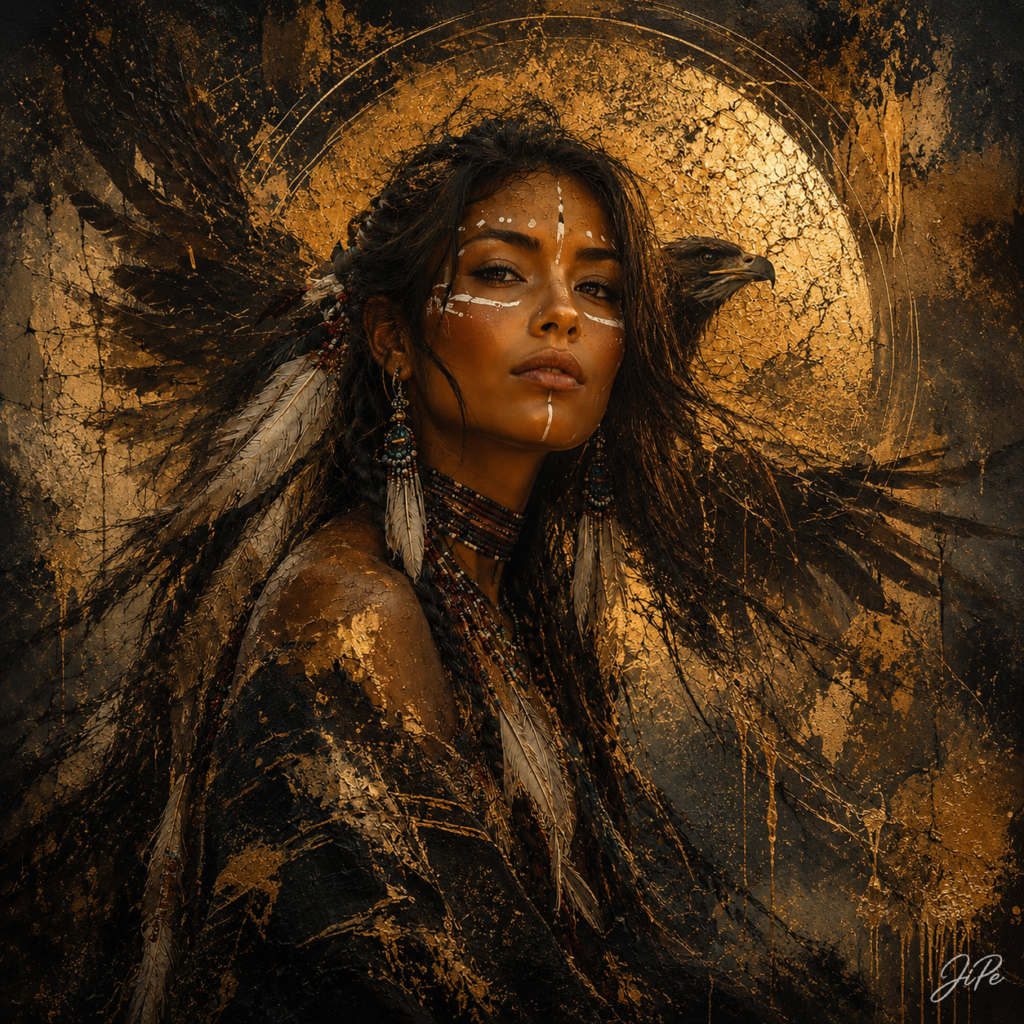
Keeper of the Sacred Eagle is a profound meditation on spiritual guardianship, ancestral wisdom, and humanity’s enduring relationship with the natural world. Blending symbolic portraiture, contemporary visionary art, and indigenous-inspired iconography, the painting presents a timeless figure who stands at the meeting point between earth and sky, instinct and consciousness, tradition and transcendence. Rather than depicting a specific historical individual or culture, the work draws upon universal archetypes, inviting viewers to reflect upon the sacred responsibility of preserving wisdom that has been carried across generations.
At the centre of the composition is the commanding portrait of a young woman whose unwavering gaze immediately establishes a powerful emotional connection with the viewer. Her expression is composed and deeply introspective, balancing quiet confidence with remarkable serenity. She does not appear to confront or challenge the observer; instead, she seems to acknowledge a silent understanding that exists beyond language. Her presence is both intimate and monumental, transforming the portrait into something that transcends individuality and enters the realm of myth and collective memory.
The white ceremonial markings upon her face serve as one of the painting’s most significant symbolic elements. Rather than functioning as decorative ornament, these carefully placed lines evoke ritual, identity, and spiritual initiation. Throughout many indigenous traditions, sacred markings represent belonging, protection, wisdom, and communion with unseen forces. Here they become visual expressions of an inner journey, suggesting that true identity is not defined solely by appearance but by the invisible experiences that shape the soul.
Flowing through her dark hair are feathers that immediately establish a connection with the avian world. Feathers have long symbolised communication between earthly existence and higher realms of consciousness. They embody freedom, transcendence, courage, and the ability to perceive from elevated perspectives. Within the composition they become extensions of the figure herself, blurring the boundary between humanity and nature, reminding the viewer that the deepest forms of wisdom often arise through harmony with the living world rather than mastery over it.
Emerging quietly behind her shoulder is the noble profile of an eagle. Although partially concealed, the bird possesses extraordinary symbolic significance. Throughout countless cultures, the eagle has represented vision, strength, spiritual authority, and the ability to travel between the earthly and celestial realms. Here it functions not as a companion animal but as a guardian spirit—an embodiment of heightened perception and enduring wisdom. Its calm presence reinforces the central theme of the painting: that true guardianship begins with clarity of vision rather than physical power.
The title, Keeper of the Sacred Eagle, expands this symbolism even further. The figure is not portrayed as someone who possesses the eagle but as one entrusted with its legacy. The word keeper implies stewardship, responsibility, and devotion rather than ownership. She safeguards not merely a magnificent creature, but the timeless principles it represents: courage, perspective, integrity, and the sacred relationship between humanity and the natural world.
Behind the figure radiates an immense golden circle that functions simultaneously as halo, rising sun, celestial portal, and sacred mandala. This luminous form anchors the composition both visually and philosophically. Unlike traditional religious halos that identify divine figures, this radiant disc symbolises awakened consciousness. It represents the invisible field of wisdom surrounding those who have learned to live in harmony with forces greater than themselves. The perfect geometry of the circle contrasts beautifully with the expressive textures surrounding it, creating a dialogue between eternal order and the spontaneity of life.
The composition’s restrained colour palette is central to its emotional impact. Rich charcoal blacks, deep earth tones, weathered bronze, and radiant gold create an atmosphere of timeless dignity. Gold flows across the surface in fractured textures, painterly splashes, and luminous accents, recalling ancient gilded manuscripts, ceremonial objects, and the philosophy of kintsugi, where visible fractures become symbols of resilience rather than imperfection. Here, gold represents living wisdom—something accumulated through experience, preserved through memory, and continually renewed through transformation.
The richly layered painterly surface reinforces this narrative. Distressed textures, expressive brushwork, abstract gestures, delicate cracks, and weathered passages give the impression that the image has emerged through countless layers of history rather than being confined to a single moment in time. The portrait feels simultaneously ancient and contemporary, existing beyond historical chronology while remaining deeply relevant to the modern search for identity and belonging.
Although the work possesses remarkable anatomical realism, it continually dissolves into abstraction. Hair merges with feathers, feathers dissolve into painterly movement, and the surrounding atmosphere appears to breathe with organic energy. This fusion of realism and abstraction reflects the painting’s central philosophical idea: that the visible world and the invisible world are never truly separate. Every material form carries within it an unseen spiritual dimension waiting to be recognised.
From an art historical perspective, Keeper of the Sacred Eagle occupies a compelling position between symbolic portraiture, contemporary figurative painting, visionary realism, and monumental fine art. While echoes of indigenous visual traditions, Romantic symbolism, and modern mixed-media aesthetics are present, the painting deliberately avoids direct cultural appropriation or historical illustration. Instead, it creates a universal visual language that honours humanity’s shared reverence for nature, ancestral knowledge, and spiritual continuity.
The painting ultimately reflects upon one of the oldest human questions: How do we preserve wisdom in an age that often values speed over reflection? The figure offers no verbal answer. Instead, she embodies one. Her stillness, her unwavering gaze, and her quiet relationship with the eagle suggest that wisdom is not accumulated through possession but through attentive listening, humility, and respect for the living world.
Ultimately, Keeper of the Sacred Eagle is a celebration of guardianship in its highest form. It reminds us that the most enduring forms of strength are rooted not in conquest but in responsibility; not in dominance but in harmony. Standing before this portrait, viewers are invited to reflect upon the invisible inheritances they themselves carry—the values, memories, and truths entrusted to every generation. In the silent dialogue between the woman, the eagle, and the radiant circle of light, the painting reveals that true guardians are those who preserve not only the beauty of the world, but also the wisdom that gives it meaning.