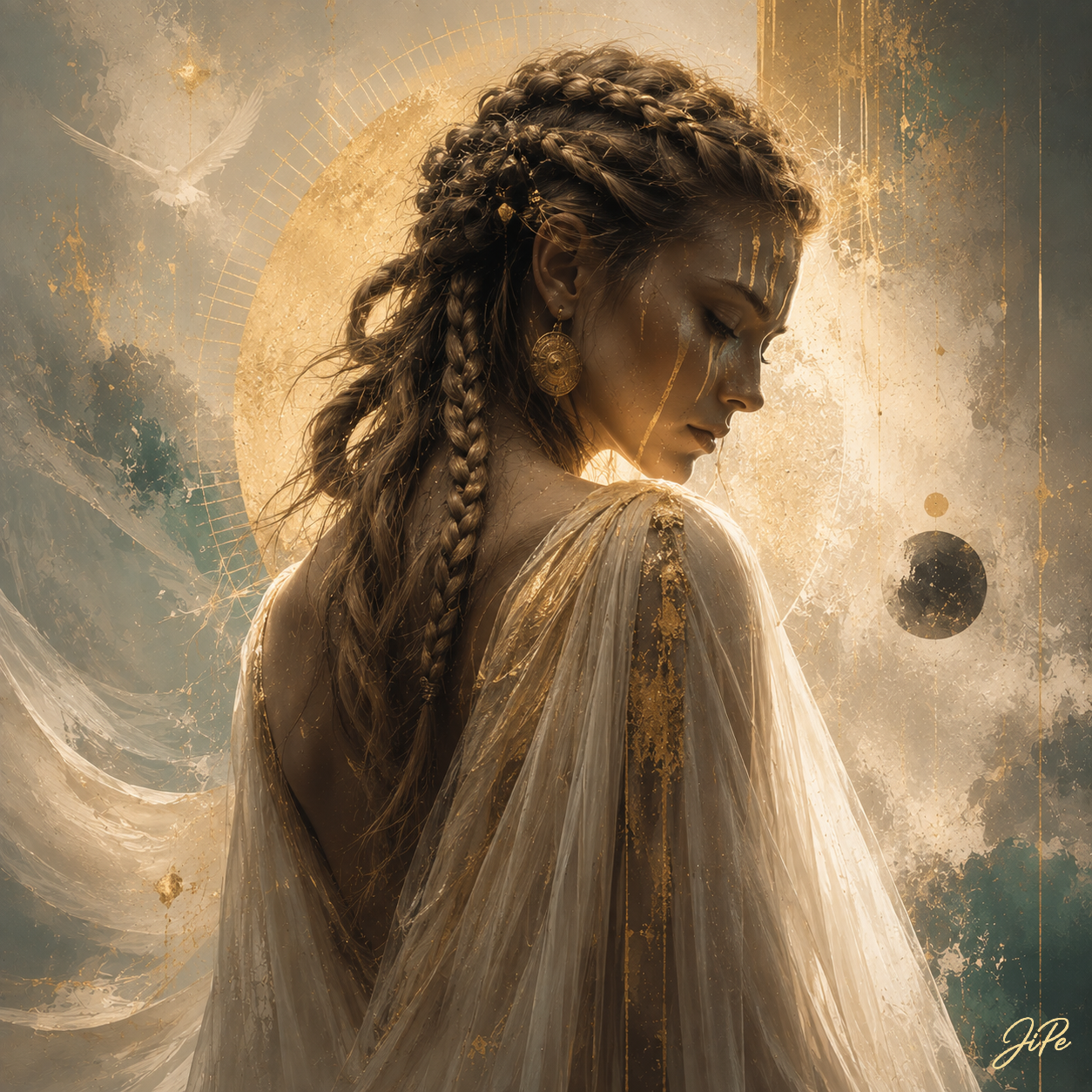
The Elegance of Shadows

The Elegance of Shadows explores the quiet authority of mystery, revealing beauty not through complete disclosure, but through suggestion, restraint, and symbolic complexity. Positioned between contemporary figurative painting, visionary symbolism, and abstract mixed-media aesthetics, the work invites viewers into a contemplative world where darkness is transformed into a language of refinement rather than fear. Every element within the composition—its commanding figure, celestial geometry, raven, wine, flowing fabric, and luminous gold—functions as part of a carefully orchestrated visual narrative that celebrates the power of the unseen.
Rather than presenting shadow as an absence of light, the painting proposes that shadow is a space of depth, introspection, and transformation. It is within these hidden places that identity matures, wisdom is gathered, and beauty acquires permanence. The title itself suggests that true elegance is not born from perfection or visibility, but from confidence in ambiguity—from the ability to remain composed while carrying mysteries that need no explanation.
At the center of the composition sits a solitary female figure whose presence commands immediate attention. Dressed in black, wearing dark glasses, and framed by an immense circular halo of fractured gold, she appears suspended between the contemporary and the timeless. Her posture conveys neither arrogance nor submission; instead, it embodies complete self-possession. She neither performs for the viewer nor retreats from observation. She simply exists with absolute certainty.
This deliberate stillness transforms the portrait into something archetypal. She becomes less an individual and more a symbol of inner sovereignty—a figure who has discovered that genuine strength requires neither spectacle nor validation. Her elegance is therefore psychological before it is visual. It arises from composure rather than ornament.
The black garments reinforce this interpretation. Throughout art history, black has occupied contradictory roles, representing mourning, sophistication, power, spirituality, and secrecy. Within this painting, these associations merge into a unified visual language. Black absorbs rather than reflects, inviting prolonged observation instead of immediate understanding. It becomes the perfect companion to gold, whose brilliance appears even more profound against surrounding darkness.
Behind the figure unfolds a monumental circular form composed of textured gold leaf and weathered surfaces. This celestial disk functions simultaneously as halo, moon, eclipse, architectural monument, and metaphysical symbol. Its cracked surface recalls ancient frescoes, weathered icons, and archaeological fragments, suggesting that sacredness is never untouched by time.
Rather than serving merely as a decorative backdrop, the golden circle establishes the painting’s conceptual center. It suggests completeness while acknowledging fracture, reinforcing one of the work’s central ideas: wholeness does not emerge through perfection, but through integration. Every crack within the surface becomes evidence of history rather than damage, transforming imperfection into visual richness.
The presence of the black eclipse suspended within the golden disk introduces another profound symbolic layer. Throughout mythology and philosophy, eclipses represent moments of transition when ordinary perception is interrupted. They remind us that cycles of concealment are as essential as cycles of revelation. Here the eclipse becomes a visual metaphor for the hidden dimensions of consciousness—the aspects of ourselves that remain invisible until moments of profound transformation.
Flowing through the composition are translucent ribbons that drift across the scene like fragments of memory or passing thoughts. Their graceful movement contrasts beautifully with the figure’s unwavering stillness, introducing rhythm into an otherwise monumental composition. These luminous forms blur distinctions between fabric, smoke, spirit, and light, creating a poetic ambiguity that encourages viewers to interpret them according to their own experiences.
Their movement suggests the invisible forces constantly shaping human existence: time, memory, emotion, intuition, and imagination. Though impossible to grasp, they leave undeniable traces upon identity. In this sense, the painting acknowledges that much of what defines us remains intangible.
One of the composition’s most striking symbolic elements is the raven positioned beside the central figure. Throughout countless cultures, ravens have represented wisdom, prophecy, guardianship, transformation, and communication between visible and invisible worlds. Far from functioning as an omen of darkness alone, the raven here becomes an intellectual companion—a silent witness whose presence reinforces the painting’s contemplative atmosphere.
Unlike dramatic portrayals of ravens within Gothic traditions, this bird remains composed and observant. It neither threatens nor distracts. Instead, it balances the composition while quietly suggesting that knowledge often arrives through patience rather than certainty. The relationship between the woman and the raven remains intentionally undefined, inviting endless interpretation. Are they companions? Reflections of one another? Keeper and guide? The painting offers no definitive answer.
The glass of red wine positioned before the figure introduces an unexpected note of humanity within an otherwise symbolic environment. Wine has long represented celebration, ritual, sacrifice, memory, and the passage of time. Here it may be understood as an emblem of lived experience itself—its richness, complexity, and occasional bitterness.
Placed at the intersection between viewer and subject, the glass becomes a subtle invitation. It reminds us that contemplation is not detached from life but deeply rooted within it. Wisdom is not accumulated outside experience but distilled from it, much like wine itself matures through time and patience.
The composition’s architectural organization reflects remarkable discipline. Vertical lines descend throughout the painting like invisible axes connecting heaven and earth. Circular geometries establish visual harmony while fragmented textures introduce tension and movement. This careful balance between order and spontaneity gives the work its distinctive emotional resonance.
The viewer’s eye continually travels between opposing forces: light and darkness, solidity and transparency, stillness and motion, concealment and revelation. Rather than resolving these oppositions, the painting allows them to coexist, suggesting that genuine harmony arises not from eliminating contradiction but from embracing it.
Materiality plays an equally important role within the painting’s visual language. Thick painterly textures evoke cracked plaster, aged frescoes, oxidized metals, and sculptural relief. These richly layered surfaces create the illusion that the work has accumulated history over centuries. Gold appears applied, weathered, fractured, and rediscovered rather than simply painted.
This tactile complexity strengthens the painting’s conceptual foundation. Time itself becomes visible through texture. Every crack, every layered surface, every fragment of gold suggests endurance rather than decay. The work celebrates the beauty of permanence achieved through transformation rather than preservation.
From an art historical perspective, The Elegance of Shadows draws inspiration from multiple visual traditions while maintaining a distinctly contemporary voice. The symbolic richness recalls the late nineteenth-century Symbolist movement, where visual metaphors replaced literal narratives in the pursuit of emotional and spiritual truth. The monumental portraiture echoes Renaissance icon painting while simultaneously embracing the expressive materiality of contemporary mixed-media practice.
Its dramatic interplay between luminous gold and enveloping darkness also reflects echoes of Baroque chiaroscuro, yet here light functions less as theatrical illumination than as philosophical metaphor. The work ultimately belongs to a contemporary lineage of visionary realism in which external appearances become gateways into psychological and spiritual landscapes.
Emotionally, the painting communicates extraordinary restraint. Nothing within the composition seeks immediate drama. Instead, its power emerges gradually through silence, balance, and symbolic density. The viewer becomes aware that the true subject is not the woman herself, but the atmosphere surrounding her—the invisible space where identity, memory, beauty, and mystery converge.
This atmosphere invites prolonged contemplation. Every viewing reveals additional relationships between geometry, symbolism, texture, and gesture. Small details—the suspended botanical branch, delicate circular forms, layered architectural fragments, and flowing translucent ribbons—expand the narrative without ever overwhelming its central presence.
Perhaps the most remarkable quality of The Elegance of Shadows is its refusal to explain itself. Contemporary culture often demands immediate interpretation and complete transparency. This painting resists that expectation with quiet confidence. It reminds us that mystery is not ignorance but depth. Some truths cannot be translated into language because they exist primarily as experience.
The figure’s hidden eyes reinforce this philosophy. Although concealed behind dark lenses, she paradoxically appears more perceptive than many portraits in which every expression is fully visible. Her concealed gaze becomes an invitation for viewers to shift their attention inward. Instead of asking what she sees, we begin asking what the painting allows us to see within ourselves.
Ultimately, The Elegance of Shadows is a celebration of the profound beauty found in restraint, contemplation, and inner certainty. It proposes that elegance is not created through ornament alone, but through the harmony between confidence and silence, strength and vulnerability, darkness and light. Every symbolic element contributes to a visual meditation on identity as something continually shaped by hidden experiences rather than external appearances.
Standing before this work, viewers encounter more than an extraordinary portrait—they enter a sanctuary of reflection where time slows, symbolism unfolds, and silence acquires remarkable presence. The painting becomes both mirror and threshold, asking each observer to consider an enduring question: what if the most luminous parts of ourselves are not those exposed to the world, but those carefully preserved within the elegant architecture of our own shadows?