Monumental Contemporary Symbolism exploring humanity’s encounter with the eternal through light, sacred geometry, mythic architecture, fragmented forms and transcendent landscapes.

Monumental Contemporary Symbolism exploring humanity’s encounter with the eternal through light, sacred geometry, mythic architecture, fragmented forms and transcendent landscapes.

Religious Paintings

Between Destiny and Choice

Between Destiny and Choice

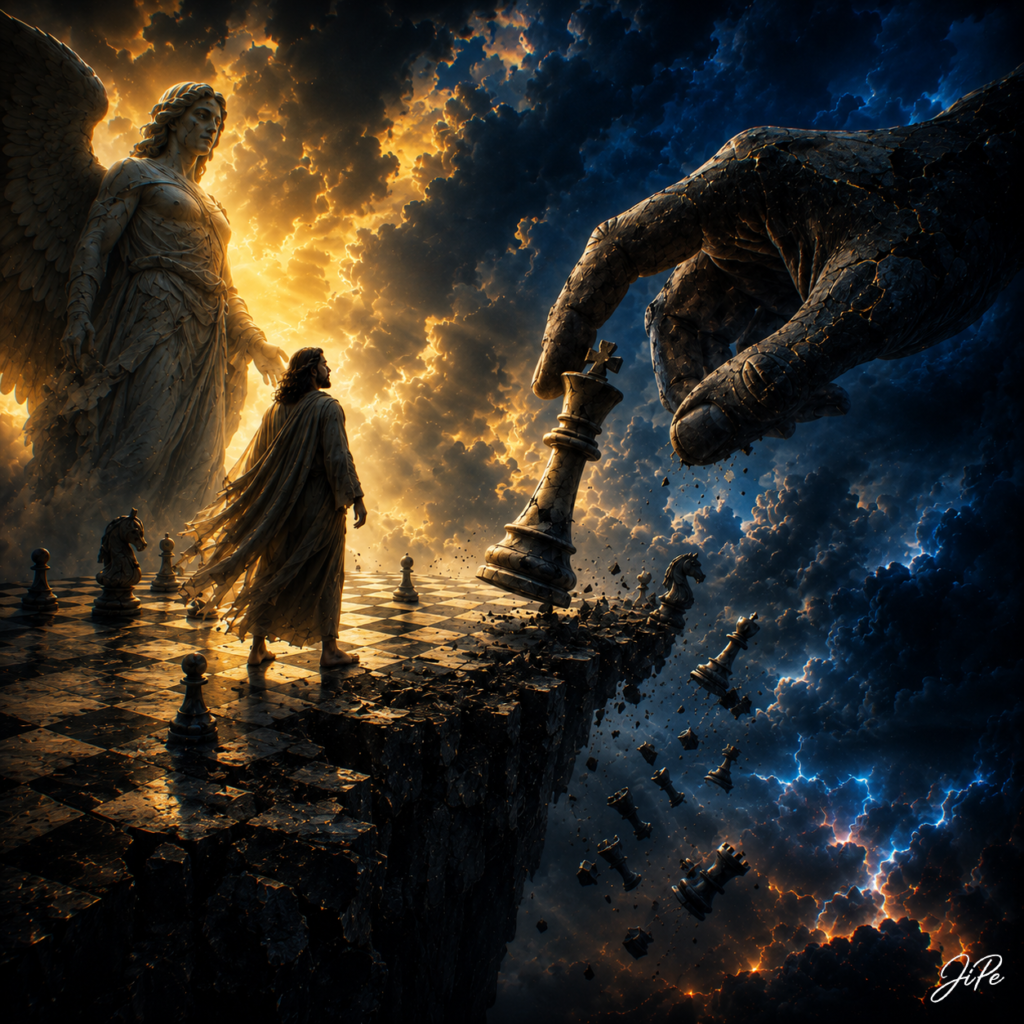
Between Destiny and Choice presents a monumental allegory of human freedom, uncertainty, and the invisible forces that shape existence. Set upon a vast chessboard suspended above an abyss, the work transforms the familiar imagery of a strategic game into an existential landscape. A solitary man stands at the fractured edge of the board while an immense hand reaches from the darkness to move a chess piece before him. Behind the traveler, a colossal winged figure emerges from radiant golden light. Around them, storm clouds divide the heavens into opposing realms of illumination and shadow.

The painting captures neither the beginning nor the conclusion of a story. Instead, it holds the viewer within the decisive moment between what appears predetermined and what may still be chosen.

This tension is already contained within the title. Destiny implies forces beyond individual control: circumstances inherited rather than selected, events already set in motion, and patterns whose full meaning may only become visible in retrospect. Choice, by contrast, suggests agency—the ability to decide, resist, redirect, or create a path where none previously existed.

The painting refuses to declare which of these forces ultimately governs human existence.

Instead, it places the individual directly between them.

The chessboard as a metaphor for existence

The chessboard is the central symbolic structure of the work. Throughout cultural history, chess has frequently served as a metaphor for strategy, conflict, hierarchy, intelligence, power, and fate. Every piece moves according to predetermined rules, yet within those rules an extraordinary number of possibilities remains.

This contradiction makes chess particularly appropriate to the philosophical concerns of Between Destiny and Choice.

A chess piece possesses limited freedom. A bishop cannot move like a rook; a knight follows a specific pattern; a pawn advances according to strict conditions. Yet the outcome of the game is not predetermined simply because rules exist. Decisions still matter.

The board therefore becomes an image of human existence itself.

We enter life within conditions we did not choose: a particular time, place, body, history, culture, and set of circumstances. Certain limits are already present before individual agency begins. Yet within those boundaries, decisions accumulate. A single movement can open possibilities, close others, alter relationships, or redirect an entire future.

The painting asks a fundamental question:

Are we players upon the board—or pieces being moved across it?

Perhaps we are both.

The chessboard is not presented as a stable surface. Its outer edge has broken away, and pieces fall into the enormous darkness below. This destruction changes the meaning of the game. The familiar rules may still exist, but the board itself is collapsing.

Order has encountered uncertainty.

The world can no longer be understood entirely through strategy.

The solitary figure

At the center-left of the composition stands a lone traveler. His scale is modest compared with the supernatural forces surrounding him, yet his position makes him the emotional center of the work.

He faces the enormous hand.

His posture suggests neither submission nor aggression. He appears to be witnessing, questioning, perhaps waiting. His cloak is caught by an unseen force, giving the impression that the environment itself is moving around him while he remains suspended in contemplation.

Importantly, he stands close to the broken edge.

One more step could represent progress, surrender, danger, or transformation.

There is no obvious safe direction.

This gives the figure a distinctly existential character. He has reached a point where the ordinary structure of the world ends. The familiar board no longer extends indefinitely before him. He must confront something beyond its boundaries.

The viewer is invited to identify with this figure precisely because his identity remains ambiguous. He may be a pilgrim, seeker, prophet, king without a kingdom, or simply a human being confronting the consequences of existence.

His anonymity makes him universal.

He becomes the individual at the moment when a decision can no longer be avoided.

The hand that moves the piece

From the dark right side of the composition enters an enormous hand.

Its scale immediately transforms the scene from allegory into metaphysical drama. The hand is not simply larger than the traveler; it belongs to an order of existence beyond ordinary human proportion. Its surface appears dark, weathered, fractured, almost geological. It could belong to a god, a creator, fate itself, or some unknown intelligence operating beyond the visible world.

Between its fingers is a chess piece.

The gesture is delicate.

This is significant.

Despite its overwhelming size, the hand does not strike, destroy, or seize the traveler. Instead, it performs the controlled gesture of a player making a move.

That subtle action may be more unsettling than violence would have been.

If the hand represents destiny, then the painting suggests that fate does not necessarily arrive dramatically. It may operate through seemingly small movements—an encounter, an accident, a decision made by another person, an unexpected loss, an opportunity, a moment of timing.

A single move can transform the entire board.

Yet another interpretation remains possible.

Perhaps the hand does not represent destiny at all.

Perhaps it represents the illusion of destiny—the human tendency to imagine that an unseen player must exist whenever events appear too complex or meaningful to be accidental.

The painting deliberately preserves this uncertainty.

We see the hand.

We do not see who—or what—it belongs to.

The guardian of light

Behind the traveler rises an enormous winged figure illuminated by a brilliant golden opening in the clouds.

Its presence establishes a powerful counterweight to the dark hand.

The figure resembles an angel, guardian, messenger, or monumental sculpture brought into supernatural life. Yet it does not intervene directly. One hand extends toward the traveler, but there is no physical restraint. The figure neither pulls him away from danger nor dictates his next action.

This restraint is crucial.

The guardian may represent guidance without coercion.

Wisdom may be offered.

Protection may be present.

But the choice remains with the individual.

This interpretation creates an important philosophical distinction between guidance and control. The winged presence occupies the realm of illumination, while the giant hand emerges from darkness. It would be tempting to reduce these forces to conventional opposites of good and evil, but the painting supports a more complex reading.

Light may represent consciousness, understanding, revelation, hope, or spiritual awareness.

Darkness may represent uncertainty, fate, the unconscious, mortality, or everything that lies beyond human control.

Neither must be understood purely morally.

Instead, they represent different conditions of existence.

The traveler stands between them.

A divided universe

The sky reinforces this duality through a dramatic division of color and light.

On the left, golden illumination breaks through monumental clouds behind the winged figure. The atmosphere appears almost incandescent, filled with warm light suggesting revelation or transcendence.

On the right, the palette shifts toward deep blue and black. Storm clouds accumulate, lightning cuts through the darkness, and the enormous hand emerges from an environment that appears unstable and immeasurable.

Yet the division is not absolute.

Golden light enters the darkness.

Blue penetrates the illuminated clouds.

The two realms meet near the center.

This prevents the composition from becoming a simplistic battle between opposites. Destiny and choice are not separated into independent worlds. They overlap.

Human existence occurs precisely within that overlap.

The king at the threshold

The chess piece held by the colossal hand appears especially important because of its prominence and position. Whether interpreted specifically as a king or more broadly as a major piece within the game, its scale and placement transform it into a symbol of consequence.

In chess, the king possesses a paradoxical status. It is the most important piece, yet its physical movement is extremely limited. The entire game revolves around protecting it, although many other pieces possess greater mobility.

This provides a powerful analogy for the human condition.

Importance does not guarantee freedom.

Power does not eliminate vulnerability.

Even a king remains constrained by the rules of the board.

If the hand is moving the king, the scene raises an unsettling question: even those who believe themselves powerful may themselves be pieces within a larger system.

Political power, wealth, status, knowledge, and ambition may determine position on the board, but none necessarily provides control over the board itself.

The broken chess pieces falling into the abyss reinforce this idea.

Every piece can fall.

The abyss beyond the board

One of the most psychologically important areas of the composition is the vast space beneath the fractured edge.

There is no visible ground below.

Chess pieces and fragments of the board disappear into cloud and darkness, creating a powerful sense of vertigo. The orderly geometry of the chessboard ends abruptly, giving way to an environment without recognizable rules.

The abyss can therefore represent everything that lies beyond certainty.

Death.

The future.

Chaos.

The unconscious.

The consequences of irreversible decisions.

Or simply the unknown.

Its significance comes precisely from the fact that it remains undefined.

The board represents what can be understood.

The abyss represents what cannot.

The traveler stands where the two meet.

The moment before the move

Although the painting contains enormous visual drama, its true subject is surprisingly quiet.

It is about hesitation.

The giant hand has not yet completed its movement. The traveler has not yet taken another step. The winged guardian has not intervened. The falling pieces remain suspended in space.

Everything is caught in an extraordinary instant of anticipation.

This suspended moment transforms the painting from narrative illustration into philosophical allegory.

We are witnessing the space before consequence.

Human life contains countless such moments, although most appear far less dramatic. Before a decision is made, multiple futures remain possible. Immediately afterward, possibility becomes history.

This transition is invisible in ordinary life.

Between Destiny and Choice gives it monumental form.

Sacred scale and human vulnerability

The dramatic difference in scale between the traveler, guardian, and hand is essential to the emotional impact of the work.

The human figure appears physically small, but the composition does not portray him as meaningless.

Quite the opposite.

Everything appears to revolve around his position.

The hand makes its move before him.

The guardian watches over him.

The board leads toward him.

The opposing fields of light and darkness converge around him.

His smallness becomes the source of the painting’s emotional intensity.

This relationship connects the work to the historical concept of the sublime—the experience of confronting something so vast, powerful, or incomprehensible that ordinary measures of human scale become inadequate.

Romantic painters frequently used mountains, storms, oceans, ruins, and immense skies to create this sensation. Here, however, the sublime is psychological and metaphysical.

The traveler confronts not merely nature, but the possibility that existence itself may operate according to forces beyond his understanding.

Between Symbolism and Surrealism

From an art-historical perspective, Between Destiny and Choice can be situated within a contemporary lineage of visionary symbolism, surrealism, allegorical figurative painting, and the sublime.

Its visual language is highly representational, yet the relationships between objects are impossible. A chessboard becomes a landscape. An angel assumes architectural scale. A disembodied hand emerges from a cosmic storm. Gravity breaks down as pieces fall through an immeasurable void.

These surreal elements are not included simply for spectacle. They function symbolically.

Like historical Symbolist artists, the work uses recognizable imagery to communicate invisible states of mind and philosophical ideas. Rather than illustrating a specific event, it constructs an internal world in which abstract concepts become physical.

Destiny becomes a hand.

Choice becomes the traveler.

Order becomes the chessboard.

Uncertainty becomes the abyss.

Guidance becomes the angel.

Conflict becomes the divided sky.

The painting therefore transforms philosophy into landscape.

Light as a moral and psychological force

Light plays an active role throughout the composition.

The golden illumination behind the guardian does more than establish dramatic contrast. It creates a zone of possibility. Light falls across the traveler and reaches portions of the chessboard, allowing the physical world to emerge from darkness.

Yet the traveler does not stand entirely within the light.

Nor does he stand entirely within shadow.

Once again, he occupies the boundary.

This intermediate position may be the key to the painting.

Absolute certainty would eliminate meaningful choice. If the traveler knew the outcome of every possible action, his decision would become calculation rather than freedom.

Choice requires uncertainty.

The darkness is therefore not merely an obstacle.

It is the condition that makes freedom possible.

The illusion of control

Chess is fundamentally a game built around anticipation. A skilled player attempts to predict consequences several moves in advance.

Human beings behave similarly.

We plan careers, relationships, journeys, investments, ambitions, and futures. We attempt to calculate risk and influence outcomes. Much of civilization is built upon the belief that the future can, at least partially, be organized.

Yet life continually introduces moves no individual has chosen.

Illness, coincidence, historical events, the actions of others, natural forces, unexpected encounters, opportunity, loss, and time itself enter the game.

The colossal hand becomes an extraordinarily effective symbol for these interventions.

It reminds the viewer that agency exists within conditions that agency did not create.

This does not necessarily make freedom meaningless.

It makes freedom more complex.

We may not choose the board.

We may not choose every move made around us.

But we may still choose how to respond.

Destiny and free will

The philosophical conflict between destiny and free will is among humanity’s oldest questions.

If every event results from causes that precede it, in what sense are individuals truly free?

If destiny exists, can it be resisted?

If a higher intelligence knows the future, does human choice remain genuine?

And if existence is fundamentally unpredictable, how much control can anyone realistically possess?

The painting does not attempt to resolve these questions intellectually.

Instead, it makes the viewer feel them.

The traveler stands between an enormous supernatural hand and an angelic presence, upon a board governed by rules but collapsing into chaos.

There could hardly be a more precise visual metaphor for the paradox of human freedom.

We are constrained.

And yet we choose.

We are influenced.

And yet we act.

We cannot control the entire game.

And yet our moves matter.

The guardian who does not decide

Perhaps one of the most sophisticated aspects of the work is the passivity of the winged figure.

A more conventional composition might show the angel rescuing the traveler or fighting the dark force. Here, no such confrontation occurs.

The guardian simply remains present.

This can be interpreted as a profound statement about freedom.

If a higher power physically prevented every harmful decision, choice would cease to exist. If destiny controlled every action completely, responsibility would disappear.

The painting instead imagines a universe in which guidance may exist without eliminating autonomy.

The hand moves.

The guardian watches.

The traveler must decide.

That triangular relationship forms the philosophical core of the composition.

A world already breaking apart

The fractured chessboard adds another layer of urgency.

This is not an abstract philosophical debate occurring in a perfectly ordered universe. The environment itself is collapsing.

Pieces fall.

Stone breaks.

Lightning spreads through the clouds.

The edge beneath the traveler is unstable.

There may be no opportunity to wait indefinitely.

Choice exists within time.

And time eventually forces movement.

This is one of the painting’s most human insights. Many of life’s most important decisions are made without complete information. We rarely receive absolute certainty before choosing a direction.

The board may already be changing while we decide.

The viewer as participant

The composition places the viewer slightly behind and beside the traveler, creating the sensation of entering the scene rather than observing it from a detached position.

We see what he sees.

The hand is before us.

The broken edge is before us.

The angel stands behind and beside us.

The abyss opens below.

This spatial arrangement transforms the philosophical question into something personal.

The painting does not merely ask whether the traveler possesses free will.

It asks whether we do.

If the enormous hand moved a piece before us, would we interpret it as destiny?

Would we resist?

Would we follow?

Would we step backward toward safety?

Would we continue toward the edge?

Or would we discover that what appeared to be the only possible move was never the only possibility at all?

The dignity of choosing

Despite its darkness, Between Destiny and Choice is not fundamentally pessimistic.

The traveler remains standing.

He has not fallen.

He has not been moved like a chess piece.

His feet remain his own.

This detail matters.

The enormous hand manipulates the pieces of the board, but it does not touch the man.

The distinction may contain the painting’s deepest statement about human agency.

Circumstances can be moved around us.

The world can change.

Structures can collapse.

Other forces can influence the conditions under which we live.

But there remains a difference between being affected by the game and surrendering the capacity to choose within it.

Whether that freedom is absolute is less important than the responsibility created by its existence.

Between two possibilities

The title ultimately refuses to place the viewer on either side of the philosophical argument.

It does not say Destiny.

It does not say Choice.

It says Between Destiny and Choice.

That “between” is where human existence takes place.

We live between what has already happened and what has not yet occurred.

Between circumstances and decisions.

Between inheritance and possibility.

Between forces beyond our control and actions for which we remain responsible.

Between certainty and uncertainty.

Between the move made against us and the move we choose in response.

The painting gives monumental form to this invisible territory.

Its angel, giant hand, collapsing chessboard, storm-filled heavens, and solitary traveler transform an abstract philosophical question into an emotionally immediate encounter.

Ultimately, Between Destiny and Choice does not tell us whether destiny exists.

Nor does it promise that every individual is entirely free.

Instead, it presents something more nuanced: a universe in which forces larger than ourselves unquestionably exist, but in which the meaning of our response remains unresolved until we act.

The hand may make its move.

The board may fracture.

The guardian may offer light.

The abyss may wait.

But the traveler has not yet moved.

And in that brief interval—after destiny has revealed its hand, but before the next step has been taken—the painting locates the fragile, extraordinary possibility of human freedom.

Perhaps we cannot choose every piece placed before us. Perhaps we cannot determine the shape of the board or prevent its edges from breaking away. But somewhere between what happens to us and what we do next lies the territory in which a life becomes our own.

Lämna ett svar