Monumental Contemporary Symbolism exploring humanity’s encounter with the eternal through light, sacred geometry, mythic architecture, fragmented forms and transcendent landscapes.

Monumental Contemporary Symbolism exploring humanity’s encounter with the eternal through light, sacred geometry, mythic architecture, fragmented forms and transcendent landscapes.

Fantasy Paintings

Between Sun and Moon

Between Sun and Moon

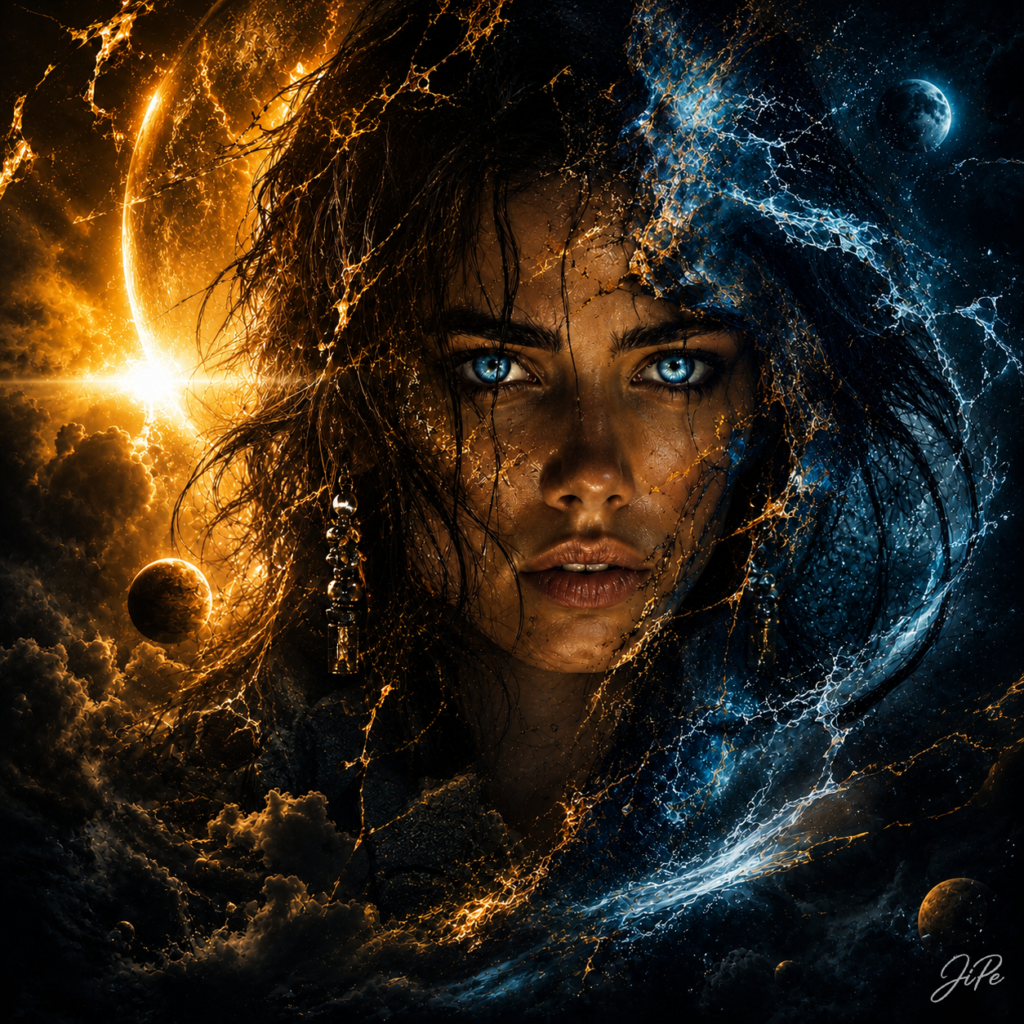
Between Sun and Moon is a monumental exploration of duality, identity, and the fragile equilibrium between opposing forces. At the center of the composition, a solitary female figure emerges from a cosmic environment divided between incandescent gold and deep celestial blue. On one side, the radiance of the sun burns through clouds and fractured matter; on the other, the moon inhabits a cold, seemingly infinite universe. Between them, the woman becomes both boundary and bridge—a human presence suspended between light and darkness, warmth and cold, consciousness and mystery.

The work initially presents itself as a portrait, yet conventional portraiture quickly dissolves. The woman is not positioned against a background in the traditional sense. Instead, her face appears embedded within the universe itself. Hair, skin, clouds, planetary bodies, liquid currents, darkness, and luminous fractures merge until the separation between figure and cosmos becomes uncertain.

She does not simply exist within this universe.

She appears to contain it.

This fusion establishes the central idea of Between Sun and Moon: the possibility that the great oppositions we perceive in the external world may also exist within the individual.

The figure between two worlds

The woman occupies the precise psychological threshold between the painting’s two dominant realms.

To her left, the universe is illuminated by an intense golden sun. Clouds erupt around it, and warm light spreads through the darkness like molten energy. A large celestial arc rises behind her, while smaller planetary bodies appear suspended within the glowing atmosphere.

To her right, the visual temperature changes dramatically. Golden fire gives way to deep blue, black, silver, and icy turquoise. A moon hangs in the distant darkness, surrounded by stars and flowing structures that resemble water, nebulae, shattered glass, or frozen cosmic currents.

The contrast is immediate, but the boundary is not clean.

Gold crosses into blue.

Blue penetrates the darkness around the face.

Fine luminous fractures spread across both sides.

The woman herself carries traces of each realm.

The composition therefore rejects a simple separation of opposites. Instead, it presents identity as something created precisely where opposites meet.

She is neither entirely of the sun nor entirely of the moon.

She exists between them.

The symbolism of the sun

The sun has been one of humanity’s most enduring symbols. Across civilizations it has represented life, consciousness, creation, vitality, knowledge, divine authority, rebirth, and the visible source of earthly existence.

Within Between Sun and Moon, however, the sun is not depicted as a calm celestial disc. It appears explosive and almost overwhelming. Its light erupts through dense clouds, creating a dramatic golden field that seems capable of consuming the surrounding darkness.

This intensity gives solar symbolism an ambiguous character.

Light can reveal.

But too much light can blind.

Fire can sustain life.

But it can also destroy.

The sun therefore represents more than uncomplicated goodness. It embodies energy in its most uncompromising form—the force of existence made visible.

Its golden radiance illuminates one side of the woman, suggesting consciousness, outward experience, vitality, action, and the world that can be perceived directly.

Yet she does not turn toward it.

She looks forward.

This distinction matters.

The figure acknowledges neither the sun nor the moon as her sole source of identity.

She belongs to both—and perhaps to something beyond both.

The symbolism of the moon

On the opposite side, the moon occupies a quieter but equally significant position.

Where the sun overwhelms through radiance, the moon attracts through distance.

Its light is colder, subtler, and more mysterious. It belongs to night, dreams, intuition, memory, transformation, and the hidden rhythms of existence. Unlike the sun, which appears to announce itself through enormous luminosity, the moon exists within darkness without attempting to eliminate it.

This gives the lunar side of the composition a deeply introspective quality.

The surrounding blue currents resemble both cosmic matter and water, connecting the moon symbolically with the subconscious. They flow around the woman’s hair and face as though thoughts, memories, and emotions were becoming visible.

The right side of the painting can therefore be interpreted as an interior realm.

If the sun represents what is revealed, the moon may represent what remains partially hidden.

If the sun represents consciousness, the moon suggests intuition.

If the sun represents action, the moon represents reflection.

Neither is complete without the other.

A portrait of equilibrium

The woman’s frontal gaze becomes especially important within this symbolic structure.

She does not appear overwhelmed by the opposing forces surrounding her. Her expression is controlled, direct, and enigmatic. Her extraordinary blue eyes establish the strongest psychological contact with the viewer.

Unlike many visionary portraits in which the figure looks away, closes the eyes, or enters a state of transcendence, the woman in Between Sun and Moon looks directly outward.

She sees us.

This transforms the viewer from observer into participant.

Her gaze seems almost to ask whether we recognize the same division within ourselves.

The emotional restraint of her expression intensifies this encounter. She neither smiles nor displays fear. She does not dramatize her position between cosmic extremes.

She simply remains.

Her stillness becomes a form of strength.

Around her, planets move, clouds erupt, energy fractures, and light collides with darkness. Yet the face remains the stable center of the composition.

The universe is turbulent.

The individual is still.

The fractured surface

One of the most distinctive visual elements of the work is the network of cracks spreading across the woman and surrounding cosmic environment.

These fractures resemble broken stone, damaged fresco, shattered glass, dried earth, or veins of precious material running through a dark surface. Golden fissures are especially prominent, creating the impression that light exists beneath the visible exterior and is escaping through openings in matter.

This introduces a recurring symbolic relationship between fracture and illumination.

The cracks do not simply indicate damage.

They reveal.

A perfectly intact surface conceals what lies beneath it. A fracture creates an opening.

Within this visual language, vulnerability becomes a form of revelation.

The woman’s face is therefore not diminished by its apparent fragmentation. The fractures deepen her symbolic identity. She appears to have endured transformation without losing coherence.

Indeed, the cracks may be precisely what connects her to the universe.

Similar patterns extend across the celestial environment, suggesting that the same structure exists within the individual and the cosmos.

The boundary between inner and outer worlds begins to collapse.

Gold as inner illumination

Gold plays a particularly important role throughout the work.

It appears in the solar atmosphere, along the edges of the woman’s face, within the fractures, and throughout the darker regions of the composition. Because it repeatedly appears within broken surfaces, gold becomes associated with something hidden but enduring.

It may represent consciousness.

Memory.

Spiritual energy.

Life.

Or the persistence of meaning through transformation.

The visual effect recalls traditions in which precious material is used to emphasize sacredness, while also suggesting the aesthetic principle of treating fracture not as something to conceal but as part of an object’s history.

Here, however, gold is not merely applied to broken surfaces.

It seems to originate from within them.

The woman appears illuminated from beneath her own exterior.

This makes the portrait less about physical beauty than about interior radiance.

Blue as infinity

If gold represents illumination, blue becomes the language of infinity.

The deep blues surrounding the moon create an enormous psychological and spatial distance. They evoke deep water and deep space simultaneously—two environments in which ordinary human orientation becomes uncertain.

This ambiguity is deliberate.

Water and cosmos have long shared symbolic associations with origins, mystery, depth, and the unknown. Both can appear limitless. Both conceal more than they reveal.

The blue material flowing around the woman therefore seems to occupy an intermediate state between water, atmosphere, energy, and celestial matter.

It cannot be identified completely.

And because it cannot be identified, it becomes symbolic rather than literal.

It represents the unknown dimension of existence.

Fire and water

The painting’s two primary chromatic realms can also be interpreted elementally.

The golden side resembles fire.

The blue side resembles water.

Fire transforms through heat.

Water transforms through movement.

Fire rises.

Water falls.

Fire illuminates.

Water reflects.

One consumes.

The other surrounds.

Yet both are essential to life.

The woman stands at their meeting point, suggesting that identity is formed not through allegiance to one element but through the capacity to contain contradiction.

This interpretation expands the meaning of the title beyond astronomy.

The painting is not simply about celestial bodies.

It is about opposing energies held within a single consciousness.

The cosmos as psychological landscape

Although planets, stars, and celestial structures fill the image, Between Sun and Moon should not necessarily be understood as a literal depiction of outer space.

The cosmos can instead be interpreted psychologically.

Throughout the history of art and literature, external landscapes have frequently served as representations of internal emotional states. Storms become conflict. Mountains become obstacles. Oceans become subconscious depth. Dawn becomes awakening.

Here, the entire universe becomes an interior landscape.

The planets may represent distant memories or possible worlds.

The sun becomes consciousness.

The moon becomes intuition.

The clouds become emotional turbulence.

The fractures become lived experience.

The darkness becomes the unknown.

And the woman becomes the consciousness in which all of these forces coexist.

Seen this way, Between Sun and Moon is not primarily an image of a woman inside the universe.

It is an image of the universe inside a human being.

The eyes as a point of convergence

The intense blue eyes provide the painting’s most immediate focal point.

Their luminosity connects them chromatically to the lunar half of the composition, yet warm reflections from the golden side prevent them from belonging entirely to one realm.

They appear almost illuminated from within.

Eyes traditionally symbolize perception, consciousness, knowledge, revelation, and the relationship between inner and outer realities. In this work, their directness becomes particularly meaningful because everything surrounding them is unstable.

Surfaces fracture.

Clouds shift.

Planets float.

Energy flows.

But the gaze remains fixed.

The eyes therefore function as an anchor of consciousness within a universe of transformation.

They suggest awareness itself—the capacity to observe contradictory experiences without necessarily being destroyed by them.

The female figure as archetype

Although highly individualized in appearance, the central woman also functions as an archetypal figure.

She can be interpreted as a guardian of balance, a celestial being, an embodiment of night and day, or a personification of the boundary between opposing cosmic forces.

Yet the painting avoids giving her explicit attributes of conventional mythology. She has no crown identifying her as queen, no weapon defining her as warrior, and no obvious religious emblem establishing a specific theological meaning.

This absence makes her more universal.

She belongs to no single mythology.

Instead, she appears to emerge from a new mythology created within the painting itself.

She could represent the self divided between reason and intuition.

The present and memory.

Strength and vulnerability.

Certainty and mystery.

Mortality and transcendence.

What matters is not identifying her by name, but recognizing the condition she embodies.

Duality without conflict

One of the most important aspects of Between Sun and Moon is that the two sides of the painting are not depicted as enemies.

There is tension, certainly.

The colors oppose one another dramatically.

The temperature shifts from burning gold to cold blue.

The sun and moon occupy different visual worlds.

Yet there is no battle.

This distinction separates the work from traditional imagery of good versus evil.

Instead, it explores complementarity.

Day requires night.

Light becomes perceptible because darkness exists.

Consciousness is shaped partly by what remains unconscious.

Strength acquires meaning through vulnerability.

Certainty exists alongside mystery.

The woman’s identity emerges from the coexistence of these conditions.

She does not defeat one side.

She contains both.

Between portraiture and abstraction

From an art-historical perspective, Between Sun and Moon occupies a territory between visionary symbolism, surrealism, contemporary figurative art, and cosmic abstraction.

The woman’s face is rendered with a high degree of realism, providing an immediate emotional point of access. Yet the surrounding environment increasingly dissolves into abstract structures—fractures, currents, clouds, splashes, filaments, and fields of light.

This tension between realism and abstraction is fundamental to the work.

The face gives the viewer something recognizable.

The surrounding universe destabilizes that recognition.

The result is a visual movement from the familiar toward the unknowable.

Rather than abandoning representation entirely, abstraction appears to grow from the figure herself. Hair becomes cosmic matter. Skin becomes fractured terrain. Clothing disappears into darkness. The boundary of the portrait dissolves.

Identity becomes landscape.

Echoes of the sublime

The work also participates in the tradition of the sublime, in which art attempts to evoke experiences too vast or overwhelming to be contained by ordinary human scale.

Historically, artists often achieved this through immense mountains, violent seas, storms, volcanic eruptions, or endless landscapes. Between Sun and Moon transfers this experience into cosmic space.

The scale of the universe surrounding the woman should make her insignificant.

Yet the opposite occurs.

Her face dominates the cosmos.

This reversal is crucial.

Humanity may be physically small within the universe, but consciousness possesses the extraordinary ability to imagine that universe, contemplate it, question it, and search for meaning within it.

The painting therefore creates a paradox:

the cosmos contains the human being, while the human mind contains an image of the cosmos.

Neither scale completely defeats the other.

A threshold rather than a destination

The word “Between” in the title is perhaps more important than either “Sun” or “Moon.”

To be between things is to occupy a threshold.

It means that one has not completely entered one state or left another.

Thresholds are inherently ambiguous spaces. They belong simultaneously to what lies behind and what lies ahead.

The woman inhabits precisely such a condition.

She exists between illumination and mystery.

Between heat and cold.

Between the visible and invisible.

Between physical identity and cosmic dissolution.

Between what can be known and what must remain uncertain.

The painting does not present this intermediate condition as a weakness.

Instead, it suggests that balance itself may be a form of power.

The human condition as duality

On a broader philosophical level, the work can be read as a meditation on the contradictory nature of human identity.

People are rarely only one thing.

We can be rational and intuitive.

Strong and vulnerable.

Hopeful and afraid.

Certain and uncertain.

Connected and isolated.

Defined by our past while still capable of change.

The desire to eliminate contradiction can create an artificial image of the self. Between Sun and Moon proposes another possibility: that wholeness may not require choosing one side over another.

Perhaps wholeness means learning to contain both.

The fractures across the woman’s face reinforce this interpretation. She is not presented as untouched or perfectly unified.

Her unity includes fracture.

Her light includes darkness.

Her strength includes vulnerability.

Her identity includes contradiction.

Cosmic balance

The celestial bodies surrounding the woman also introduce the concept of balance on a universal scale.

Planetary systems depend upon forces that oppose and sustain one another. Gravity holds bodies together while momentum prevents collapse. Stars exist through equilibrium between immense inward and outward forces.

Balance in the universe is therefore not static.

It is dynamic.

The same principle can be applied symbolically to the human figure.

Her serenity does not suggest the absence of opposing forces.

It suggests their equilibrium.

This is a more complex vision of peace.

Peace is not a world without tension.

It is the ability to remain whole while tension exists.

A contemporary myth of the self

Ultimately, Between Sun and Moon can be understood as a form of contemporary mythology.

Instead of illustrating an established myth, it creates a new symbolic narrative from archetypal elements that remain deeply recognizable: the sun, moon, darkness, light, water, fire, planets, fracture, and the human face.

These symbols are ancient.

Their combination is contemporary.

The painting uses them to address a distinctly enduring question:

How does a person remain whole within a world built from opposites?

Its answer is not delivered through words.

It appears in the woman herself.

She does not escape the divided universe.

She becomes its center.

The sun burns beside her.

The moon watches from the darkness.

Golden fractures cross her skin.

Blue currents move through her hair.

Planets drift around her.

Light and shadow meet across her face.

And still she looks directly outward.

There is no visible fear in that gaze.

Only presence.

The space between opposites

In the final interpretation, Between Sun and Moon is less concerned with choosing between light and darkness than with understanding the space that exists between them.

That space is where transformation occurs.

Dawn exists between night and day.

Twilight exists between day and night.

Memory exists between past and present.

Possibility exists between what has happened and what has yet to occur.

Identity exists between what we have been and what we may become.

The woman inhabits this territory.

She is not merely illuminated by two celestial bodies.

She becomes the threshold through which their opposing energies meet.

This is why the portrait feels simultaneously intimate and monumental. The face belongs to one individual, yet the forces surrounding it are universal.

The painting takes an interior human experience—the struggle to reconcile opposing aspects of existence—and expands it to cosmic scale.

Ultimately, Between Sun and Moon proposes that darkness and light need not cancel one another. They may instead reveal different dimensions of the same reality.

The sun illuminates what can be seen.

The moon accompanies what remains hidden.

One burns.

One reflects.

One announces.

One whispers.

And between them stands the human consciousness, carrying traces of both.

In Between Sun and Moon, wholeness is not found by choosing light over darkness or certainty over mystery. It emerges in the ability to stand between opposing worlds, to carry both within oneself, and to discover that the boundary separating them may also be the place where identity becomes most complete.

Lämna ett svar