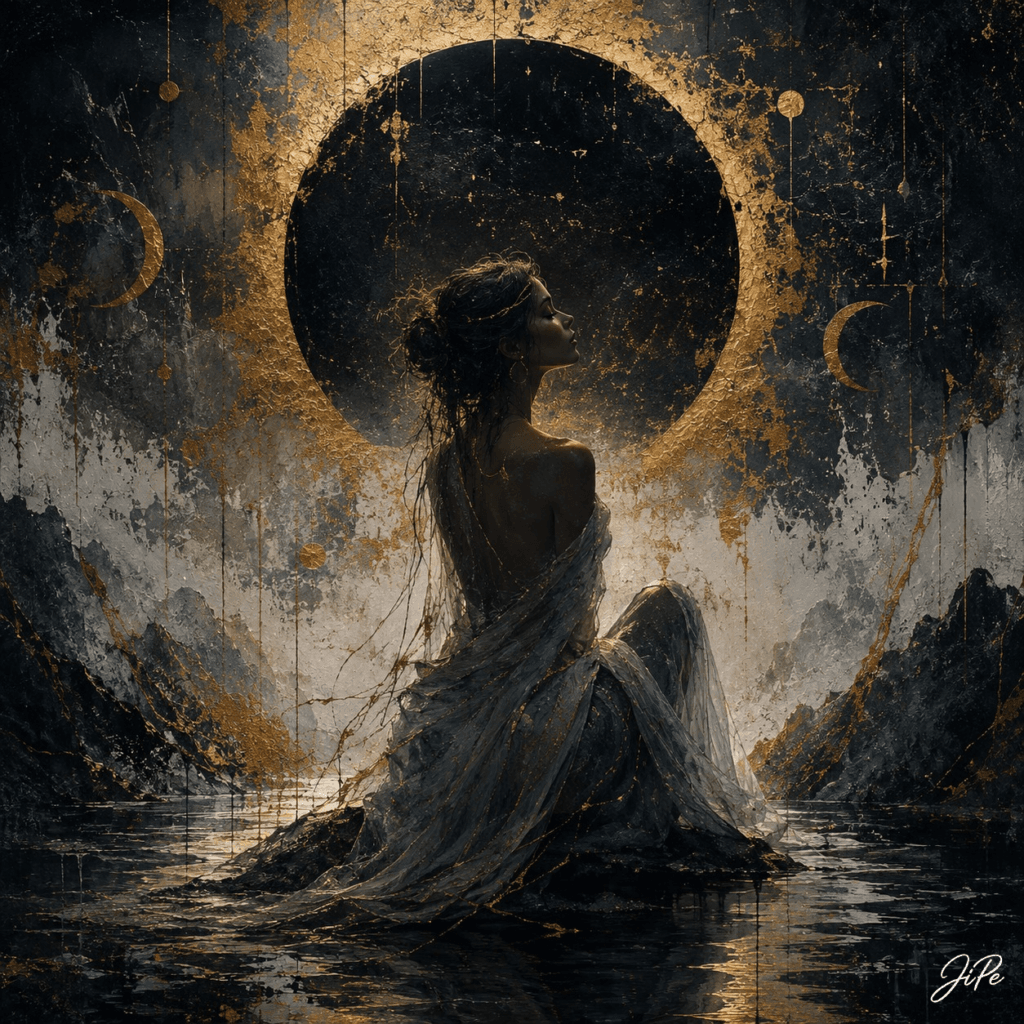
At the Edge of the Eclipse

At the Edge of the Eclipse is a meditation on transition, silence, and the delicate threshold where certainty dissolves into mystery. Suspended between illumination and shadow, the painting explores the profound psychological and spiritual space that exists during moments of transformation—those rare intervals when the familiar world fades, yet the future has not fully revealed itself. Rather than portraying an astronomical phenomenon alone, the eclipse becomes a universal metaphor for the cycles of consciousness, identity, and renewal that define the human experience.
The title refers to more than the celestial event itself. The ”edge” is symbolic of every moment in life when we stand between opposing realities: between fear and hope, memory and possibility, solitude and belonging, the known and the unknowable. It is within these liminal spaces that genuine transformation begins. The painting suggests that growth rarely occurs in moments of certainty, but rather at the boundaries where light and darkness meet in perfect equilibrium.
At the center of the composition sits a solitary female figure, wrapped in flowing ivory fabric and surrounded by still water. She neither reaches toward the eclipse nor turns away from it. Instead, she occupies a posture of quiet acceptance, embodying the calm that arises when one no longer resists change. Her upward gaze is contemplative rather than expectant, suggesting an awareness that true revelation cannot be forced but must emerge naturally through patience and presence.
The figure functions not as an individual portrait but as an archetype of human consciousness. She represents every person who has experienced moments of uncertainty, introspection, and renewal. Her anonymity allows the viewer to enter the composition emotionally, projecting personal memories, questions, and aspirations onto her silent presence. She becomes less a character than a mirror in which the viewer may recognize aspects of their own inner journey.
Dominating the composition is the immense eclipse suspended behind her. Traditionally, eclipses have inspired awe, fear, and spiritual reflection across civilizations, often interpreted as moments when cosmic order temporarily gives way to mystery. In At the Edge of the Eclipse, however, the eclipse is stripped of ominous associations and reimagined as a symbol of balance. Neither the light nor the darkness claims dominance. Instead, both coexist within a single celestial form, suggesting that apparent opposites are not adversaries but complementary aspects of a larger reality.
The luminous golden ring surrounding the dark celestial disk introduces one of the painting’s central symbolic motifs. Echoing the visual language of halos, sacred geometry, and cosmic cycles, it transforms the eclipse into an icon of unity rather than obscuration. Gold becomes the visible expression of continuity, reminding the viewer that even when light appears hidden, it continues to exist beyond immediate perception. The eclipse therefore becomes less an image of disappearance than one of concealed presence.
The surrounding crescent moons and suspended celestial forms reinforce this cosmological narrative. These delicate symbols evoke the rhythms of lunar cycles, the passage of time, and the perpetual movement of the universe. Rather than serving as decorative elements, they establish an invisible framework connecting personal experience with cosmic order. Every celestial body becomes a reminder that human transformation unfolds within patterns far older and greater than individual existence.
Water plays an equally significant symbolic role throughout the composition. Calm and reflective, it serves as both physical environment and psychological landscape. Across cultures, water has long represented the unconscious mind, intuition, purification, and emotional depth. Here, the still surface mirrors fragments of the celestial light without offering a complete reflection, suggesting that truth often reveals itself only partially. Like memory itself, the water preserves impressions while concealing immeasurable depths beneath its surface.
The rocky island upon which the figure rests introduces a subtle yet important contrast. Emerging from the surrounding water, it symbolizes stability amid uncertainty. It is neither fortress nor destination, but a temporary place of contemplation—a threshold between movement and stillness. The viewer senses that the figure has paused not because the journey has ended, but because every meaningful transformation requires moments of silence before the next step can be taken.
The restrained color palette contributes profoundly to the emotional atmosphere of the work. Muted ivory, charcoal, weathered black, deep slate blue, and luminous gold create a sophisticated visual harmony rooted in timeless symbolism. Gold functions as the language of illumination and transcendence, while the surrounding darkness evokes introspection, mystery, and the fertile silence from which insight emerges. Rather than opposing one another, these colors exist in continuous dialogue, reinforcing the painting’s central philosophy that light derives meaning through shadow.
Textural richness is essential to the visual language of At the Edge of the Eclipse. Layered brushstrokes, fractured surfaces, subtle impasto, weathered gold leaf effects, and expressive paint drips create an organic material presence that contrasts with the serenity of the composition. These tactile surfaces suggest the passage of time, reminding the viewer that every emotional and spiritual transformation leaves visible traces. The painting embraces imperfection, echoing the philosophy that beauty often emerges through weathering rather than flawlessness.
Compositionally, the work is governed by remarkable balance and restraint. The circular eclipse anchors the entire composition, establishing a powerful visual axis around which every element quietly revolves. The seated figure occupies the lower center, creating a stable triangular structure that contrasts with the expansive circular geometry above. This dialogue between horizontal stillness and vertical aspiration generates an atmosphere of profound equilibrium, encouraging slow and contemplative viewing.
Negative space plays a critical role within the painting. The expansive dark sky surrounding the eclipse is not empty but charged with presence. It functions as visual silence, allowing the central forms to breathe while inviting viewers to project their own emotional interpretations into the composition. This careful use of emptiness reflects principles found in both Eastern aesthetics and contemporary minimalist composition, where absence becomes as meaningful as form itself.
From an art historical perspective, At the Edge of the Eclipse occupies a compelling position within contemporary symbolic realism while drawing upon traditions of Romantic landscape painting, Symbolism, and visionary art. Echoes of Caspar David Friedrich’s contemplative solitude, Gustav Klimt’s luminous ornamentation, and contemporary mixed-media abstraction coexist within a unified visual language. Yet the work avoids direct historical quotation, instead synthesizing these influences into an aesthetic that feels distinctly contemporary while remaining timeless in its symbolic resonance.
Conceptually, the painting addresses one of the most enduring aspects of human existence: the experience of standing between what has been and what has yet to come. Every life contains moments when familiar certainties fade, leaving us suspended in uncertainty. Rather than portraying these intervals as periods of loss, At the Edge of the Eclipse proposes that they are sacred spaces of possibility. It is precisely when external clarity disappears that inner vision begins to emerge.
The eclipse therefore becomes an image not of darkness overcoming light, but of temporary concealment. Just as the sun continues to exist beyond the shadow of the moon, hope, wisdom, and transformation often remain present even when temporarily hidden from view. The painting gently reminds us that uncertainty is not the opposite of meaning—it is often the very condition through which deeper understanding becomes possible.
The work intentionally resists definitive interpretation. Some viewers may perceive a meditation on spiritual awakening, while others encounter themes of grief, healing, personal rebirth, or existential reflection. The celestial imagery may evoke mythology, astronomy, sacred symbolism, or psychological introspection depending upon the viewer’s own experiences. This openness is central to the painting’s purpose, transforming observation into participation and allowing every encounter to become uniquely personal.
Ultimately, At the Edge of the Eclipse is an invitation to embrace the quiet moments that exist between endings and beginnings. It reminds us that life unfolds not only through moments of brilliant illumination, but also through periods of stillness, uncertainty, and inward reflection. Standing before this work, the viewer is invited to recognize that the edge of the eclipse is not a place of fear, but of profound possibility—a threshold where darkness and light briefly become one, revealing the hidden harmony that has existed all along.