
Daughter of the North
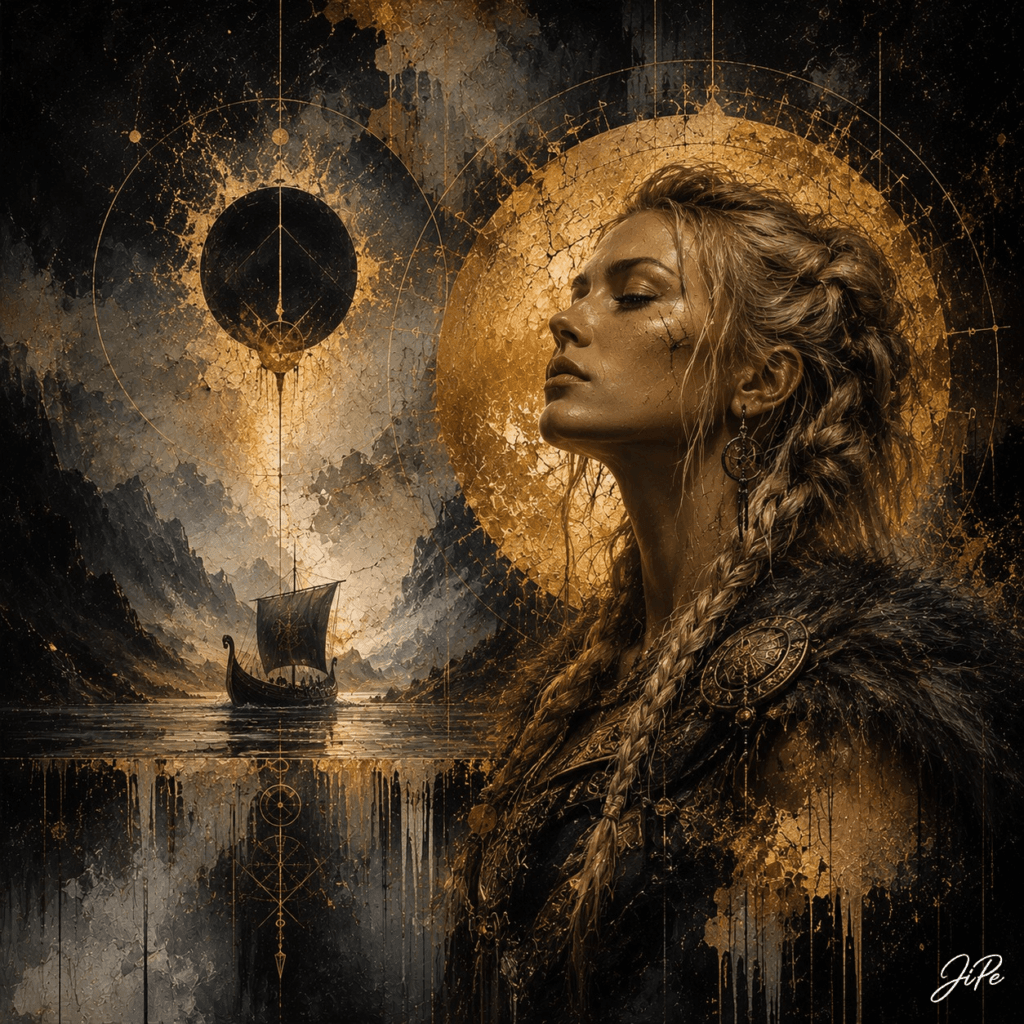
Daughter of the North is a symbolic meditation on memory, resilience, and the timeless spirit of the northern world. Rooted in the visual language of Norse mythology while transcending historical narrative, the painting explores the profound relationship between humanity, nature, and the cosmic forces that shape existence. Rather than portraying a specific historical figure or legendary heroine, the central character becomes an archetype—a guardian of memory and a living embodiment of endurance, wisdom, and quiet strength.
The title, Daughter of the North, refers not only to geography but to an inherited state of being. The North has long existed in mythology and literature as a realm of harsh beauty, spiritual endurance, vast silence, and elemental power. It is a place where survival requires harmony with nature rather than dominion over it. In this painting, the North becomes a symbolic landscape of the soul, representing resilience forged through adversity and the enduring search for meaning beneath infinite skies.
At the center of the composition stands a woman whose eyes remain gently closed as she turns her face toward an unseen light. Her expression is one of deep contemplation rather than triumph or sorrow. She does not confront the viewer directly; instead, she appears immersed in an inner dialogue that transcends time. Her stillness radiates quiet confidence, suggesting a profound awareness of forces greater than herself. Rather than being defined by action, she is defined by presence.
The figure is intentionally portrayed as both human and symbolic. She is not a queen, shield-maiden, or goddess in the conventional sense, yet she contains echoes of each. She embodies the timeless feminine principle found throughout Nordic mythology: wisdom balanced with courage, compassion strengthened by resilience, and an unwavering connection to both earth and sky. In doing so, she becomes a universal representation of inner sovereignty rather than historical identity.
Her braided hair serves as an important symbolic element. Across Norse culture, braids often represented continuity, lineage, and the weaving together of past and future. Here they become visual metaphors for memory itself—interwoven strands connecting generations, traditions, and the unseen threads of destiny. The careful craftsmanship of the hairstyle reflects the broader structure of the painting, where every detail contributes to a larger symbolic order.
The fur cloak draped across her shoulders reinforces this connection to the northern landscape. It is not presented merely as historical costume but as an extension of the environment itself. The textures evoke survival, protection, and an intimate relationship with the natural world. Rather than separating humanity from nature, the garment symbolizes coexistence with the elemental forces of wind, snow, stone, and sea that have shaped northern civilizations for millennia.
Behind the figure, a radiant golden disc dominates the composition. Echoing both the visual language of sacred halos and the eternal movement of celestial bodies, the circle becomes one of the painting’s central metaphors. It simultaneously represents the sun, eternity, divine consciousness, and the cyclical nature of existence. Weathered with visible cracks and irregular textures, it avoids perfect geometry, reminding us that even eternity reveals itself through imperfection and the passage of time.
Contrasting this luminous circle is the smaller black solar disk suspended above the distant horizon. This celestial form evokes an eclipse—a recurring symbol throughout the artist’s work representing moments of transition, hidden knowledge, and transformation. Rather than suggesting catastrophe, the eclipse becomes an image of balance. It reminds us that light and darkness are inseparable aspects of the same cosmic rhythm, each giving meaning to the other.
The Viking longship quietly crossing the still water introduces another essential narrative dimension. Throughout Scandinavian history, the longship represented exploration, courage, migration, and humanity’s willingness to venture beyond familiar horizons. Here it functions less as a historical vessel than as a symbolic journey through consciousness. Sailing toward the eclipse, it becomes an image of every human life navigating uncertainty while guided by unseen stars and inherited wisdom.
The surrounding fjord landscape reinforces this atmosphere of timeless solitude. Towering mountains rise like ancient monuments carved by glaciers and centuries of silence. Their monumental forms frame the composition without overpowering it, suggesting permanence amid the transience of human existence. Water reflects both landscape and sky, becoming a visual bridge between earthly reality and celestial symbolism.
Throughout the painting, sacred geometry quietly structures the visual experience. Delicate golden circles, astronomical diagrams, and finely drawn linear constellations evoke ancient cosmological maps as well as Norse concepts of an ordered universe. These subtle geometric forms establish invisible relationships between the portrait, the landscape, and the celestial bodies, suggesting that individual identity is inseparable from the greater architecture of existence.
Gold plays a defining symbolic role throughout the composition. Rather than functioning simply as ornamentation, it becomes the visual language of continuity, memory, and transcendence. Inspired by traditions ranging from illuminated manuscripts to Byzantine iconography and the philosophy of kintsugi, the gold emphasizes that wisdom often emerges through experience rather than perfection. Every luminous fracture and delicate line speaks of lives shaped, tested, and ultimately strengthened by time.
The restrained palette of charcoal black, weathered ivory, muted earth tones, and luminous gold creates an atmosphere of quiet monumentality. The limited color range reflects the northern environment itself, where subtle variations of light often possess greater emotional resonance than vivid color. This deliberate restraint allows the painting to communicate through atmosphere and texture rather than spectacle.
Technically, Daughter of the North combines highly refined figurative realism with expressive painterly abstraction. The portrait is rendered with remarkable anatomical sensitivity, while surrounding forms dissolve into textured brushwork, fractured surfaces, cascading pigments, and luminous metallic accents. Thick painterly layers preserve the tactile quality of handcrafted painting, allowing the physical surface to become an active participant in the work’s conceptual meaning.
Compositionally, the painting demonstrates exceptional balance between portraiture and landscape. The monumental profile dominates the right side of the canvas while the expansive northern seascape opens toward the left, creating a dialogue between the intimate and the infinite. This asymmetrical structure introduces visual movement while maintaining emotional stillness. The viewer’s gaze flows naturally from the contemplative figure toward the distant voyage, reinforcing the painting’s themes of memory and journey.
From an art historical perspective, Daughter of the North exists at the intersection of symbolic portraiture, contemporary visionary realism, and Nordic mythology. Echoes of Romantic landscape painting, Symbolist philosophy, and classical iconography merge with contemporary mixed-media aesthetics to create a visual language that is both ancient and modern. Rather than illustrating a myth directly, the painting constructs a new mythology—one rooted in universal human experience rather than historical narrative alone.
Conceptually, the work reflects upon the enduring relationship between identity and heritage. Every individual carries invisible inheritances shaped by culture, family, landscape, and collective memory. Daughter of the North proposes that these inheritances are not burdens of the past but living sources of resilience. The northern landscape becomes both literal and psychological, representing the quiet inner strength that emerges through solitude, endurance, and reflection.
The painting intentionally remains open to interpretation. Some viewers may recognize echoes of Norse mythology, while others perceive themes of feminine wisdom, spiritual awakening, or humanity’s relationship with nature. The longship may symbolize exploration, destiny, or the passage of life itself. The eclipse may evoke mystery, transformation, or the hidden cycles governing existence. This openness allows each observer to enter into a deeply personal dialogue with the work, discovering meanings shaped by their own experiences and imagination.
Ultimately, Daughter of the North is a tribute to the enduring spirit that survives beyond history, beyond legend, and beyond time. It reminds us that true strength is rarely expressed through conquest, but through quiet resilience, inner balance, and unwavering fidelity to one’s deepest nature. Standing before this work, the viewer is invited to journey into the silence of the northern landscape—not merely to witness its beauty, but to recognize within it the timeless qualities of courage, wisdom, and belonging that continue to shape the human spirit across every generation.