Monumental Visionary Fine Art exploring mythology, consciousness, sacred light, and timeless visual storytelling.

Monumental Visionary Fine Art exploring mythology, consciousness, sacred light, and timeless visual storytelling.

Viking and Norse Mythology Paintings

No Mercy

No Mercy
No Mercy

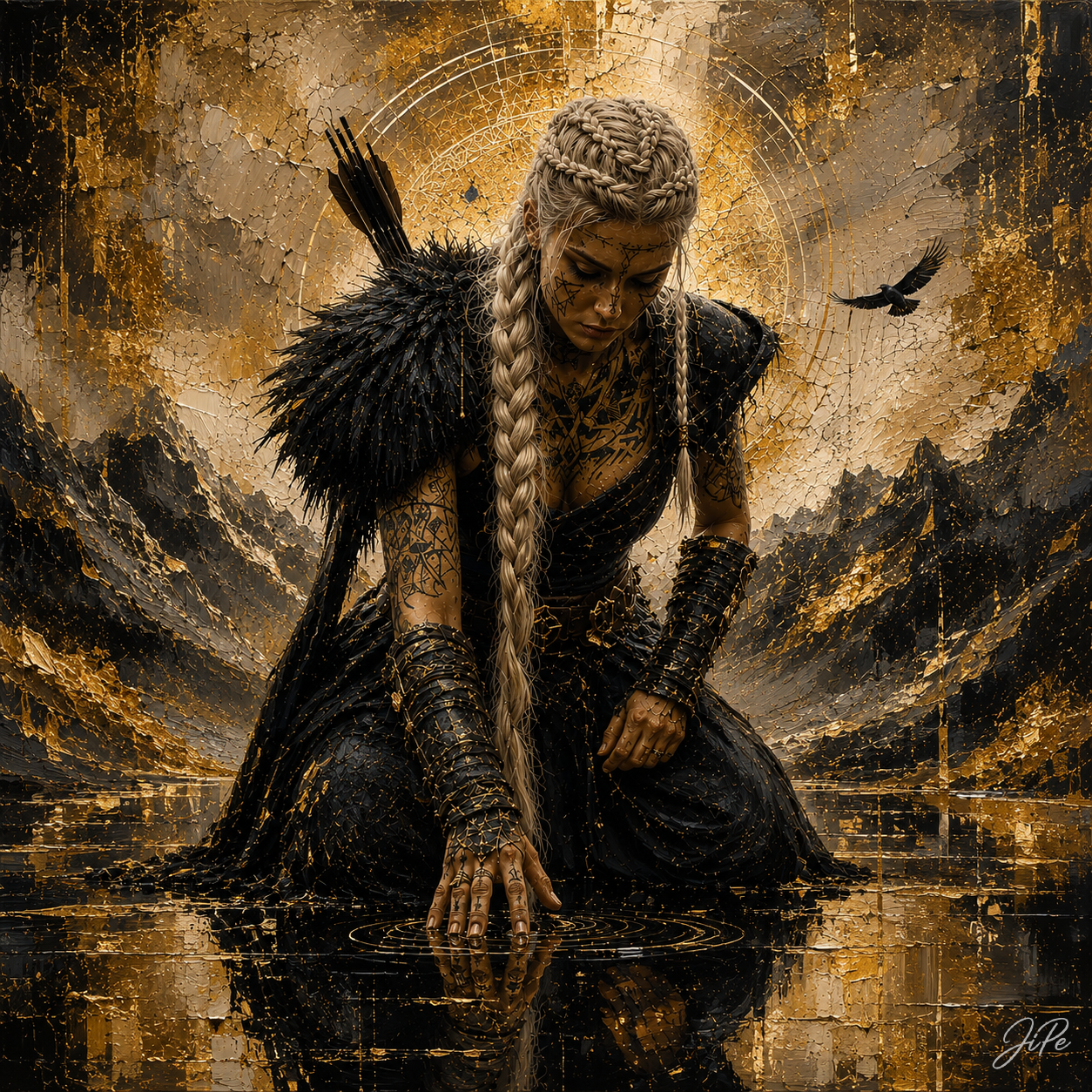
No Mercy is a powerful meditation on resolve, survival, and the uncompromising force of human determination. Rather than glorifying violence or conflict, the painting examines the psychological state that emerges when every illusion has fallen away and only purpose remains. It is an exploration of the moment when fear no longer governs action, when hesitation disappears, and when identity is forged through conviction rather than circumstance.

The title, No Mercy, is intentionally provocative. At first glance, it suggests brutality or vengeance, yet the painting proposes a more profound interpretation. The absence of mercy is not directed toward others but toward weakness, self-deception, and the internal limitations that prevent transformation. It speaks of discipline over comfort, truth over illusion, and resilience over surrender. In this sense, the work becomes an allegory of inner conquest rather than external conflict.

At the center of the composition stands a female warrior whose unwavering gaze immediately commands attention. She confronts neither an enemy nor the viewer directly; instead, her expression suggests complete alignment with her own purpose. There is no visible anger, fear, or triumph. Instead, her face communicates absolute clarity—a state where emotion has been refined into determination. This psychological restraint gives the portrait its extraordinary intensity.

The figure exists beyond historical specificity. While elements of Nordic and tribal aesthetics are visible through braided hair, ceremonial markings, and protective garments, she is not intended to represent a particular culture or historical individual. Instead, she becomes an archetype of resilience—a timeless embodiment of courage, discipline, and inner sovereignty. She represents the universal warrior that exists within every individual who has endured adversity and emerged transformed.

Her piercing eyes form the emotional center of the composition. They communicate neither aggression nor hostility, but unwavering awareness. They are the eyes of someone who has accepted the cost of difficult choices and no longer seeks external validation. Rather than inviting sympathy, the portrait demands respect. The viewer becomes aware that true strength often manifests not through dramatic action, but through complete self-possession.

The blue ceremonial markings across the face introduce one of the painting’s most significant symbolic elements. Historically, body markings have served as expressions of identity, protection, initiation, and spiritual transformation across countless cultures. Within No Mercy, the pigment transcends historical reference to become a visual language of psychological evolution. These marks are not camouflage but inscriptions—visible evidence that transformation has already taken place. They signify passage through experience rather than preparation for battle.

The vertical line descending through the center of the forehead establishes another important symbolic axis. It suggests alignment, balance, and focused consciousness. Echoing ancient ritual symbolism and sacred geometry, this central line transforms the portrait into something more than an image of a warrior. It becomes a meditation on internal order—the alignment of mind, spirit, and action into a unified purpose.

Behind the figure, a weathered golden circle dominates the composition. Throughout the artist’s symbolic vocabulary, the circle represents eternity, unity, and the invisible order underlying existence. Here it simultaneously recalls the sun, an eclipse, and the halo found in sacred iconography. Yet unlike traditional halos associated with sanctity, this one has been fractured and weathered by time. Its imperfections suggest that wisdom is earned through endurance rather than granted through innocence.

The interplay between the radiant gold and the deep charcoal-black forms establishes the conceptual framework of the work. Gold symbolizes illumination, truth, and higher consciousness, while darkness represents uncertainty, instinct, and the hidden dimensions of the self. Rather than opposing one another, both coexist throughout the composition, reflecting the painting’s central philosophy: authentic strength emerges only through the integration of light and shadow.

The raven positioned within the lower left portion of the composition introduces another powerful symbolic dimension. In Norse mythology, ravens were associated with Odin, carrying the names Huginn (Thought) and Muninn (Memory), representing wisdom, observation, and knowledge gathered through experience. Here, the raven becomes a silent witness rather than an omen. It embodies intelligence, perception, and the ability to navigate uncertainty with unwavering awareness. Its presence subtly reinforces the painting’s emphasis on strategic wisdom rather than brute force.

Delicate geometric structures surrounding the portrait create an invisible cosmological framework. Fine linear constructions, suspended circles, and sacred proportions evoke astronomical diagrams, navigational instruments, and ancient symbolic systems. These elements remind the viewer that the warrior does not exist outside universal order but within it. Strength is portrayed not as chaos, but as harmony achieved through discipline and conscious alignment.

The composition demonstrates exceptional architectural precision. The portrait occupies the central vertical axis, stabilized by the golden circle while balanced through asymmetrical painterly gestures that expand outward into expressive abstraction. This careful orchestration creates an extraordinary tension between stillness and explosive energy. Every brushstroke appears dynamic, yet the central figure remains perfectly composed.

Surface texture is fundamental to the work’s emotional impact. Thick painterly layers, expressive splashes, fractured pigments, weathered surfaces, and visible brushwork create an archaeological quality, suggesting that the image has emerged through layers of time and experience. Rather than concealing the artistic process, these textures celebrate it, emphasizing that transformation itself is layered, imperfect, and deeply physical.

The restrained palette of ivory, charcoal, black, muted blue, and luminous gold contributes to the painting’s monumental presence. The blue markings become the only significant chromatic interruption, immediately drawing attention to the psychological center of the work. Gold illuminates without overwhelming, while black provides emotional gravity and visual depth. This controlled color harmony reinforces the portrait’s atmosphere of disciplined restraint.

From an art historical perspective, No Mercy exists at the intersection of symbolic portraiture, contemporary figurative realism, and mythological archetype. It draws upon the psychological intensity of Symbolist portraiture, the monumental simplicity of sacred icon painting, and the expressive materiality of contemporary mixed-media practice. Rather than depicting historical mythology directly, it creates a modern mythology rooted in universal human experience.

Conceptually, the painting reflects upon the nature of true resilience. Contemporary culture often associates strength with domination, victory, or physical power. No Mercy quietly rejects these interpretations. Instead, it proposes that the greatest battles occur within the individual. The absence of mercy becomes the refusal to compromise one’s integrity, abandon one’s purpose, or surrender to fear. It is a philosophy of uncompromising authenticity rather than aggression.

The work intentionally remains open to interpretation. Some viewers may recognize a Viking shield-maiden preparing for battle. Others may perceive an allegory of psychological endurance, feminine strength, or spiritual initiation. The raven may symbolize wisdom, destiny, or ancestral memory. The ceremonial markings may evoke ritual, identity, or personal transformation. Every interpretation enriches the dialogue between artwork and observer, allowing the painting to evolve through individual experience.

Ultimately, No Mercy is not a portrait of conflict but of conviction. It reminds us that the most formidable battles are often invisible, fought within the silent landscape of the human spirit. Strength is revealed not through domination but through unwavering clarity, discipline, and the courage to remain faithful to one’s deepest truth. Standing before this work, the viewer encounters more than a warrior—they encounter the uncompromising force of inner resolve. It is a portrait of the moment when fear has exhausted itself, illusion has fallen away, and nothing remains except purpose. In that profound stillness, mercy is not absent because compassion has disappeared, but because truth can no longer be negotiated.

Lämna ett svar