Baldr’s Sacred Moment in a Golden Forest Glade

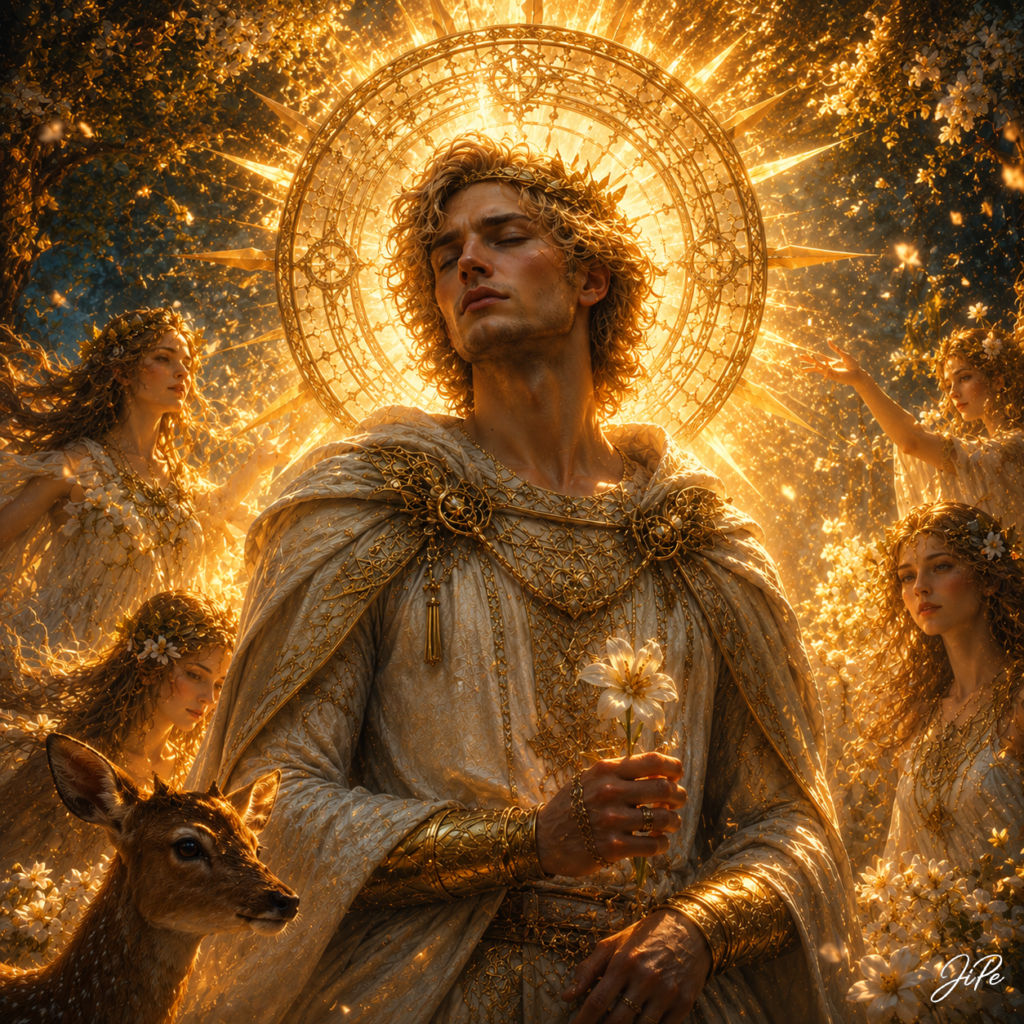
Baldr’s Sacred Moment in a Golden Forest Glade is a luminous celebration of purity, renewal, and the divine harmony between humanity and nature. Inspired by the legendary Norse god Baldr—the embodiment of light, beauty, innocence, and hope—the painting transcends mythology to become a timeless meditation on spiritual serenity and the fragile brilliance that exists within every living soul. Rather than illustrating a specific episode from Norse legend, the work captures an imagined moment of sacred stillness, where myth, nature, and eternity converge in perfect balance.
At the heart of the composition stands Baldr, portrayed not as a triumphant warrior or distant deity, but as a figure of profound inner peace. His eyes remain gently closed, his expression free from conflict, suggesting complete harmony with both the natural world and the unseen forces that surround him. He neither commands nor conquers. Instead, his quiet presence radiates calm authority, embodying a form of strength rooted in compassion, wisdom, and grace rather than power alone.
The delicate white flower he holds serves as one of the painting’s central symbolic elements. Throughout history, white blossoms have represented innocence, hope, spiritual awakening, and the fleeting beauty of life itself. Within the context of Baldr’s mythology, the flower becomes an especially poignant emblem of purity destined to encounter mortality. It reminds the viewer that beauty is made more precious by its impermanence, and that even the brightest light carries within it the awareness of eventual loss.
Behind Baldr rises an immense golden halo composed of intricate celestial geometry. Far more than a decorative motif, this radiant structure functions as the visual axis of the entire composition. Its concentric circles evoke cosmic order, eternal cycles, and the invisible architecture that governs both the natural universe and the human spirit. The luminous disc transforms Baldr into a symbolic bridge between the earthly and the divine, while simultaneously recalling sacred iconography from numerous artistic traditions. Although deeply rooted in Norse mythology, the work reaches beyond any single cultural framework, presenting light itself as a universal language.
Surrounding Baldr are ethereal female figures who appear less as individual characters than as manifestations of nature’s living spirit. Their flowing garments, floral adornments, and graceful gestures dissolve the distinction between humanity and the surrounding forest. They may be interpreted as guardians, forest spirits, memories of the ancient Vanir, or symbolic embodiments of beauty, growth, and seasonal renewal. Their presence transforms the woodland into a sacred sanctuary where every branch, blossom, and beam of sunlight participates in an ongoing act of quiet celebration.
The young deer emerging from the foreground introduces another profound symbolic dimension. Across mythological traditions, the deer has long represented gentleness, intuition, renewal, and the sacred relationship between humanity and the natural world. Positioned beside Baldr, it reflects the absence of fear and the restoration of primordial harmony. The animal does not merely accompany the central figure; it acknowledges him, reinforcing the painting’s vision of a world where innocence creates communion rather than domination.
Light serves as the true protagonist of the composition. Golden radiance pours through the forest canopy with extraordinary intensity, dissolving the boundary between physical illumination and spiritual revelation. Every leaf, garment, and strand of hair appears infused with living light, creating an atmosphere that feels simultaneously earthly and transcendent. Rather than functioning as a naturalistic source of illumination, the golden glow becomes a visible expression of divine presence, transforming the entire environment into an extension of Baldr’s inner essence.
The carefully restrained palette of ivory, warm gold, amber, and soft earth tones enhances this atmosphere of timeless serenity. Gold dominates the composition not simply as a color but as an emotional and symbolic force. Throughout the history of art, gold has represented incorruptibility, enlightenment, immortality, and divine perfection. Here, it permeates every surface with an almost alchemical brilliance, suggesting that the forest itself has become sanctified through Baldr’s presence.
Compositionally, the work achieves remarkable balance between intimacy and monumentality. The close portrait of Baldr establishes immediate emotional connection, while the expansive halo and surrounding figures extend the visual narrative into a broader symbolic universe. Every element converges toward the central figure without overwhelming him, creating an elegant rhythm of circular movement, radiant expansion, and contemplative stillness. The result is a composition that invites prolonged observation, revealing new relationships and symbolic details with each encounter.
Within the broader tradition of contemporary visionary art, Baldr’s Sacred Moment in a Golden Forest Glade draws upon Symbolism, Romanticism, and mythological painting while embracing a distinctly modern visual language. The work recalls the Symbolists’ fascination with archetypal imagery and spiritual meaning, while its luminous atmosphere echoes the Romantic pursuit of the sublime within nature. At the same time, its dreamlike realism and refined treatment of light position it firmly within the evolving field of contemporary visionary art, where mythology becomes a vehicle for exploring universal psychological and philosophical questions.
For art historians, the painting offers a compelling reinterpretation of one of the most beloved figures in Norse mythology. Rather than emphasizing the dramatic prophecy of Baldr’s death—a narrative that has traditionally dominated artistic representations—the work focuses on his enduring symbolic significance as the embodiment of purity, hope, and the light that persists even in the shadow of inevitable change. This shift transforms Baldr from a tragic mythological character into an eternal archetype whose relevance extends far beyond Scandinavian cultural history.
The painting also reflects contemporary humanity’s renewed fascination with ancient mythologies as sources of timeless wisdom rather than historical narratives. By presenting Baldr within an environment where sacred geometry, nature, and divine light coexist seamlessly, the work suggests that mythology continues to function as a living language through which modern audiences can contemplate identity, spirituality, and humanity’s relationship with the natural world.
Ultimately, Baldr’s Sacred Moment in a Golden Forest Glade is a meditation on the enduring power of light—not merely as physical illumination, but as a state of being. It reminds us that true strength often reveals itself through gentleness, that beauty possesses its greatest meaning because it is temporary, and that harmony with nature begins with harmony within ourselves. Standing before this radiant vision, the viewer is invited not only to witness a mythological figure, but to reflect upon the quiet moments of grace, compassion, and inner stillness that illuminate the human journey across every age and every culture.