
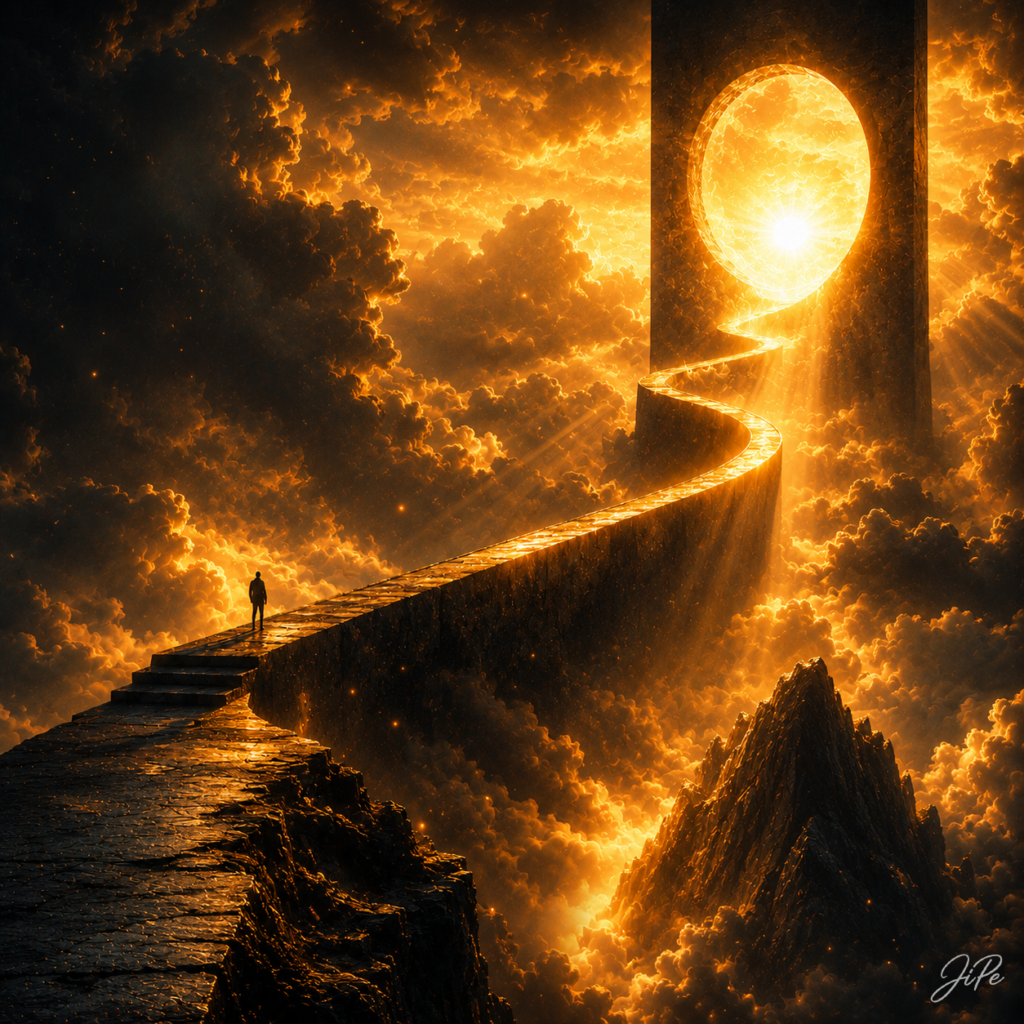
A Journey to the Glowing Portal

A Journey to the Glowing Portal is a visionary exploration of transcendence, transformation, and the irresistible human longing to move beyond the boundaries of the known. Suspended between reality and imagination, the composition presents a solitary traveler standing at the beginning of an elevated stone pathway that winds through a vast celestial landscape toward an immense portal of radiant golden light. The destination remains both visible and unreachable, inviting the viewer to contemplate not only where the journey leads, but why it must be undertaken.
Rather than depicting a physical location, the painting constructs a symbolic landscape that exists within the realm of consciousness. Every architectural element, every cloud formation, and every beam of light functions as visual metaphor. The monumental gateway becomes an archetype of transition—a threshold between one state of being and another, between limitation and possibility, mortality and eternity, certainty and faith.
The winding path is central to the work’s narrative. Its elegant curve deliberately rejects the notion of a direct route toward enlightenment or fulfillment. Instead, it reflects the nonlinear nature of personal growth, where every detour, challenge, and moment of uncertainty contributes to transformation. The traveler is intentionally rendered as a small silhouette, emphasizing humanity’s fragile scale when confronted with forces that are timeless and infinite. Yet this apparent insignificance also carries dignity, suggesting that even the smallest individual possesses the courage to seek the extraordinary.
Light serves as the painting’s dominant expressive language. Rather than merely illuminating the environment, it becomes an active presence that shapes space, atmosphere, and emotion. Brilliant golden rays break through dense formations of dramatic clouds, dissolving darkness without erasing it. Shadow remains an essential counterpart, reinforcing the idea that illumination acquires meaning only through contrast. This dialogue between darkness and light reflects one of the oldest themes in art history—the coexistence of fear and hope, doubt and conviction, endings and beginnings.
The glowing portal itself resists literal interpretation. It may be understood as a symbol of spiritual awakening, divine presence, self-realization, or the infinite unknown. Its circular form evokes notions of completeness, eternity, and cosmic order, while its radiant core suggests an energy that cannot be fully comprehended by the rational mind. The portal does not reveal what lies beyond it, preserving the mystery that gives the work its emotional power. It invites contemplation rather than providing answers.
Architecturally, the composition combines monumental simplicity with cinematic grandeur. The towering vertical structures frame the portal like guardians of an ancient sanctuary, while the elevated pathway creates a powerful visual rhythm that naturally guides the eye through the painting. This carefully orchestrated movement transforms the viewer into an active participant, encouraging an imagined progression from the foreground toward the luminous destination.
The warm palette of gold, amber, and deep charcoal reinforces the painting’s symbolic language. Gold has long represented wisdom, divinity, and transcendence across civilizations, and here it functions not merely as color but as an emotional atmosphere. The luminous environment appears almost alchemical, suggesting that the landscape itself is undergoing continuous transformation. The clouds become sculptural forms rather than passive background elements, emphasizing the dynamic relationship between matter and light.
Within the broader tradition of contemporary visionary art, A Journey to the Glowing Portal draws upon influences from Symbolism, Romanticism, and Surrealism while maintaining a distinctly modern visual language. The monumental scale, dramatic perspective, and immersive lighting recall the emotional ambitions of nineteenth-century landscape painting, yet the conceptual focus shifts from depicting nature toward visualizing the interior landscape of the human spirit. Reality and imagination merge seamlessly, allowing symbolic meaning to emerge through atmosphere rather than narrative.
For art historians, the work may be viewed as an exploration of the archetypal ”hero’s journey,” translated into contemporary symbolic imagery. The solitary figure, the ascending path, and the radiant threshold echo universal myths found across cultures, where transformation requires movement toward an unknown destination. The absence of explicit religious or cultural markers allows these symbols to remain universally accessible, encouraging interpretations that are personal as much as collective.
Ultimately, A Journey to the Glowing Portal is not simply a painting about reaching a destination. It is a meditation on aspiration itself. It reminds us that the most meaningful journeys begin long before we arrive, and that every step toward the light reshapes the traveler along the way. The glowing portal stands as both invitation and mystery—a timeless symbol of hope, discovery, and the endless human desire to move beyond the horizon of what is known.