Alone at the Cliff’s Edge

Alone at the Cliff’s Edge is a contemplative meditation on solitude, courage, and the profound silence that often precedes transformation. Suspended between the intimacy of a sheltered cavern and the immensity of an open horizon, the painting captures a single figure standing at the threshold between protection and possibility. Rather than presenting a literal landscape, the work unfolds as an inner geography—a symbolic space where the external world mirrors the emotional and spiritual journey of the individual.
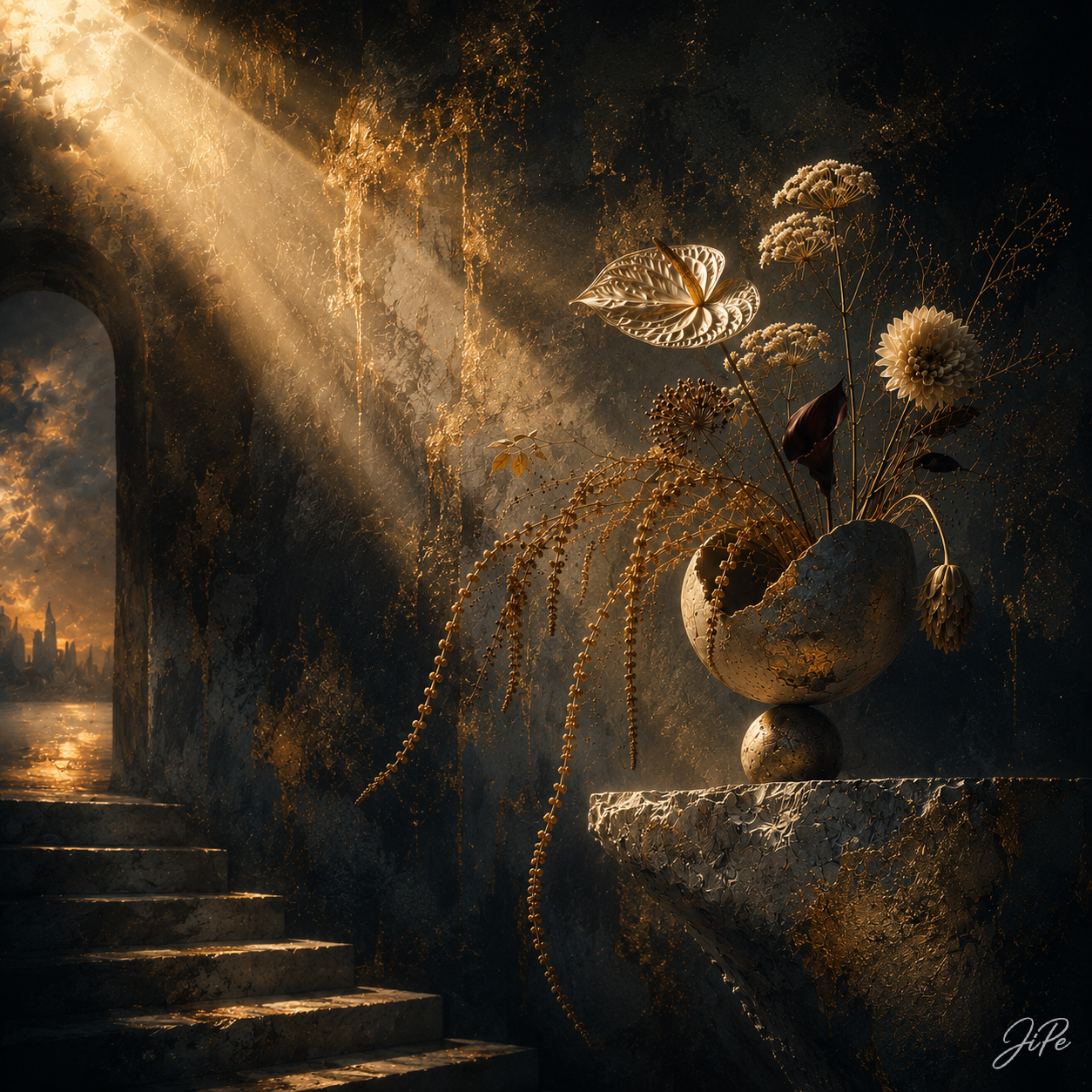
The viewer encounters the composition from within the darkness of a monumental cave. Its naturally sculpted walls envelop the scene like the interior of an ancient sanctuary, framing a luminous opening that reveals an expansive sea, distant rock formations, and a sky illuminated by the golden light of a setting or rising sun. This carefully orchestrated contrast between shadow and radiance immediately establishes the central dialogue of the work: the movement from uncertainty toward revelation.
At the heart of the composition stands a solitary woman, positioned at the end of a weathered stone staircase. She neither advances nor retreats. Instead, she occupies a moment of complete stillness—a pause that transforms the painting from a depiction of place into a meditation on decision. Her small silhouette, surrounded by monumental natural forms, reinforces humanity’s fragile relationship with the vastness of existence while simultaneously emphasizing the extraordinary strength found in quiet resolve.
The staircase serves as one of the painting’s most significant symbolic elements. Throughout the history of art, ascending steps have represented growth, initiation, and the pursuit of higher understanding. Here, however, the journey does not culminate at a summit but at an opening. The ascent becomes psychological rather than physical, suggesting that the greatest thresholds are crossed not by conquering landscapes, but by confronting one’s own fears, hopes, and uncertainties.
The cave itself functions as an archetypal symbol of introspection. Across mythology, religion, and philosophy, caves have represented places of withdrawal, contemplation, and transformation. They are spaces where the familiar dissolves and new understanding emerges. In Alone at the Cliff’s Edge, the cavern becomes both refuge and limitation. Its darkness protects the figure, yet the luminous world beyond quietly invites her toward something greater. The painting never reveals whether she will step forward, allowing the viewer to inhabit the uncertainty alongside her.
Light plays an essential role in shaping the emotional architecture of the work. Rather than merely illuminating the landscape, it becomes a symbolic force that transforms the atmosphere itself. Golden rays spill across the water and surrounding cliffs, dissolving into soft reflections that imbue the entire scene with warmth and transcendence. The luminous horizon suggests hope, wisdom, and possibility, while the surrounding shadows preserve the mystery necessary for genuine contemplation. Neither darkness nor light dominates the composition; instead, they exist in harmonious dialogue, each defining the other.
The distant rock formation rising from the sea introduces another powerful symbolic presence. Monumental yet isolated, it appears almost like an ancient monolith or forgotten temple shaped by geological time. Its vertical form contrasts with the expansive horizontal plane of the ocean, creating visual tension between permanence and movement, stability and change. It becomes an unattainable destination as much as an inner ideal—a reminder that the most significant journeys often begin with a vision rather than a certainty.
The restrained color palette of deep charcoal, warm earth tones, amber, and luminous gold reinforces the painting’s timeless atmosphere. Gold has historically symbolized divinity, enlightenment, and transcendence across cultures, and within this work it functions as an emotional language rather than simple decoration. Every illuminated surface appears touched by an unseen presence, suggesting that transformation is already unfolding long before the first step is taken.
Compositionally, the painting demonstrates a refined balance between intimacy and grandeur. The cave opening naturally frames the landscape beyond, creating a circular visual structure that draws the viewer’s gaze toward the distant horizon. This framing device transforms the cave into both architectural space and symbolic portal, inviting contemplation while maintaining an overwhelming sense of scale. The carefully controlled perspective encourages a gradual visual journey from darkness, through the solitary figure, and outward toward the infinite sea and sky.
Within the broader context of contemporary visionary art, Alone at the Cliff’s Edge occupies a compelling intersection between Symbolism, Romanticism, and Surrealism. The emotional power of the landscape recalls the Romantic fascination with the sublime, where nature reflects the inner life of humanity rather than objective reality. At the same time, the symbolic clarity of the composition aligns with the Symbolist tradition, using visual metaphor to communicate psychological and spiritual ideas that transcend language. The dreamlike atmosphere introduces elements of Surrealism, dissolving the boundaries between external landscape and interior consciousness.
For art historians, the painting may be interpreted as an exploration of the universal threshold motif—a recurring archetype found throughout mythology, literature, and religious imagery. The solitary traveler, the ascending steps, the cave, the sea, and the radiant horizon all belong to an enduring visual vocabulary that speaks to initiation, self-discovery, and the search for meaning. Yet the work avoids specific cultural or religious references, allowing its symbolism to remain universally accessible and deeply personal.
Ultimately, Alone at the Cliff’s Edge is not a painting about isolation but about presence. It captures the extraordinary significance of a single silent moment—the instant before action, before transformation, before crossing into the unknown. It reminds us that life’s most profound journeys rarely begin with certainty. They begin with stillness, with contemplation, and with the quiet courage to stand at the edge of possibility, trusting that the light beyond the horizon is worth seeking, even when the path remains unseen.