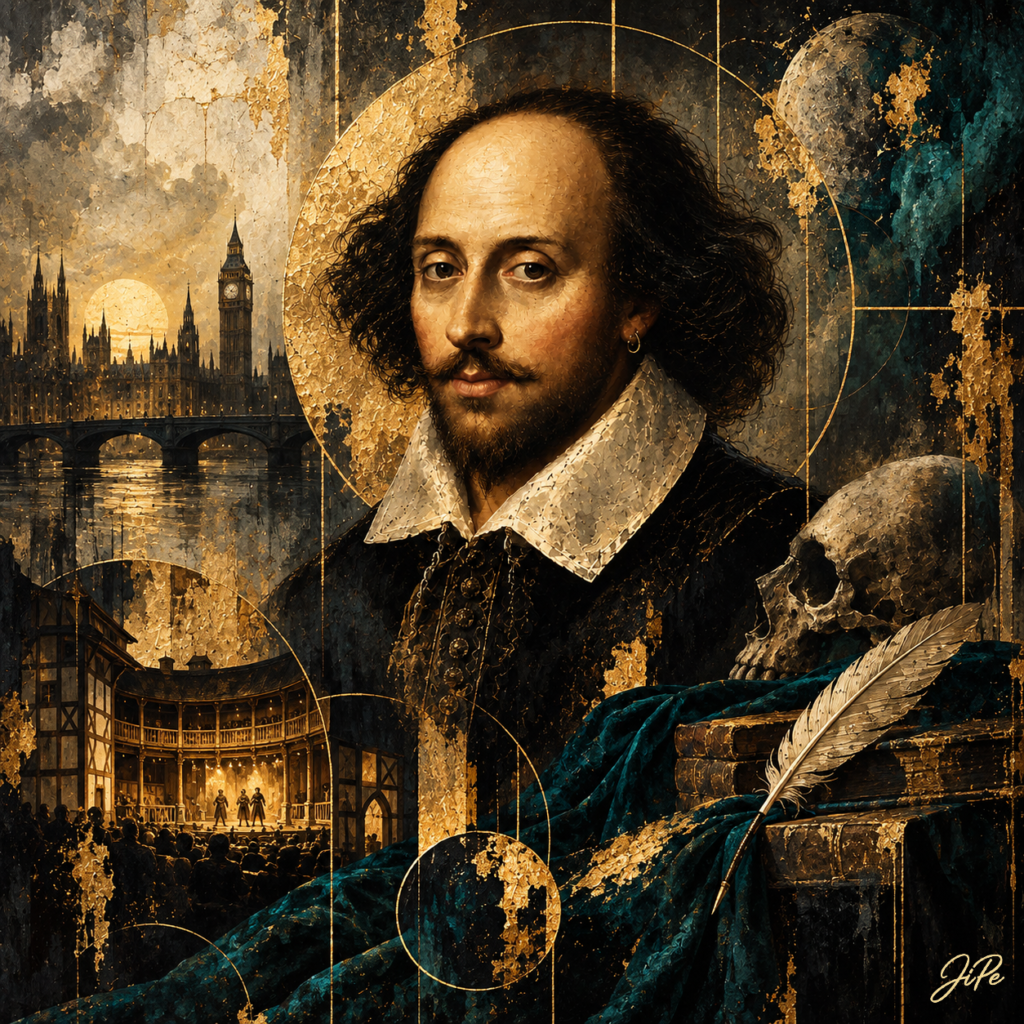
William Shakespeare holds the playwright between historical presence and the vast imaginative territory that has grown around his name. More than four centuries after his death, Shakespeare remains among the world’s most famous and widely performed writers, his plays and language embedded so deeply in global culture that characters such as Hamlet, Macbeth, Lear, and Romeo and Juliet have acquired lives far beyond the stage.
Here, that immense legacy surrounds a figure of striking quietness. The direct gaze seems almost detached from the worlds it has come to signify, while light gathers across the image like something passing between memory and permanence. Theatre, mortality, language, and the city appear to coexist within a space where centuries collapse into one another. The monumental scale does not resolve the man; it makes his distance more palpable.
The title William Shakespeare names someone universally familiar yet historically elusive. His words survive with extraordinary vitality, while the individual behind them remains partly inaccessible—a human presence increasingly surrounded by the mythology of his own endurance.
Perhaps this is the final tension: we continue to hear Shakespeare everywhere, yet across four centuries of voices, performances, and interpretations, the silence of the man himself remains unbroken.