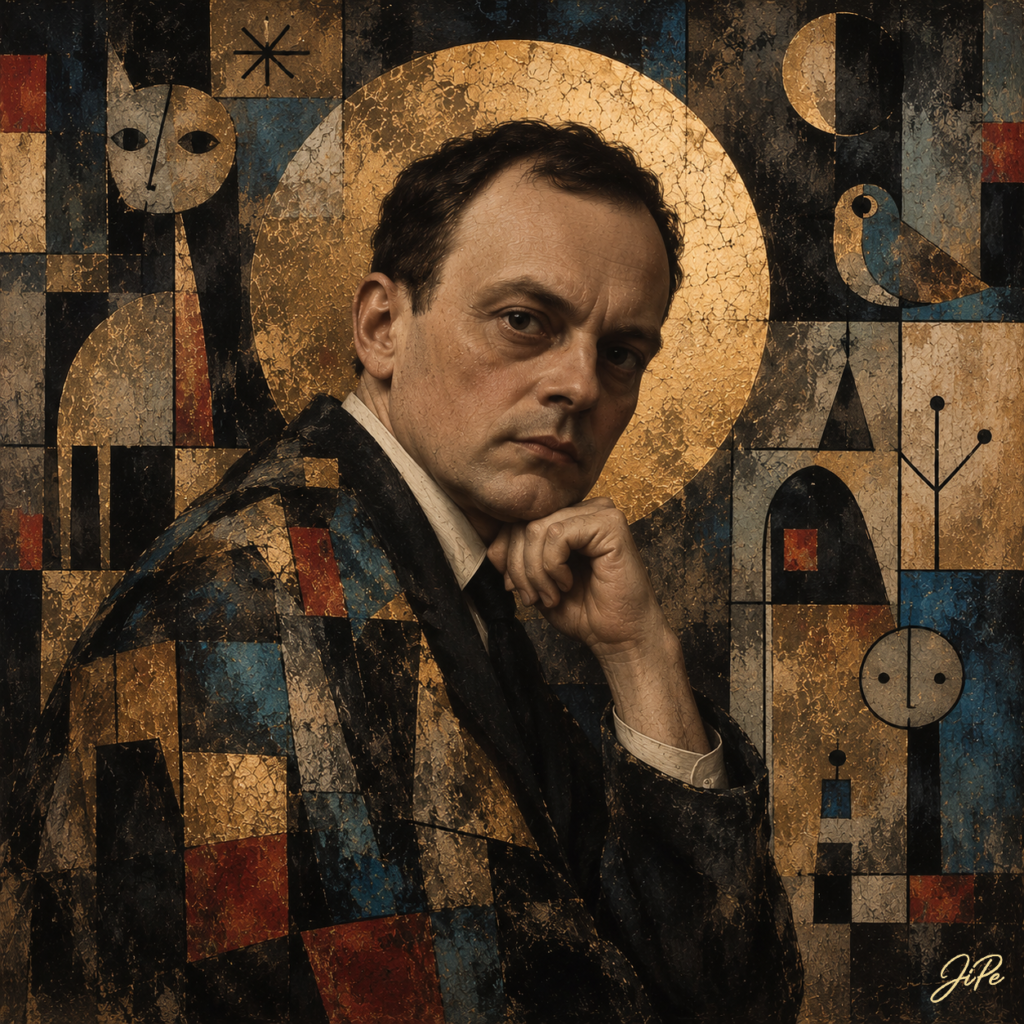
Paul Klee holds the artist within a world that seems governed by an internal logic of signs, intervals, and quiet correspondences. Klee became one of the defining figures of twentieth-century art, and his international reputation rests on an extraordinary visual language in which observation, imagination, music, and poetic thought could coexist. His influence has endured far beyond his lifetime, making his name synonymous with an unusually personal way of seeing.
Here, however, fame recedes behind concentration. The central presence is introspective, almost guarded, while the surrounding space seems to oscillate between order and uncertainty. Light gathers behind him with restrained intensity, creating a sense of psychological distance rather than spectacle. The figure appears suspended within a universe that could be read as memory, thought, or some private system whose meaning remains deliberately incomplete.
In Paul Klee, the distinction between the artist and the world associated with him begins to dissolve. Identity becomes entangled with creation; the maker seems gradually absorbed into the language through which generations have come to recognize him.
When an artist leaves behind a universe distinctive enough to outlive its creator, does that universe preserve something of the person—or make the person increasingly unknowable?