Vincent van Gogh holds the artist between the intimacy of a solitary presence and the immense cultural afterlife of his work. Today, Van Gogh is among the most famous artists in the world, his paintings reproduced and recognized across cultures with a familiarity he never experienced during his lifetime. That distance between limited recognition then and extraordinary fame now gives his image an unavoidable poignancy.
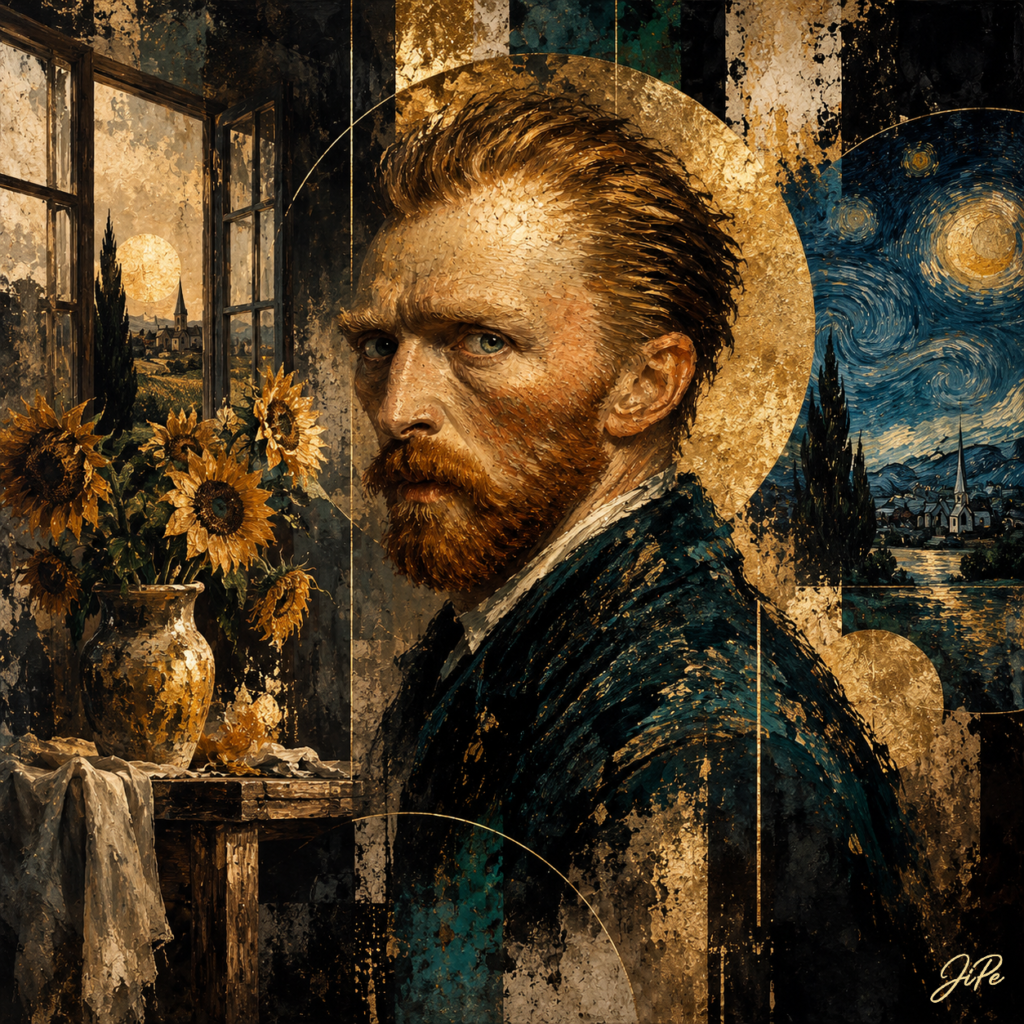
Here, the figure appears almost suspended between his own world and ours. Light gathers around him with quiet intensity, while fragments associated with his visual legacy seem less like quotations than memories orbiting their maker. The surrounding space feels simultaneously interior and infinite, as though landscape, night, and recollection have entered the same psychological territory. His gaze remains direct yet unreachable.
The title Vincent van Gogh restores the name behind images that have become cultural icons. Yet fame has also transformed the individual into a mythology—one continually reconstructed through paintings, letters, biography, and collective imagination.
Perhaps the deepest tension lies in that reversal of time: a man who could not witness the magnitude of his own legacy now seems to look outward from within it. What might it mean to become immortal only after one is no longer there to experience being seen?