Monumental Visionary Fine Art exploring mythology, consciousness, sacred light, and timeless visual storytelling.

Monumental Visionary Fine Art exploring mythology, consciousness, sacred light, and timeless visual storytelling.

Figurative Paintings

The Weight of Gold

The Weight of Gold
The Weight of Gold

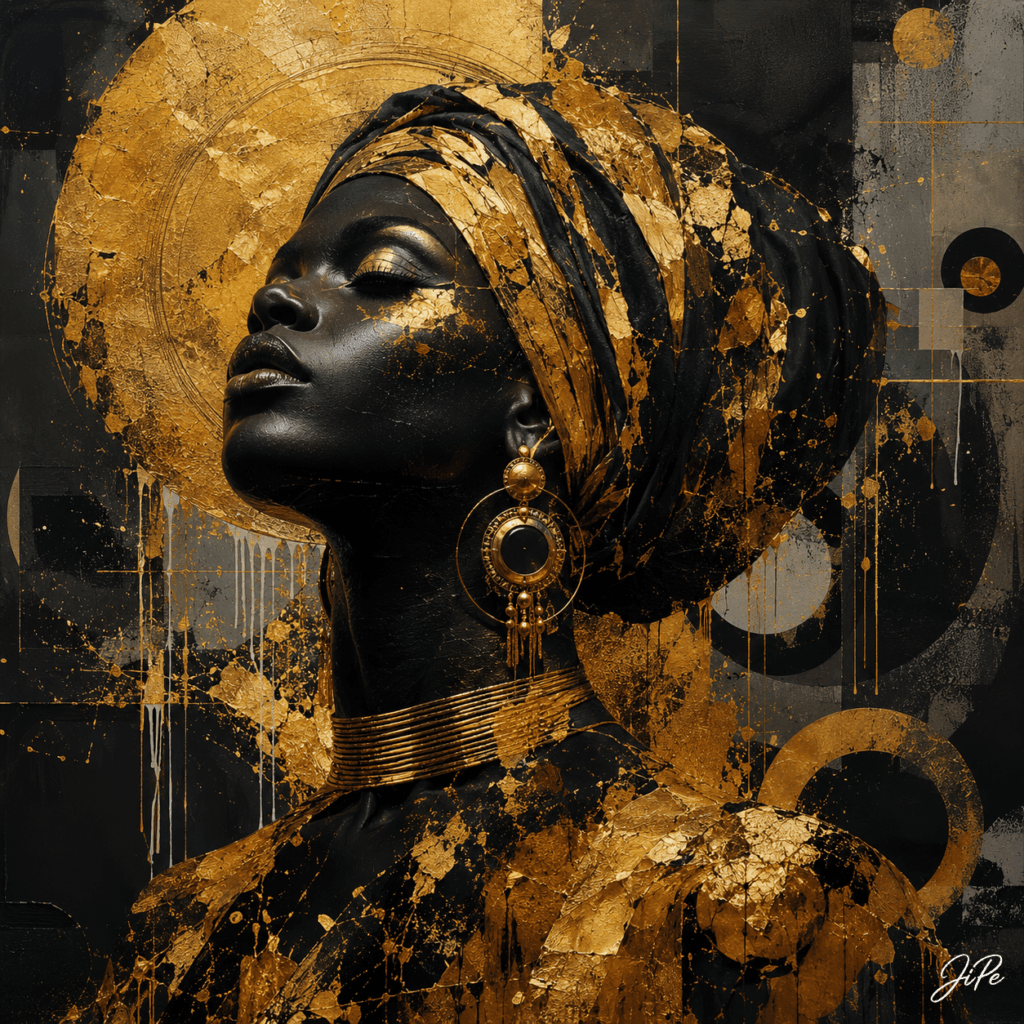
The Weight of Gold is a contemplative exploration of value, identity, and the invisible burdens carried beneath outward beauty. Existing at the intersection of symbolic portraiture, contemporary realism, and abstract expression, the painting examines humanity’s enduring relationship with power, dignity, memory, and self-worth. Rather than presenting gold as a symbol of wealth or luxury, the work redefines it as the visible language of experience—a material that carries both illumination and responsibility.

The title is intentionally paradoxical. Gold is traditionally associated with prosperity, perfection, divinity, and triumph. Yet every form of value carries its own gravity. Wisdom has weight. Memory has weight. Heritage has weight. Even beauty, when shaped by expectation or history, possesses its own silent burden. The Weight of Gold asks the viewer to consider not what gold is worth, but what it costs to carry it.

At the center of the composition stands a solitary woman whose head is gently lifted toward an unseen source of light. Her eyes remain peacefully closed, and her expression radiates complete serenity. There is no performance, no desire to impress, and no awareness of being observed. She exists entirely within herself, suspended between contemplation and transcendence. This inward stillness transforms the portrait from a depiction of physical beauty into a meditation on spiritual presence.

The figure functions not as an individual portrait but as an archetype. She embodies dignity that requires no validation, strength expressed through stillness rather than dominance, and beauty rooted in authenticity rather than ornament. She represents the universal human search for identity beyond appearances—a reminder that true richness originates from within.

The deep black tones of her skin hold extraordinary symbolic significance. Rather than absorbing the surrounding light, the figure appears to generate it. The richness of the dark surface allows every reflection of gold to become more luminous, establishing a profound visual dialogue between darkness and illumination. Here, darkness is not portrayed as absence but as infinite depth—the fertile ground from which consciousness, memory, and resilience emerge.

Encircling her head is a monumental golden disc whose luminous presence recalls the visual language of halos, celestial bodies, and sacred iconography. Throughout the artist’s symbolic vocabulary, the circle represents eternity, unity, and the invisible order that connects all existence. Yet unlike traditional religious imagery, this halo possesses a weathered, fractured surface. Time has marked it. Experience has reshaped it. Its imperfections become essential to its beauty, suggesting that enlightenment is never pristine but continually refined through life itself.

Gold flows throughout the painting like living matter. It covers the headwrap, ornaments, garments, and surrounding space in expressive splashes, fractured textures, and layered surfaces. Rather than functioning as decorative embellishment, the gold appears to emerge organically from the figure herself, as though wisdom has gradually crystallized upon the surface of lived experience.

This symbolic use of gold recalls the Japanese philosophy of kintsugi, in which broken ceramics are repaired using precious metals, transforming fractures into the most beautiful aspects of an object. Within The Weight of Gold, however, the gold does not merely repair—it reveals. It illuminates history rather than concealing it, suggesting that every challenge, every memory, and every act of endurance contributes to the radiance of the human spirit.

The elaborate headwrap introduces another significant symbolic layer. More than an article of clothing, it functions as a crown without royalty, embodying cultural continuity, ancestral memory, and personal identity. Wrapped around the head—the seat of thought, imagination, and consciousness—it becomes an architectural structure protecting the invisible world of the mind. Its folds evoke both ceremonial tradition and sculptural abstraction, reinforcing the painting’s dialogue between history and timelessness.

The large circular earrings echo the geometry of the halo behind the figure, establishing visual rhythms throughout the composition. These repeated circles reinforce themes of continuity, cycles, and interconnectedness. Every circular element, from jewelry to celestial forms, contributes to an invisible symbolic architecture suggesting that human existence unfolds within larger universal patterns.

The delicate gold collar surrounding the neck introduces yet another duality. It may be interpreted as an ornament of dignity, an emblem of honor, or a symbolic reminder that every responsibility, privilege, or calling carries weight. Positioned where voice and breath originate, the collar subtly evokes the relationship between truth, expression, and personal integrity.

The background combines expressive abstraction with precise geometric structures. Fragmented planes, suspended circles, vertical lines, and weathered surfaces suggest architectural remains, sacred diagrams, or the invisible framework of consciousness itself. These elements never compete with the portrait but instead establish an environment that feels simultaneously ancient and contemporary, physical and metaphysical.

Compositionally, the painting achieves remarkable equilibrium. The upward inclination of the figure creates gentle movement toward transcendence, while the monumental halo stabilizes the composition through perfect circular balance. Gold splashes and painterly gestures expand beyond the portrait’s boundaries, allowing the figure to merge gradually with the surrounding symbolic landscape. This dissolution of boundaries reinforces the central concept that identity is shaped not in isolation but through continual dialogue with history, culture, memory, and the cosmos.

Texture plays a vital role throughout the work. Thick painterly surfaces, weathered pigments, expressive splashes, cracked gold leaf effects, and layered brushwork create extraordinary tactile richness. These visible traces of artistic process preserve the painting as a physical object while simultaneously echoing the layered nature of human experience. Like memory itself, the surface contains countless visible and invisible histories accumulated over time.

The restrained palette of deep black, warm ivory, muted charcoal, and radiant gold creates an atmosphere of profound emotional resonance. Black provides infinite depth and psychological stillness. Gold introduces warmth, illumination, and transcendence. Their relationship forms the emotional heart of the painting, suggesting that light is not diminished by darkness but made meaningful through it.

From an art historical perspective, The Weight of Gold occupies a distinctive place within contemporary symbolic realism. It draws inspiration from Byzantine icon painting, the luminous ornamentation of Gustav Klimt, African sculptural traditions, Symbolist portraiture, and contemporary mixed-media abstraction. Yet rather than quoting these traditions directly, the painting synthesizes them into a personal visual language that celebrates both cultural specificity and universal human experience.

Conceptually, the work reflects upon the nature of value in contemporary society. Modern culture often equates wealth with possession and success with external recognition. The Weight of Gold quietly challenges these assumptions by proposing that life’s greatest riches cannot be accumulated—they must be cultivated. Wisdom, compassion, resilience, memory, dignity, and self-knowledge become forms of gold carried invisibly throughout a lifetime.

The painting intentionally remains open to interpretation. Some viewers may perceive a portrait of sacred femininity. Others may recognize themes of ancestry, resilience, spiritual awakening, cultural identity, or inner sovereignty. The halo may symbolize enlightenment, eternity, or the sun itself. The gold may represent history, transformation, or the invisible inheritance passed from one generation to another. Every reading enriches the dialogue between artwork and observer.

Ultimately, The Weight of Gold is a meditation on what it truly means to carry value. It reminds us that the brightest forms of radiance are not inherited through privilege nor purchased through wealth, but earned through experience, courage, compassion, and unwavering authenticity. Standing before this work, the viewer encounters a presence that neither seeks admiration nor demands explanation. Instead, the painting offers a quiet revelation: the heaviest gold we carry is often invisible, and the greatest wealth we possess is the wisdom that time, memory, and resilience have gently forged within us. In that profound stillness, gold ceases to be a symbol of possession and becomes a testament to the enduring brilliance of the human spirit.

Lämna ett svar