Monumental Visionary Fine Art exploring mythology, consciousness, sacred light, and timeless visual storytelling.

Monumental Visionary Fine Art exploring mythology, consciousness, sacred light, and timeless visual storytelling.

Surreal Paintings

The Space Between Thoughts

The Space Between Thoughts

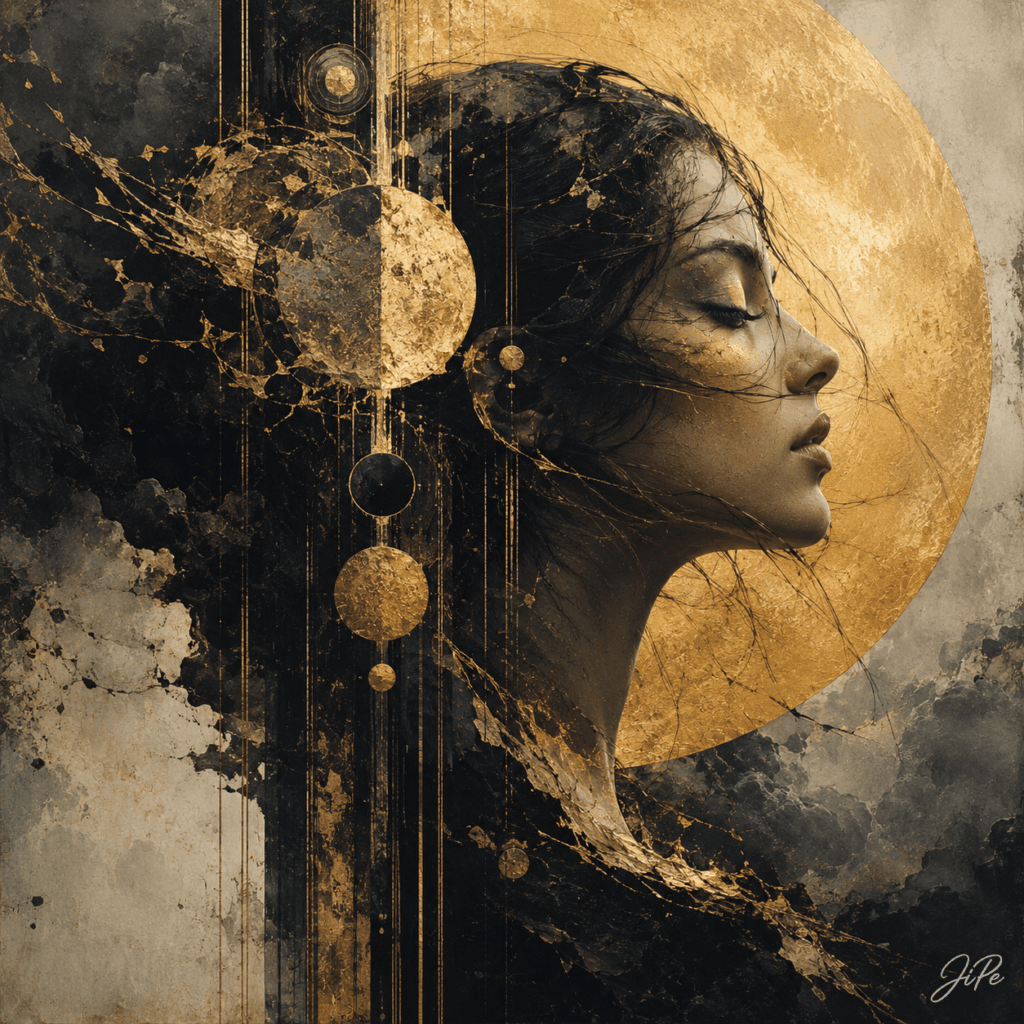
The Space Between Thoughts is a contemplative exploration of consciousness, silence, and the invisible threshold that exists between perception and awareness. Existing between symbolic portraiture, contemporary abstraction, and metaphysical realism, the painting invites the viewer into a realm where time appears suspended and the restless movement of the mind briefly comes to rest. It is not a portrait of a woman, but a portrait of stillness itself—a visual meditation on the rare and transformative moments when thought dissolves into pure presence.

The title refers to an experience that is both deeply personal and universally human. Between every thought lies an infinitesimal pause—a silent interval that often goes unnoticed. Within that space exists no memory, no expectation, no judgment, and no fear. It is a moment untouched by language, where awareness becomes larger than identity. The Space Between Thoughts seeks to give visual form to that intangible state, suggesting that our deepest understanding of ourselves may arise not from thinking more, but from thinking less.

At the center of the composition appears the profile of a solitary woman with closed eyes and a serene expression. Her face is illuminated by warm golden light while her posture remains completely relaxed, suggesting surrender rather than sleep. She is not withdrawing from the world but entering it more fully through inward attention. Her calm presence establishes an atmosphere of profound contemplation, inviting viewers to slow their own perception and inhabit the same quiet stillness.

The figure functions as an archetype rather than an individual portrait. She represents the universal human capacity for reflection, intuition, and inner awakening. Without direct eye contact, she remains psychologically open while preserving an essential mystery. Her silence becomes an invitation rather than an absence, encouraging every observer to bring their own memories, emotions, and interpretations into dialogue with the work.

Dominating the background is a monumental golden disc that radiates behind the figure’s profile like a celestial body suspended beyond time. Simultaneously recalling the sun, the full moon, an eclipse, and the halo of sacred iconography, this luminous circle serves as the spiritual center of the composition. Throughout the artist’s symbolic language, the circle represents wholeness, eternity, and the cyclical nature of existence. Here it also becomes a metaphor for expanded consciousness—a quiet source of illumination that exists beyond rational thought.

The weathered texture of the golden circle is especially significant. Its cracked and imperfect surface resists the illusion of flawless transcendence, suggesting instead that wisdom is accumulated through experience. Like memory itself, the surface bears the visible traces of time, reminding us that enlightenment is never detached from life but is shaped by every joy, every loss, and every transformation.

Running vertically through the composition are delicate geometric structures and suspended celestial forms. These circles, lines, and proportional relationships evoke sacred geometry, astronomical diagrams, and ancient cosmological systems. They establish an invisible architecture connecting the human figure to a greater universal order. Rather than functioning as decorative elements, they suggest that consciousness itself possesses structure—that beneath the apparent randomness of thought lies an underlying harmony shared by both the individual and the cosmos.

The sequence of suspended circles introduces another symbolic dimension. Their gradual progression evokes planetary movement, lunar cycles, or the unfolding stages of awareness. They become visual representations of thought itself: appearing, expanding, dissolving, and returning in endless rhythm. Yet between each sphere lies open space, reinforcing the central idea that silence exists not outside experience but between its countless moments.

The composition is carefully divided between luminous gold and profound darkness. These opposing visual territories create a subtle philosophical dialogue rather than a dramatic conflict. Gold symbolizes awareness, insight, memory, and transcendence, while black evokes mystery, the unconscious, and the fertile silence from which all thought arises. Neither dominates the other. Instead, they exist in continuous balance, suggesting that light derives meaning from shadow just as consciousness emerges from stillness.

The flowing strands of the woman’s hair dissolve naturally into the surrounding abstraction, blurring the distinction between figure and environment. Individual identity gradually merges with cosmic space, reinforcing the painting’s central concept that consciousness is not isolated but intimately connected to a larger reality. This dissolution of boundaries transforms the portrait into something universal, where the individual becomes inseparable from the rhythms of existence itself.

Texture plays an essential role throughout the work. Thick painterly surfaces, fractured pigments, weathered gold leaf effects, expressive splashes, and subtle scratches preserve the physical presence of the painting while enriching its symbolic language. These layered surfaces evoke ancient frescoes, eroded manuscripts, and timeworn walls, suggesting that the work itself carries the memory of countless silent moments accumulated across time.

The restrained palette of charcoal black, warm ivory, muted earth tones, and luminous gold creates a refined emotional atmosphere rooted in quiet contemplation. Every color has symbolic significance. Gold becomes the visual language of awakening and remembrance. Black embodies infinite possibility and introspection. Soft neutral tones preserve the humanity of the portrait while allowing light itself to become the painting’s primary expressive force.

Compositionally, The Space Between Thoughts achieves extraordinary balance through asymmetrical harmony. The luminous profile anchors the right side of the canvas while expressive abstraction expands organically across the left. Vertical geometric structures stabilize the composition without restricting its fluidity. Negative space becomes as meaningful as painted form, allowing silence to function as an active compositional element rather than mere emptiness.

From an art historical perspective, the work occupies a distinctive place within contemporary symbolic realism. It draws inspiration from the spiritual serenity of Byzantine icons, the ornamental luminosity of Gustav Klimt, the psychological subtlety of Symbolist portraiture, and the expressive materiality of contemporary mixed-media painting. Yet rather than referencing these traditions directly, the painting synthesizes them into a contemporary visual language centered on consciousness and inner experience.

Conceptually, The Space Between Thoughts reflects upon one of the defining challenges of modern existence. Surrounded by constant information, relentless stimulation, and uninterrupted mental activity, genuine stillness has become increasingly rare. The painting quietly suggests that silence is not the absence of life but the condition in which life can be experienced most deeply. It reminds us that creativity, compassion, clarity, and wisdom often emerge not through effort, but through the willingness to pause.

The work intentionally avoids a single interpretation. Some viewers may perceive a meditation on mindfulness or spiritual awakening. Others may recognize themes of emotional healing, feminine intuition, memory, or the relationship between the human mind and the cosmos. The golden disc may symbolize the sun, the moon, enlightenment, or the eternal cycle of existence. The suspended geometry may evoke scientific precision, sacred symbolism, or the invisible architecture of consciousness itself. Every interpretation contributes to the painting’s evolving dialogue with its audience.

Ultimately, The Space Between Thoughts is an invitation to experience rather than simply observe. It asks the viewer to enter the quiet interval that exists beyond words and beneath emotion—the place where awareness becomes clear, where identity softens, and where silence reveals itself not as emptiness, but as the foundation from which all understanding arises. Standing before this work, one is reminded that life’s most profound revelations rarely arrive through noise or certainty. They emerge within the gentle stillness between one thought and the next, where the human spirit briefly encounters its own infinite depth.

Lämna ett svar