Figure Before the Colossal Mask

Figure Before the Colossal Mask is a monumental meditation on identity, memory, and the silent confrontation between the individual and the immense forces that shape human existence. Situated within the visual language of contemporary symbolic realism, the work transcends traditional portraiture to become an allegory of self-recognition. It explores the fragile yet profound moment when an individual stands before the accumulated weight of history, consciousness, and the countless identities that precede the present self.
Rather than presenting a narrative with a fixed beginning or conclusion, the painting creates a timeless psychological space—a sanctuary suspended between mythology and introspection. The viewer enters an architectural realm that resembles an ancient temple, a forgotten cathedral, or an inner sanctuary existing beyond ordinary time. Within this sacred environment, every element becomes symbolic, every shadow intentional, and every source of light a visual language speaking about transformation.
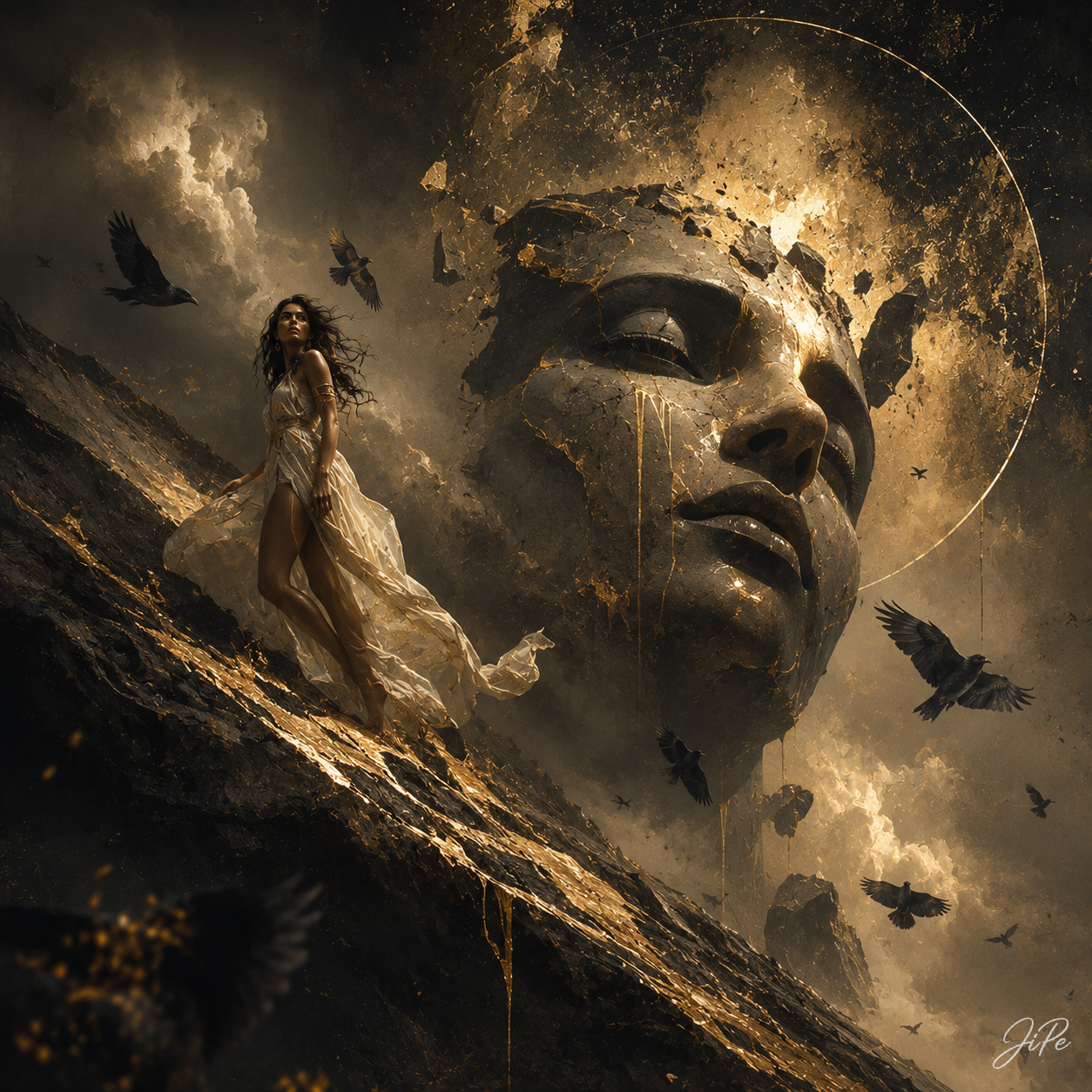
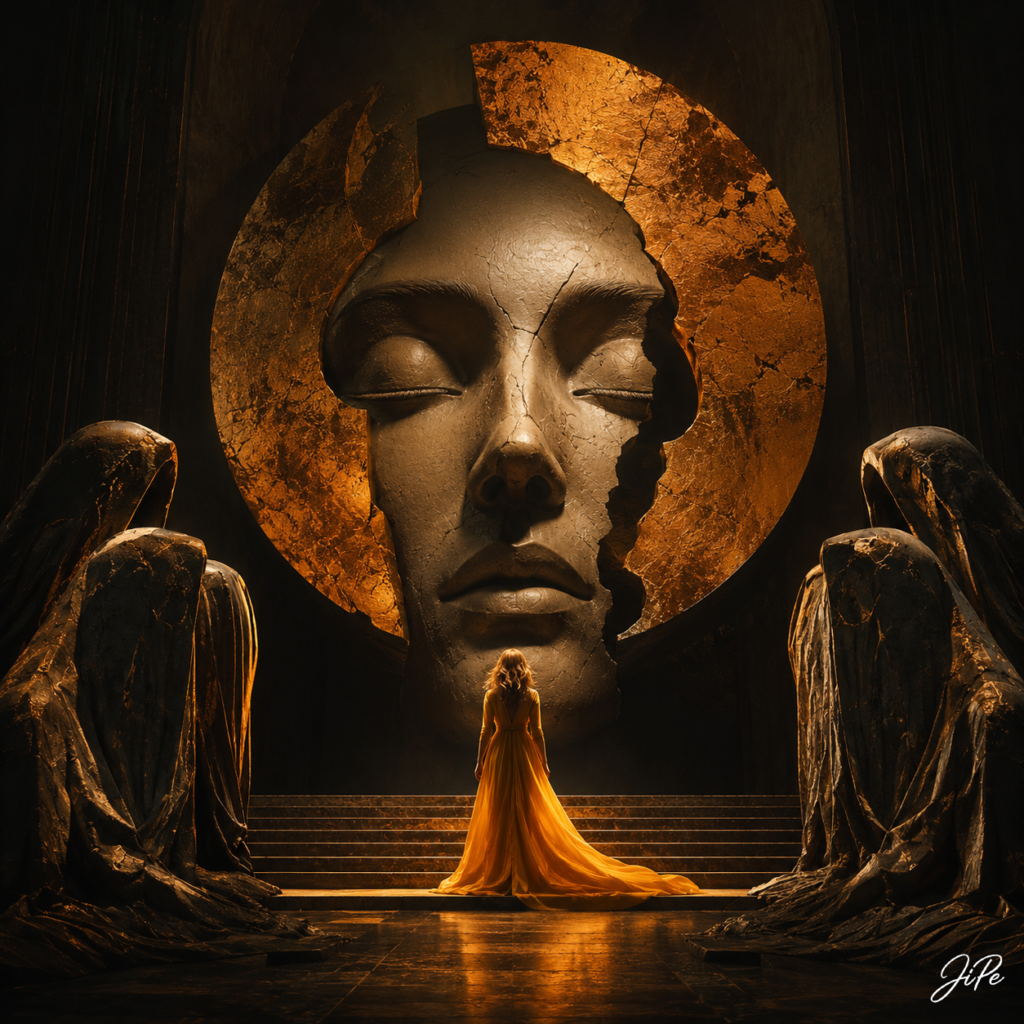
At the heart of the composition stands a solitary figure clothed in luminous gold. Small in physical scale yet immense in symbolic significance, the figure faces an enormous fractured face carved with the permanence of stone. This dramatic contrast between human vulnerability and monumental architecture immediately establishes the central tension of the work. The individual appears insignificant before the colossal presence, yet paradoxically becomes the emotional center of the composition. The painting suggests that true greatness is not measured by physical scale, but by the courage to stand before the unknown.
The colossal mask dominates the architectural space like an ancient relic of forgotten civilizations. It possesses closed eyes and an expression of profound serenity, neither welcoming nor rejecting the visitor before it. It remains suspended in absolute silence, existing somewhere between sculpture and living consciousness. The fractured surface transforms the face into something more than stone. It becomes a monument to memory itself—a symbol of every identity that has been broken, reconstructed, and ultimately transcended.
The crack that divides the face is perhaps the painting’s most significant symbolic gesture. Rather than representing destruction, it functions as evidence of transformation. Throughout history, fractured monuments have often become more evocative than untouched perfection because they bear visible witness to time. Here, the fracture becomes a metaphor for human experience. Every life accumulates breaks, losses, disappointments, and moments of profound change. Yet these fractures do not erase identity—they reveal it.
The immense golden halo positioned behind the monument reinforces this duality. Traditionally associated with sanctity and divine presence, the halo is reinterpreted here as an architectural and psychological space rather than a purely religious symbol. Its radiant circular form evokes completeness and eternity, while the fractured face before it suggests that perfection is not found in wholeness but in the acceptance of imperfection. Light therefore becomes inseparable from brokenness. The halo does not conceal the cracks—it illuminates them.
The anonymous female figure standing at the base of the monument serves as the viewer’s surrogate. She is deliberately presented without individualized characteristics, allowing her to become universal rather than personal. She could represent memory, humanity, the artist, or the viewer themselves. Her golden garment echoes the luminous circle behind the monumental face, visually connecting her to the same source of illumination. This relationship suggests that the qualities embodied by the monument are not external ideals but dormant possibilities residing within every individual.
The posture of the figure conveys reverence without submission. She neither kneels nor reaches outward. Instead, she stands quietly, allowing presence itself to become an act of courage. The silence of her stance carries extraordinary emotional power. She has arrived not to worship the monument, but to encounter it. This subtle distinction transforms the work into a philosophical meditation rather than a religious image.
Flanking the central space are two hooded sculptural forms draped in heavy folds of dark fabric. These enigmatic figures deepen the painting’s symbolic complexity. Their bowed posture evokes grief, guardianship, contemplation, or eternal witnessing. They remain anonymous, stripped of individual identity, functioning instead as archetypal presences. They may represent forgotten civilizations, ancestral memory, silent judgment, or the timeless passage of history observing every human life.
Their placement establishes a ceremonial symmetry that frames the encounter unfolding at the center. Unlike the golden figure, they never move toward illumination. Instead, they remain rooted in shadow, emphasizing the distinction between passive remembrance and active transformation.
Architecturally, the composition possesses extraordinary monumentality. Towering vertical walls and ascending steps create a powerful sense of sacred geometry, guiding the viewer’s eye toward the central confrontation. Every line converges upon the fractured face, reinforcing its role as both destination and question. The architecture is deliberately stripped of ornament, allowing proportion, scale, and light to carry emotional significance. The result recalls the timeless language of classical temples while remaining unmistakably contemporary in its visual expression.
The restrained palette of charcoal black, deep bronze, and luminous gold contributes significantly to the painting’s emotional atmosphere. Gold functions not merely as decoration but as symbolic illumination. It represents consciousness, transcendence, memory, and spiritual endurance. Against the surrounding darkness, every golden surface acquires extraordinary visual gravity, suggesting that moments of insight emerge most powerfully from places of uncertainty.
The painterly treatment of texture further enriches the symbolic language. Weathered stone surfaces, fractured gold leaf effects, layered pigments, and subtle signs of erosion give the monument an archaeological presence. The painting appears simultaneously ancient and newly created, existing outside historical chronology. This timeless quality reinforces one of the work’s central ideas: the questions it raises belong not to a specific culture or era, but to the universal human condition.
The contrast between stillness and monumentality defines the emotional rhythm of the composition. Nothing dramatic occurs in a conventional narrative sense. There is no movement, conflict, or visible action. Yet the psychological intensity remains immense because the true event takes place internally. The painting captures the precise instant before revelation—the silent threshold where recognition becomes possible but has not yet fully occurred.
From an art historical perspective, Figure Before the Colossal Mask resonates with multiple traditions while maintaining a distinct contemporary identity. Echoes of Symbolism appear in its layered metaphors and dreamlike atmosphere. The architectural grandeur recalls Romantic explorations of the sublime, where humanity confronts overwhelming forces beyond comprehension. Elements of Surrealism emerge through the impossible scale relationships and psychological space, while the tactile materiality reflects contemporary mixed-media aesthetics and textured abstraction.
Yet despite these references, the work speaks with its own visual language. It combines realism with visionary symbolism, creating an image that feels simultaneously familiar and impossible. The monumental face becomes less a sculpture than an idea given physical form.
Philosophically, the painting addresses one of humanity’s oldest questions: Who are we when we stand before the accumulated weight of memory, history, and our own inner selves? The colossal mask may be interpreted as civilization, the unconscious, ancestral identity, forgotten wisdom, or the countless versions of ourselves that time has left behind. The work deliberately refuses a single interpretation, inviting viewers to bring their own experiences into dialogue with the image.
The mask itself is especially significant because masks traditionally conceal identity while simultaneously revealing deeper truths. Across cultures, masks have served as instruments of transformation, ritual, protection, and revelation. Here, however, the mask is monumental, fractured, and motionless. It no longer hides a face; it has become the face. In doing so, it suggests that identity itself is constructed through layers of memory, experience, and symbolic inheritance.
Ultimately, Figure Before the Colossal Mask is not a painting about fear or judgment, but about encounter. It invites viewers to consider what it means to stand before something infinitely larger than oneself without turning away. It proposes that genuine transformation begins not through conquest, but through presence; not through certainty, but through contemplation.
Standing before this work becomes an experience of quiet introspection. The silence within the painting gradually becomes the viewer’s own silence. The monument ceases to belong solely to the image and begins to reflect inward, asking timeless questions about identity, memory, vulnerability, and transcendence.
In the end, Figure Before the Colossal Mask reminds us that the greatest monuments are not those built from stone, but those constructed within human consciousness. Every fracture carries history. Every shadow preserves memory. Every encounter with the unknown offers the possibility of becoming someone new. The painting transforms architectural grandeur into psychological revelation, inviting each viewer to step beyond the visible surface and enter the sacred space where identity is continually broken, remade, and illuminated.