Monumental Visionary Fine Art exploring mythology, consciousness, sacred light, and timeless visual storytelling.

Monumental Visionary Fine Art exploring mythology, consciousness, sacred light, and timeless visual storytelling.

Fantasy Paintings

The Silent Throne

The Silent Throne
The Silent Throne

The Silent Throne is a meditation on quiet authority, inner transcendence, and the invisible power that emerges when stillness replaces ambition. Blending contemporary visionary symbolism with classical portraiture, sacred geometry, and richly textured mixed-media aesthetics, the work presents a figure who does not rule through dominance or spectacle, but through presence itself. Rather than depicting a throne as an object of political authority, the painting transforms it into a spiritual state—an inner sanctuary where wisdom, vulnerability, and self-knowledge converge.

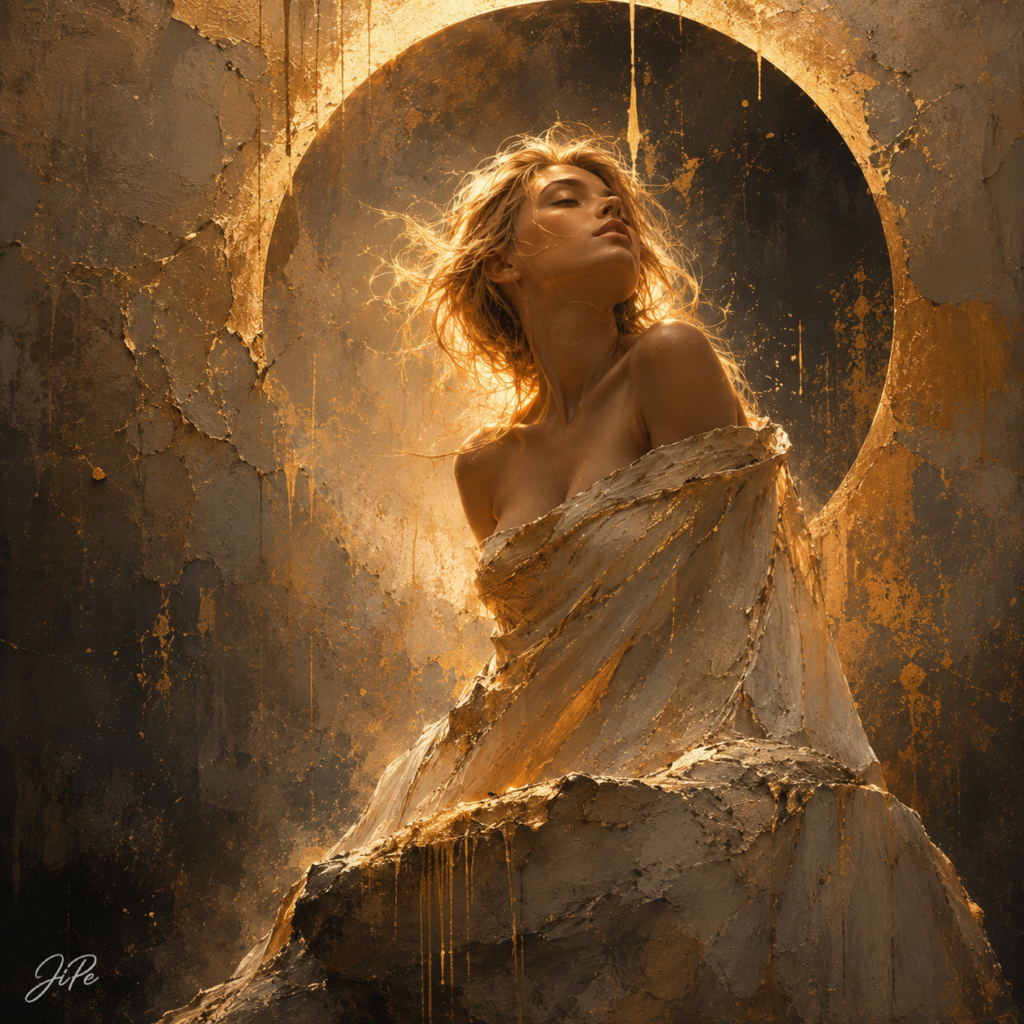
At first glance, the composition appears deceptively simple. A solitary woman is seated upon a weathered stone structure, wrapped in flowing ivory fabric that dissolves into painterly textures of cracked plaster and luminous gold. Behind her, a monumental circular form radiates like both an eclipse and a halo, surrounding her silhouette with a quiet celestial glow. Yet beneath this apparent simplicity lies an intricate symbolic architecture where every element contributes to an exploration of identity, resilience, and transcendence.

The title, The Silent Throne, immediately challenges conventional expectations. Thrones traditionally symbolize earthly power, hierarchy, conquest, and authority. Here, however, the throne is stripped of ornament, grandeur, and political meaning. It becomes an altar rather than a seat of command, suggesting that the greatest sovereignty is achieved not through control over others but through mastery of oneself.

The woman occupies this throne with remarkable serenity. Her posture is relaxed rather than ceremonial, her face lifted gently toward an unseen source of light. Her closed eyes deny outward distraction, directing all attention inward. This subtle gesture transforms the portrait into a contemplative icon, suggesting that genuine enlightenment begins in silence rather than proclamation.

She is not portrayed as a queen in the historical sense, nor as a mythological goddess in explicit narrative form. Instead, she exists as an archetype of awakened consciousness—a timeless feminine presence embodying intuition, acceptance, and inner dignity. Her expression reflects neither triumph nor sorrow, but something far more elusive: profound peace. It is the calm that arrives after conflict has ended, after questions have dissolved, and after identity no longer depends upon external validation.

The absence of overt narrative allows the painting to transcend biography. The viewer is not asked to discover who she is, but rather what she represents. She becomes a mirror through which each observer encounters their own relationship with silence, vulnerability, and personal transformation.

The circular form dominating the background functions as one of the painting’s most significant symbolic devices. Simultaneously recalling a solar disc, lunar eclipse, sacred halo, and cosmic portal, it anchors the entire composition within a timeless cosmological framework. Throughout history, circles have symbolized eternity, perfection, divine unity, and the cyclical nature of existence. Here, the circle neither begins nor ends. It simply exists, reinforcing the painting’s meditation upon continuity beyond the temporal world.

Unlike traditional halos that elevate saints above ordinary humanity, this luminous disc appears deeply integrated into the environment itself. The woman is not separated from the cosmos; she is enveloped by it. Light does not descend upon her as an external blessing but radiates naturally around her presence, suggesting an intimate harmony between the individual soul and the larger universe.

The artist’s sophisticated treatment of light serves as the emotional foundation of the composition. Warm golden illumination emerges from behind the figure, softly outlining her profile and transforming her loose strands of hair into glowing filaments. Rather than producing dramatic theatrical contrast, the light behaves almost like memory—gentle, atmospheric, and quietly transformative. It reveals rather than overwhelms, allowing shadow to retain equal importance within the visual narrative.

This interplay between light and darkness reflects one of the work’s central philosophical concerns. Illumination here does not erase shadow; instead, both coexist in delicate equilibrium. The painting suggests that wholeness arises not through the elimination of darkness but through its integration into a more complete understanding of the self.

Materiality plays an equally important role in conveying these ideas. Rich impasto textures, weathered stone surfaces, fractured plaster, and delicate traces of gold leaf create a tactile visual language that blurs the boundary between painting and sculpture. The layered surface recalls ancient frescoes worn by centuries of time, simultaneously evoking archaeological memory and contemporary mixed-media experimentation.

The cracked textures visible throughout the work carry profound symbolic significance. Rather than suggesting decay, they evoke endurance. Their subtle resemblance to kintsugi, the Japanese philosophy of repairing broken objects with gold, transforms fracture into beauty. Every imperfection becomes evidence of survival. Every scar contributes to the work’s visual and emotional integrity. The painting therefore celebrates resilience not as resistance to suffering, but as the graceful acceptance of transformation.

The restrained palette further reinforces this atmosphere of contemplative elegance. Soft ivory, warm ochre, muted charcoal, weathered stone, and luminous gold dominate the composition, creating a harmonious balance between earthly materiality and spiritual luminosity. Gold functions not merely as decoration but as a metaphysical presence—a visual manifestation of transcendence quietly permeating every surface.

Compositionally, The Silent Throne demonstrates exceptional balance and refinement. The vertical figure contrasts with the expansive circular geometry behind her, establishing both stability and movement. Large areas of negative space allow the central figure to breathe within the composition, creating an almost architectural sense of stillness. Nothing appears excessive. Every visual decision serves the painting’s meditative rhythm.

The artist also employs subtle asymmetry that prevents the composition from becoming static. Slight shifts in posture, drapery, and painterly textures introduce organic vitality into an otherwise highly structured arrangement. This dialogue between order and spontaneity reflects the painting’s broader philosophical message: harmony is not rigid perfection but dynamic balance.

Art historically, the work engages with multiple traditions while maintaining a distinctly contemporary voice. Echoes of Renaissance devotional portraiture can be found in the dignified presentation of the solitary figure. The atmospheric treatment of light recalls Romantic explorations of the sublime, while the symbolic ambiguity aligns closely with the ideals of nineteenth-century Symbolism. At the same time, the expressive mixed-media textures and digital painterly techniques firmly position the work within the evolving language of contemporary visionary art.

Psychologically, the painting resonates with Jungian concepts of individuation. The seated figure may be interpreted as the Self—the integrated center of consciousness that emerges after the reconciliation of opposing inner forces. Her silence is therefore not emptiness but completion. She has reached the throne not by conquering others but by becoming whole.

Yet The Silent Throne resists singular interpretation. For some viewers it may evoke spiritual awakening; for others, feminine empowerment, solitude, meditation, or personal healing. Its symbolism remains deliberately open, allowing each observer to enter the work through their own emotional and philosophical experience. This openness is one of its greatest strengths. Rather than imposing meaning, it invites discovery.

Perhaps the painting’s greatest achievement lies in its ability to transform stillness into presence. In a contemporary culture often defined by acceleration, distraction, and perpetual noise, The Silent Throne offers an alternative vision of strength. It proposes that silence is not absence but fullness; that contemplation is not withdrawal but profound engagement with existence itself.

Standing before this work, viewers may find themselves slowing almost instinctively. The painting asks for neither immediate admiration nor intellectual resolution. Instead, it offers a quiet encounter with timeless questions: What remains when ambition fades? Where does true authority reside? Can stillness itself become a form of wisdom?

Ultimately, The Silent Throne is not a portrait of a ruler but of an awakened state of being. It reminds us that the highest throne is never built from stone, gold, or power. It is established within the human spirit—where humility, resilience, beauty, and silence become inseparable expressions of enduring light.

Lämna ett svar